




Pure line breed refers to
A. Heterozygous only
B. Homozygous only
C. Heterozygous and linkage
D. Homozygosity and self-assortment
Answer
 Verified
654.3k+ views
Hint: These are the cultivated varieties of plants or animals that are obtained through the process of selective breeding or selfing for at least seven generations after which they become pure for a particular trait.
Complete answer:
Any breed of plant or animal is said to be a pure breed if it has gone inbreeding for several generations particularly for at least seven generations. After continuous inbreeding, it becomes homozygous for a particular trait because it possesses identical alleles of a gene present on both homologous chromosomes.
Additional Information:
If an individual is homozygous dominant for a particular trait then it means that the individual carries two copies of that particular allele that is responsible for the dominant trait. Similarly, an individual will be homozygous recessive for a particular trait if the individual carries two copies of the particular allele that is responsible for the recessive trait. The two individuals i.e. homozygous dominant and homozygous recessive will be called pure line breeds for that particular dominant or recessive trait. The figure in left indicates homozygous condition whereas the one in right is indicative of the heterozygous condition.
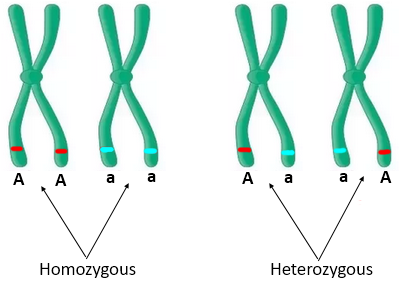
The dominant allele is represented by capital alphabetical letters whereas the recessive alleles are represented by small letters.
So, the correct answer is ‘Homozygous only’.
Note: Heterozygosity is not a pure line character because in this there are two different alleles present at a gene locus out of which one is wild type while the other is a mutant form of a gene. These traits are represented by a combination of capital and small letters.
Complete answer:
Any breed of plant or animal is said to be a pure breed if it has gone inbreeding for several generations particularly for at least seven generations. After continuous inbreeding, it becomes homozygous for a particular trait because it possesses identical alleles of a gene present on both homologous chromosomes.
Additional Information:
If an individual is homozygous dominant for a particular trait then it means that the individual carries two copies of that particular allele that is responsible for the dominant trait. Similarly, an individual will be homozygous recessive for a particular trait if the individual carries two copies of the particular allele that is responsible for the recessive trait. The two individuals i.e. homozygous dominant and homozygous recessive will be called pure line breeds for that particular dominant or recessive trait. The figure in left indicates homozygous condition whereas the one in right is indicative of the heterozygous condition.
The dominant allele is represented by capital alphabetical letters whereas the recessive alleles are represented by small letters.
So, the correct answer is ‘Homozygous only’.
Note: Heterozygosity is not a pure line character because in this there are two different alleles present at a gene locus out of which one is wild type while the other is a mutant form of a gene. These traits are represented by a combination of capital and small letters.
Recently Updated Pages
Master Class 11 Social Science: Engaging Questions & Answers for Success

Master Class 11 English: Engaging Questions & Answers for Success
Master Class 11 Accountancy: Engaging Questions & Answers for Success
Master Class 11 Physics: Engaging Questions & Answers for Success
Master Class 11 Computer Science: Engaging Questions & Answers for Success
Master Class 11 Business Studies: Engaging Questions & Answers for Success
Trending doubts
One Metric ton is equal to kg A 10000 B 1000 C 100 class 11 physics CBSE
Find the value of the expression given below sin 30circ class 11 maths CBSE
Draw a diagram of nephron and explain its structur class 11 biology CBSE
10 examples of friction in our daily life
Proton was discovered by A Thomson B Rutherford C Chadwick class 11 chemistry CBSE
The teeth used for biting and cutting food are called class 11 biology CBSE