




Prove that the tangent at any point of a circle is perpendicular to the radius through the point of contact.
Answer
 Verified
623.1k+ views
Hint: Assume a circle with center O, radius R, and a tangent AB which touches at point P of the circle. Take any point Q, other than P, on the tangent AB. Join OQ. Suppose OQ meets the circle at point R. Now, we can write OQ as the summation of OR and RQ. We know that the OP and OR are the radius of the circle. So, OP = OR. We know the property that the shortest distance is the perpendicular distance. Using this property, conclude the answer.
Complete step-by-step answer:
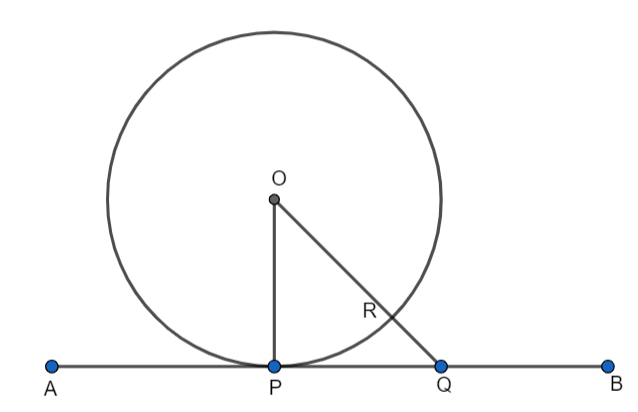
First of all, let us assume a circle with center O, R, and the line segment AB as the tangent to the circle at point P.
According to the question, we have to prove that the segment OP is perpendicular to the tangent AB.
Now, taking a point Q on the tangent AB, we have
OQ = OR + RQ ………………..(1)
We know that OP = OR because they are the radius of the same circle.
We can write equation (1) as,
OQ = OP + RQ
So, OQ>OP.
So, OP is possibly the shortest line segment than any other segment joining O to any point on AB.
We know that among all line segments joining the point O to a point on AB, the shortest one is perpendicular to AB.
Therefore, OP is perpendicular to AB.
Note: In this, question one can try to find \[\angle OPQ\] and make it equal to \[{{90}^{0}}\] . This approach is useless for this question because we don’t have sufficient data to find \[\angle OPQ\] . The only option that we have is to use the property that the shortest distance is the perpendicular distance.
Complete step-by-step answer:
First of all, let us assume a circle with center O, R, and the line segment AB as the tangent to the circle at point P.
According to the question, we have to prove that the segment OP is perpendicular to the tangent AB.
Now, taking a point Q on the tangent AB, we have
OQ = OR + RQ ………………..(1)
We know that OP = OR because they are the radius of the same circle.
We can write equation (1) as,
OQ = OP + RQ
So, OQ>OP.
So, OP is possibly the shortest line segment than any other segment joining O to any point on AB.
We know that among all line segments joining the point O to a point on AB, the shortest one is perpendicular to AB.
Therefore, OP is perpendicular to AB.
Note: In this, question one can try to find \[\angle OPQ\] and make it equal to \[{{90}^{0}}\] . This approach is useless for this question because we don’t have sufficient data to find \[\angle OPQ\] . The only option that we have is to use the property that the shortest distance is the perpendicular distance.
Recently Updated Pages
Master Class 10 Social Science: Engaging Questions & Answers for Success

Master Class 10 Science: Engaging Questions & Answers for Success
Master Class 10 Maths: Engaging Questions & Answers for Success
Master Class 10 General Knowledge: Engaging Questions & Answers for Success
Master Class 10 Computer Science: Engaging Questions & Answers for Success
Class 10 Question and Answer - Your Ultimate Solutions Guide
Trending doubts
What is the full form of PNG A Petrol Natural Gas B class 10 chemistry CBSE
Explain the Treaty of Vienna of 1815 class 10 social science CBSE
In cricket, how many legal balls are there in a standard over?
Why is there a time difference of about 5 hours between class 10 social science CBSE
Who Won 36 Oscar Awards? Record Holder Revealed
What is the median of the first 10 natural numbers class 10 maths CBSE