




Prove that the sum of the three angles in a triangle is equal to $180{}^\circ $.
Answer
 Verified
600k+ views
Hint: We will first assume a triangle $ABC$. For this problem we will also construct a line which is parallel to the base and passing through the opposite vertex of the triangle. Now we will list out the alternative angles thus formed. Now we know that the angle on a horizontal line is $180{}^\circ $ so we will take an equation that is the sum of the angles on the horizontal line at the vertex and equate it to $180{}^\circ $. Now use the equations formed when we observed alternative angles and use then here to get the result.
Complete step by step answer:
Let $ABC$ is a triangle as shown in below figure.
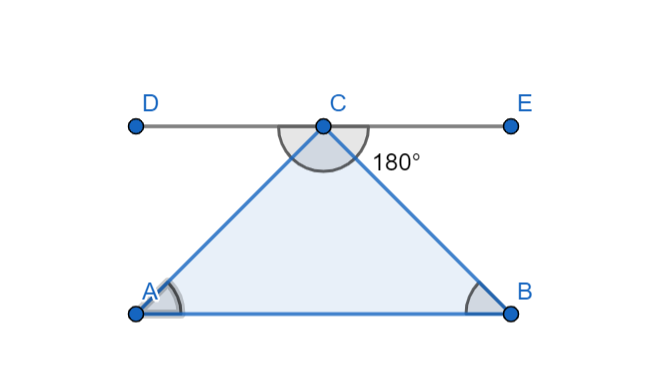
$DE$ is a line which is parallel to line $AB$ and passes through the vertex $C$ of the triangle $ABC$.
Now the alternative angles formed in the above diagram are
$\angle DCA=\angle CAB$
$\angle ECB=\angle CBA$
We know that the sum of the angle formed at a point on a horizontal line is equal to $180{}^\circ $.
$\therefore \angle DCA+\angle ACB+\angle ECB=180{}^\circ $
We have $\angle DCA=\angle CAB$ and $\angle ECB=\angle CBA$, substituting these values in the above equation then we will get
$\Rightarrow \angle CAB+\angle ACB+\angle CBA=180{}^\circ $
Now the sum of the three angles in the triangle $ABC$ is given by
$S=\angle CAB+\angle ACB+\angle CBA=180{}^\circ $
Hence Proved.
Note: We have the formula for the sum of the interior angles of the polygon with $n$ sides as $\left( 2n-4 \right)90{}^\circ $. From this formula we can calculate the sum of the interior angles of the triangle which is a polygon having $3$ sides, then we will get
$\begin{align}
& S=\left( 2\times 3-4 \right)\times 90{}^\circ \\
& \Rightarrow S=2\times 90{}^\circ \\
& \Rightarrow S=180{}^\circ \\
\end{align}$
From both the methods we got the same result.
Complete step by step answer:
Let $ABC$ is a triangle as shown in below figure.
$DE$ is a line which is parallel to line $AB$ and passes through the vertex $C$ of the triangle $ABC$.
Now the alternative angles formed in the above diagram are
$\angle DCA=\angle CAB$
$\angle ECB=\angle CBA$
We know that the sum of the angle formed at a point on a horizontal line is equal to $180{}^\circ $.
$\therefore \angle DCA+\angle ACB+\angle ECB=180{}^\circ $
We have $\angle DCA=\angle CAB$ and $\angle ECB=\angle CBA$, substituting these values in the above equation then we will get
$\Rightarrow \angle CAB+\angle ACB+\angle CBA=180{}^\circ $
Now the sum of the three angles in the triangle $ABC$ is given by
$S=\angle CAB+\angle ACB+\angle CBA=180{}^\circ $
Hence Proved.
Note: We have the formula for the sum of the interior angles of the polygon with $n$ sides as $\left( 2n-4 \right)90{}^\circ $. From this formula we can calculate the sum of the interior angles of the triangle which is a polygon having $3$ sides, then we will get
$\begin{align}
& S=\left( 2\times 3-4 \right)\times 90{}^\circ \\
& \Rightarrow S=2\times 90{}^\circ \\
& \Rightarrow S=180{}^\circ \\
\end{align}$
From both the methods we got the same result.
Recently Updated Pages
Master Class 10 English: Engaging Questions & Answers for Success

Master Class 10 Social Science: Engaging Questions & Answers for Success
Master Class 10 Computer Science: Engaging Questions & Answers for Success
Class 10 Question and Answer - Your Ultimate Solutions Guide
Master Class 10 General Knowledge: Engaging Questions & Answers for Success
Master Class 10 Maths: Engaging Questions & Answers for Success
Trending doubts
What is the full form of NDA a National Democratic class 10 social science CBSE
Explain the Treaty of Vienna of 1815 class 10 social science CBSE
Who Won 36 Oscar Awards? Record Holder Revealed
Bharatiya Janata Party was founded in the year A 1979 class 10 social science CBSE
What is the median of the first 10 natural numbers class 10 maths CBSE
Why is it 530 pm in india when it is 1200 afternoon class 10 social science CBSE