




Prove that the points A(-2,-1), B(1,0), C(4,3) and D(1,2) are the vertices of a parallelogram ABCD.
Answer
 Verified
626.7k+ views
Hint: Start by drawing the diagram, followed by proving DC is parallel to AB and AD is parallel to BC. If each pair of opposite sides of a quadrilateral is parallel, then the quadrilateral is a parallelogram. You must use the slopes of the edges of the parallelogram to show that they are parallel.
Complete step-by-step answer:
Let us start by drawing the diagram for a better visualisation of the situation given in the question.
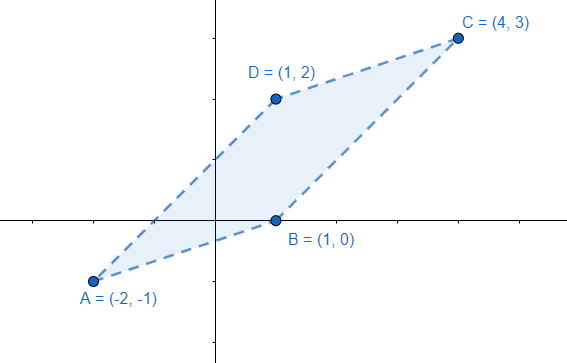
Now to start with the question, we will try to prove that AD is parallel to BC and AB is parallel to DC. So, let us first find the slope of all the four edges.
We know, the slope of a line passing through points $\left( {{x}_{1}},{{y}_{1}} \right)\text{ and }\left( {{x}_{2}},{{y}_{2}} \right)$ is given by $\dfrac{{{y}_{2}}-{{y}_{1}}}{{{x}_{2}}-{{x}_{1}}}$ .
Therefore, the sole of:
\[\begin{align}
& {{m}_{AD}}=\dfrac{2-(-1)}{1-(-2)}=\dfrac{3}{3}=1 \\
& {{m}_{AB}}=\dfrac{0-(-1)}{1-(-2)}=\dfrac{1}{3} \\
& {{m}_{DC}}=\dfrac{3-2}{4-1}=\dfrac{1}{3} \\
& {{m}_{BC}}=\dfrac{3-0}{4-1}=\dfrac{3}{3}=1 \\
\end{align}\]
Now, we know that two lines are parallel, if their slopes are equal. So, from the above results, we can see that the slope of BC is equal to the slope of AD. Also, the slope of AB is equal to the slope of DC. So, we can conclude that AD || BC and AB || DC. As we have shown that each pair of opposite sides of the quadrilateral ABCD is parallel, so the quadrilateral ABCD is a parallelogram.
Note: It is prescribed that you learn all the identities related to a straight line and its slopes, especially be careful with the formula of the slope as students generally get confused about the denominator and numerator of the formula. Also, learn the properties of parallelograms, including squares, as they might also be needed for solving such problems as we used in the above question.
Complete step-by-step answer:
Let us start by drawing the diagram for a better visualisation of the situation given in the question.
Now to start with the question, we will try to prove that AD is parallel to BC and AB is parallel to DC. So, let us first find the slope of all the four edges.
We know, the slope of a line passing through points $\left( {{x}_{1}},{{y}_{1}} \right)\text{ and }\left( {{x}_{2}},{{y}_{2}} \right)$ is given by $\dfrac{{{y}_{2}}-{{y}_{1}}}{{{x}_{2}}-{{x}_{1}}}$ .
Therefore, the sole of:
\[\begin{align}
& {{m}_{AD}}=\dfrac{2-(-1)}{1-(-2)}=\dfrac{3}{3}=1 \\
& {{m}_{AB}}=\dfrac{0-(-1)}{1-(-2)}=\dfrac{1}{3} \\
& {{m}_{DC}}=\dfrac{3-2}{4-1}=\dfrac{1}{3} \\
& {{m}_{BC}}=\dfrac{3-0}{4-1}=\dfrac{3}{3}=1 \\
\end{align}\]
Now, we know that two lines are parallel, if their slopes are equal. So, from the above results, we can see that the slope of BC is equal to the slope of AD. Also, the slope of AB is equal to the slope of DC. So, we can conclude that AD || BC and AB || DC. As we have shown that each pair of opposite sides of the quadrilateral ABCD is parallel, so the quadrilateral ABCD is a parallelogram.
Note: It is prescribed that you learn all the identities related to a straight line and its slopes, especially be careful with the formula of the slope as students generally get confused about the denominator and numerator of the formula. Also, learn the properties of parallelograms, including squares, as they might also be needed for solving such problems as we used in the above question.
Recently Updated Pages
Three beakers labelled as A B and C each containing 25 mL of water were taken A small amount of NaOH anhydrous CuSO4 and NaCl were added to the beakers A B and C respectively It was observed that there was an increase in the temperature of the solutions contained in beakers A and B whereas in case of beaker C the temperature of the solution falls Which one of the following statements isarecorrect i In beakers A and B exothermic process has occurred ii In beakers A and B endothermic process has occurred iii In beaker C exothermic process has occurred iv In beaker C endothermic process has occurred

Master Class 10 Social Science: Engaging Questions & Answers for Success
Master Class 10 Science: Engaging Questions & Answers for Success
Master Class 10 Maths: Engaging Questions & Answers for Success
Master Class 10 General Knowledge: Engaging Questions & Answers for Success
Master Class 10 Computer Science: Engaging Questions & Answers for Success
Three beakers labelled as A B and C each containing 25 mL of water were taken A small amount of NaOH anhydrous CuSO4 and NaCl were added to the beakers A B and C respectively It was observed that there was an increase in the temperature of the solutions contained in beakers A and B whereas in case of beaker C the temperature of the solution falls Which one of the following statements isarecorrect i In beakers A and B exothermic process has occurred ii In beakers A and B endothermic process has occurred iii In beaker C exothermic process has occurred iv In beaker C endothermic process has occurred
Master Class 10 Social Science: Engaging Questions & Answers for Success
Master Class 10 Science: Engaging Questions & Answers for Success
Trending doubts
In cricket, what is the term for a bowler taking five wickets in an innings?
What is deficiency disease class 10 biology CBSE
Why is there a time difference of about 5 hours between class 10 social science CBSE
Select the word that is correctly spelled a Twelveth class 10 english CBSE
Bharatiya Janata Party was founded in the year A 1979 class 10 social science CBSE
Define the 4R principle in brief class 10 physics CBSE