




Prove that the perpendicular bisector of a chord of a circle passes through the center.
Answer
 Verified
635.7k+ views
Hint: We will assume that C is not the centre of the circle and try to prove that $\Delta ADC\cong \Delta BDC$, which automatically contradicts our assumption and we come to know that C is the centre of the circle.
Complete step-by-step answer:
It is given in the question that the perpendicular bisector of a chord of a circle always passes through the centre of the circle. Let us assume that ‘S’ is a circle in which AB is chord, CD is perpendicular bisector of chord AB at D as shown,
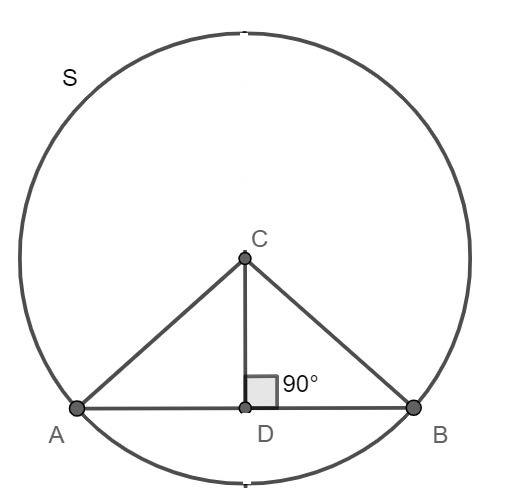
We will first assume that C is not the centre of the circle. Now, in $\Delta ADC$ and $\Delta BDC$ we have,
$CD=CD$ ( common sides from both the triangles)
$AD=BD$ ( given in the question that CD is perpendicular bisector of AB) and
$\angle ADC=\angle BDC={{90}^{{}^\circ }}$ because CD is the perpendicular bisector of AB.
From the above three conditions or equations, we can say that $\Delta ADC\cong \Delta BDC$ by SAS congruence condition, SAS means ‘Side Angle Side’ congruence.
We know that in congruent triangles sides and angles have equal measurements, thus we can say that side AC of triangle ADC is equal to side BC of triangle BDC, that is
$AC=BC$ by CPCT, Corresponding Parts of Congruent Triangles.
But if we conclude that side AC is equal to side BC then this contradicts our assumption that C is not the centre of the circle. We are saying this because the centre of the circle is the only point within the circle that has the point on the circumference equal distance from it.
Here, point C has two points A and B having equal distance, thus from this, we can say that ‘C’ is the centre of the circle. Thus, it is proved that the perpendicular bisector of the chord passes through the centre of the circle.
Hence Proved.
Note: Students may get confused with the word chord and arc, they may assume that both are the same thing but it is not actually true. Even in this question students may assume that arc AB is perpendicularly bisected by CD but in question it is very clearly given that AB is a chord and CD is bisector. Thus, it is recommended to know the actual meaning of the terms by referring to the definition of terms.
Complete step-by-step answer:
It is given in the question that the perpendicular bisector of a chord of a circle always passes through the centre of the circle. Let us assume that ‘S’ is a circle in which AB is chord, CD is perpendicular bisector of chord AB at D as shown,
We will first assume that C is not the centre of the circle. Now, in $\Delta ADC$ and $\Delta BDC$ we have,
$CD=CD$ ( common sides from both the triangles)
$AD=BD$ ( given in the question that CD is perpendicular bisector of AB) and
$\angle ADC=\angle BDC={{90}^{{}^\circ }}$ because CD is the perpendicular bisector of AB.
From the above three conditions or equations, we can say that $\Delta ADC\cong \Delta BDC$ by SAS congruence condition, SAS means ‘Side Angle Side’ congruence.
We know that in congruent triangles sides and angles have equal measurements, thus we can say that side AC of triangle ADC is equal to side BC of triangle BDC, that is
$AC=BC$ by CPCT, Corresponding Parts of Congruent Triangles.
But if we conclude that side AC is equal to side BC then this contradicts our assumption that C is not the centre of the circle. We are saying this because the centre of the circle is the only point within the circle that has the point on the circumference equal distance from it.
Here, point C has two points A and B having equal distance, thus from this, we can say that ‘C’ is the centre of the circle. Thus, it is proved that the perpendicular bisector of the chord passes through the centre of the circle.
Hence Proved.
Note: Students may get confused with the word chord and arc, they may assume that both are the same thing but it is not actually true. Even in this question students may assume that arc AB is perpendicularly bisected by CD but in question it is very clearly given that AB is a chord and CD is bisector. Thus, it is recommended to know the actual meaning of the terms by referring to the definition of terms.
Recently Updated Pages
Master Class 10 English: Engaging Questions & Answers for Success

Master Class 10 Social Science: Engaging Questions & Answers for Success
Master Class 10 Computer Science: Engaging Questions & Answers for Success
Class 10 Question and Answer - Your Ultimate Solutions Guide
Master Class 10 General Knowledge: Engaging Questions & Answers for Success
Master Class 10 Maths: Engaging Questions & Answers for Success
Trending doubts
Explain the Treaty of Vienna of 1815 class 10 social science CBSE
Who Won 36 Oscar Awards? Record Holder Revealed
What is the median of the first 10 natural numbers class 10 maths CBSE
Why is it 530 pm in india when it is 1200 afternoon class 10 social science CBSE
Make a sketch of the human nerve cell What function class 10 biology CBSE
Define Potential, Developed, Stock and Reserved resources