




Prove that, “The opposite angles of a cyclic quadrilateral are supplementary.”
Answer
 Verified
648.6k+ views
Hint: A cyclic quadrilateral is a quadrilateral whose all vertices lie on the circumference of a circle. Also, in circles, we have a property which states that - the angle subtended by an arc at the centre of the circle is double the angle on the circle. Using this property, we can solve this question.
Complete step-by-step answer:
Before proceeding with the question, we must know all the concepts that will be required to solve this question.
A cyclic quadrilateral is a quadrilateral which has all its vertices lying on the circumference of a circle.
In circles, we have a property which states that “the angle subtended by an arc at the centre of the circle is double the angle on the circle” . . . . . . . . . . . . (1)
Let us consider a cyclic quadrilateral ABCD. Let O be the centre of the circle. Let us join O to the vertices B and C.
Let us denote $\angle BOC$ as x. Since $\angle BOC$ is equal to x, the reflex angle $\angle BOC$ will be equal to 360 – x.
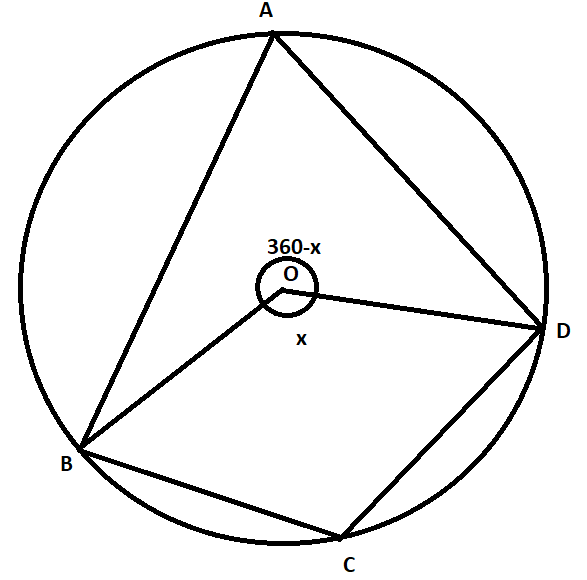
Using property (1), we can say that,
$\begin{align}
& \angle A=\dfrac{\angle BOD}{2} \\
& \Rightarrow \angle A=\dfrac{x}{2} \\
\end{align}$
$\Rightarrow x=2\angle A$ . . . . . . . . . . (2)
Using property (1), we can also say that,
Reflex $\angle BOD=2\angle C$
$\Rightarrow 360-x=2\angle C$
$\Rightarrow x=360-2\angle C$ . . . . . . . . . . . . (3)
Comparing equation (2) and equation (3), we get,
$\begin{align}
& 2\angle A=360-2\angle C \\
& \Rightarrow 2\angle A+2\angle C=360 \\
& \Rightarrow \angle A+\angle C=180 \\
\end{align}$
So, we get $\angle A$ and $\angle C$ as the supplementary angles.
Hence, we can say that the opposite angles of a cyclic quadrilateral are supplementary.
Note: There is a possibility that one may commit a mistake while using the property (1). It is always a confusion among the students that whether we have to divide or we have to multiply the angle subtended at the centre by 2. So, one must learn this property thoroughly to avoid such types of mistakes.
Complete step-by-step answer:
Before proceeding with the question, we must know all the concepts that will be required to solve this question.
A cyclic quadrilateral is a quadrilateral which has all its vertices lying on the circumference of a circle.
In circles, we have a property which states that “the angle subtended by an arc at the centre of the circle is double the angle on the circle” . . . . . . . . . . . . (1)
Let us consider a cyclic quadrilateral ABCD. Let O be the centre of the circle. Let us join O to the vertices B and C.
Let us denote $\angle BOC$ as x. Since $\angle BOC$ is equal to x, the reflex angle $\angle BOC$ will be equal to 360 – x.
Using property (1), we can say that,
$\begin{align}
& \angle A=\dfrac{\angle BOD}{2} \\
& \Rightarrow \angle A=\dfrac{x}{2} \\
\end{align}$
$\Rightarrow x=2\angle A$ . . . . . . . . . . (2)
Using property (1), we can also say that,
Reflex $\angle BOD=2\angle C$
$\Rightarrow 360-x=2\angle C$
$\Rightarrow x=360-2\angle C$ . . . . . . . . . . . . (3)
Comparing equation (2) and equation (3), we get,
$\begin{align}
& 2\angle A=360-2\angle C \\
& \Rightarrow 2\angle A+2\angle C=360 \\
& \Rightarrow \angle A+\angle C=180 \\
\end{align}$
So, we get $\angle A$ and $\angle C$ as the supplementary angles.
Hence, we can say that the opposite angles of a cyclic quadrilateral are supplementary.
Note: There is a possibility that one may commit a mistake while using the property (1). It is always a confusion among the students that whether we have to divide or we have to multiply the angle subtended at the centre by 2. So, one must learn this property thoroughly to avoid such types of mistakes.
Recently Updated Pages
Master Class 10 English: Engaging Questions & Answers for Success

Master Class 10 Social Science: Engaging Questions & Answers for Success
Master Class 10 Computer Science: Engaging Questions & Answers for Success
Class 10 Question and Answer - Your Ultimate Solutions Guide
Master Class 10 General Knowledge: Engaging Questions & Answers for Success
Master Class 10 Maths: Engaging Questions & Answers for Success
Trending doubts
Explain the Treaty of Vienna of 1815 class 10 social science CBSE
Who Won 36 Oscar Awards? Record Holder Revealed
What is the median of the first 10 natural numbers class 10 maths CBSE
Why is it 530 pm in india when it is 1200 afternoon class 10 social science CBSE
Define Potential, Developed, Stock and Reserved resources
Fill the blanks with proper collective nouns 1 A of class 10 english CBSE