




Prove that the line segment joining the midpoints of two sides of a triangle is parallel to the third side.
Answer
 Verified
640.5k+ views
Hint: In this question, we use the properties of parallelogram. If one pair of opposite sides of a quadrilateral is equal and parallel then the quadrilateral is parallelogram.
Complete step-by-step answer:
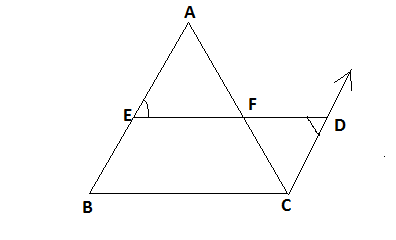
Given, ABC is a triangle where E and F are mid points of AB and AC respectively. So, AE=BE and AF=CF.
We have to prove: $EF\parallel BC$
Construction: Through C draw a line segment parallel to AB and extend EF to meet this line at D.
Now we know $AB\parallel CD$ , according to construction with transversal line ED.
$\angle AEF = \angle CDF$ (Alternate angle)
In $\vartriangle AEF{\text{ and }}\vartriangle CDF$
$
\angle AEF = \angle CDF\left( {{\text{Alternate angle}}} \right) \\
\angle AFE = \angle CFD\left( {{\text{vertically opposite angles}}} \right) \\
AF = CF\left( {{\text{F is mid point of AC}}} \right) \\
\vartriangle AEF \cong \vartriangle CDF\left( {AAS{\text{ rule}}} \right) \\
$
So, EA=DC (CPCT)
As we know, EA=EB (E is midpoint)
Hence, EB=DC
Now, in quadrilateral BCDE
$EB\parallel CD{\text{ and }}EB = CD$
Thus, one pair of opposite sides is equal and parallel.
Hence, BCDE is a parallelogram.
Since opposite sides of parallelograms are parallel.
So, $ED\parallel BC$
We can write as, $EF\parallel BC$
So, it’s proved that the line segment joining the midpoints of two sides of a triangle is parallel to the third side.
Note-In such types of problems first we have to draw a figure and also construct a line parallel to one side of the triangle then prove construct quadrilateral is also a parallelogram and we know opposite sides of parallelogram are equal and parallel.
Complete step-by-step answer:
Given, ABC is a triangle where E and F are mid points of AB and AC respectively. So, AE=BE and AF=CF.
We have to prove: $EF\parallel BC$
Construction: Through C draw a line segment parallel to AB and extend EF to meet this line at D.
Now we know $AB\parallel CD$ , according to construction with transversal line ED.
$\angle AEF = \angle CDF$ (Alternate angle)
In $\vartriangle AEF{\text{ and }}\vartriangle CDF$
$
\angle AEF = \angle CDF\left( {{\text{Alternate angle}}} \right) \\
\angle AFE = \angle CFD\left( {{\text{vertically opposite angles}}} \right) \\
AF = CF\left( {{\text{F is mid point of AC}}} \right) \\
\vartriangle AEF \cong \vartriangle CDF\left( {AAS{\text{ rule}}} \right) \\
$
So, EA=DC (CPCT)
As we know, EA=EB (E is midpoint)
Hence, EB=DC
Now, in quadrilateral BCDE
$EB\parallel CD{\text{ and }}EB = CD$
Thus, one pair of opposite sides is equal and parallel.
Hence, BCDE is a parallelogram.
Since opposite sides of parallelograms are parallel.
So, $ED\parallel BC$
We can write as, $EF\parallel BC$
So, it’s proved that the line segment joining the midpoints of two sides of a triangle is parallel to the third side.
Note-In such types of problems first we have to draw a figure and also construct a line parallel to one side of the triangle then prove construct quadrilateral is also a parallelogram and we know opposite sides of parallelogram are equal and parallel.
Recently Updated Pages
Master Class 12 Business Studies: Engaging Questions & Answers for Success

Master Class 12 Biology: Engaging Questions & Answers for Success
Master Class 12 Chemistry: Engaging Questions & Answers for Success
Class 12 Question and Answer - Your Ultimate Solutions Guide
Master Class 11 Social Science: Engaging Questions & Answers for Success
Master Class 11 English: Engaging Questions & Answers for Success
Trending doubts
Explain the Treaty of Vienna of 1815 class 10 social science CBSE
Who Won 36 Oscar Awards? Record Holder Revealed
What is the median of the first 10 natural numbers class 10 maths CBSE
Why is it 530 pm in india when it is 1200 afternoon class 10 social science CBSE
Why is there a time difference of about 5 hours between class 10 social science CBSE
What is the full form of POSCO class 10 social science CBSE