




Prove that the function defined by \[f(x) = \tan x\] is a continuous function.
Answer
 Verified
661.8k+ views
Hint: We prove continuity of the function \[\tan x\] by writing in its simpler form of fraction whose continuity is known.
* A continuous function is a function that is continuous on every point of its domain. Also, we can always check continuity by drawing a graph, where the function is continuous means there is no breaking point in the curve.
Complete step-by-step answer:
We know, \[\tan x = \dfrac{{\sin x}}{{\cos x}}\]
We know graph of \[\sin x\] looks like
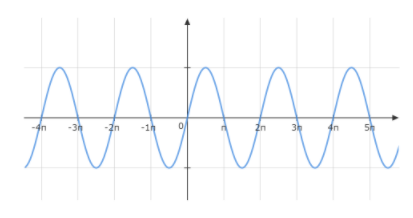
Since, there is no point where the curve breaks, so the function \[\sin x\] is continuous everywhere on R
Also, the graph of \[\cos x\] looks like.
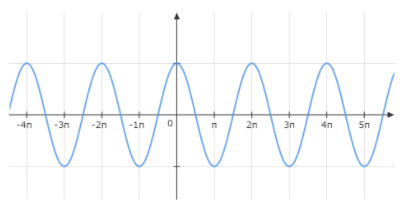
Since, there is no point where the curve breaks, so the function \[\cos x\] is continuous everywhere on R.
We know from the algebra of continuous functions that if both \[p(x)\] and \[q(x)\] are continuous functions then the function defined by their fraction \[f(x) = \dfrac{{p(x)}}{{q(x)}}\] is also continuous for all R such that \[q(x) \ne 0\]
Let us assume \[p(x) = \sin x\] and \[q(x) = \cos x\]
Then by Algebra of continuous functions \[f(x) = \dfrac{{\sin x}}{{\cos x}}\] is also continuous everywhere except at points where \[q(x) \ne 0\]
\[ \Rightarrow f(x) = \tan x\] is continuous everywhere except at points where \[q(x) \ne 0\]
Now we find points where \[ \Rightarrow f(x) = \tan x\] is not continuous.
We have \[q(x) \ne 0 \Rightarrow \cos (x) \ne 0\]
We will take all other values on R except where the values of \[\cos x\] become zero because if we make the denominator zero will make the fraction undefined.
\[
\cos (x) \ne 0 \\
\cos x \ne \cos (2n + 1)\dfrac{\pi }{2} \\
x \ne (2n + 1)\dfrac{\pi }{2} \\
\] {Since, all odd multiples of \[\dfrac{\pi }{2}\] will result in \[\cos x = 0\] }
So, \[ \Rightarrow f(x) = \tan x\] is continuous everywhere except at the points \[x = (2n + 1)\dfrac{\pi }{2}\], \[n = 0,1,2.....\]
Hence Proved
We can draw the graph of the function \[\tan x\]
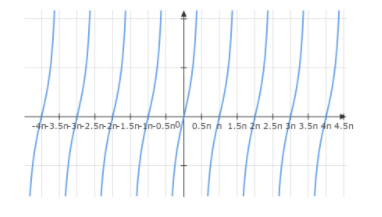
which is continuous everywhere except all the odd multiples of \[\dfrac{\pi }{2}\]
Note: Students many times get confused and write all multiples of \[\dfrac{\pi }{2}\] have function discontinuous ate them which is wrong, because when we take even multiples of \[\dfrac{\pi }{2}\], the angles becomes a multiple of \[\pi \] and which makes \[\cos \pi = - 1\] but we are finding values of x which make \[\cos x = 0\], so keep in mind we only take odd multiples of \[\dfrac{\pi }{2}\] only.
* A continuous function is a function that is continuous on every point of its domain. Also, we can always check continuity by drawing a graph, where the function is continuous means there is no breaking point in the curve.
Complete step-by-step answer:
We know, \[\tan x = \dfrac{{\sin x}}{{\cos x}}\]
We know graph of \[\sin x\] looks like
Since, there is no point where the curve breaks, so the function \[\sin x\] is continuous everywhere on R
Also, the graph of \[\cos x\] looks like.
Since, there is no point where the curve breaks, so the function \[\cos x\] is continuous everywhere on R.
We know from the algebra of continuous functions that if both \[p(x)\] and \[q(x)\] are continuous functions then the function defined by their fraction \[f(x) = \dfrac{{p(x)}}{{q(x)}}\] is also continuous for all R such that \[q(x) \ne 0\]
Let us assume \[p(x) = \sin x\] and \[q(x) = \cos x\]
Then by Algebra of continuous functions \[f(x) = \dfrac{{\sin x}}{{\cos x}}\] is also continuous everywhere except at points where \[q(x) \ne 0\]
\[ \Rightarrow f(x) = \tan x\] is continuous everywhere except at points where \[q(x) \ne 0\]
Now we find points where \[ \Rightarrow f(x) = \tan x\] is not continuous.
We have \[q(x) \ne 0 \Rightarrow \cos (x) \ne 0\]
We will take all other values on R except where the values of \[\cos x\] become zero because if we make the denominator zero will make the fraction undefined.
\[
\cos (x) \ne 0 \\
\cos x \ne \cos (2n + 1)\dfrac{\pi }{2} \\
x \ne (2n + 1)\dfrac{\pi }{2} \\
\] {Since, all odd multiples of \[\dfrac{\pi }{2}\] will result in \[\cos x = 0\] }
So, \[ \Rightarrow f(x) = \tan x\] is continuous everywhere except at the points \[x = (2n + 1)\dfrac{\pi }{2}\], \[n = 0,1,2.....\]
Hence Proved
We can draw the graph of the function \[\tan x\]
which is continuous everywhere except all the odd multiples of \[\dfrac{\pi }{2}\]
Note: Students many times get confused and write all multiples of \[\dfrac{\pi }{2}\] have function discontinuous ate them which is wrong, because when we take even multiples of \[\dfrac{\pi }{2}\], the angles becomes a multiple of \[\pi \] and which makes \[\cos \pi = - 1\] but we are finding values of x which make \[\cos x = 0\], so keep in mind we only take odd multiples of \[\dfrac{\pi }{2}\] only.
Recently Updated Pages
Which of the following graphs shows the variation of class 12 physics CBSE

Draw a labelled diagram of the human male reproductive class 12 biology CBSE
Describe the experiment to compare the emf of two cells class 12 physics CBSE
What is standard hydrogen electrode
What is conventional current and electric current class 12 physics CBSE
2Bromopentane is treated with an alcoholic KOH solution class 12 chemistry CBSE
Trending doubts
Which are the Top 10 Largest Countries of the World?
Differentiate between internal fertilization and external class 12 biology CBSE
What is the Full Form of 1.DPT 2.DDT 3.BCG
Differentiate between lanthanoids and actinoids class 12 chemistry CBSE
Sketch and label the Malpighian body class 12 biology CBSE
Why is the cell called the structural and functional class 12 biology CBSE