




Prove that the areas of similar triangles have the same ratio as the squares of the corresponding altitudes.
Answer
 Verified
618.3k+ views
Hint: Consider two similar triangles $\Delta AMT\text{ and }\Delta AHE$ . Now use the property that the area of a triangle is half of the product of the length of two sides of the triangle with the sine of the angle between these two sides.
Complete step-by-step answer:
To start with the question, let us consider two similar triangles $\Delta AMT\text{ and }\Delta AHE$ . And we let the ratio of sides of these similar triangles be k. We will also let the heights of the two triangles be ${{h}_{1}}\text{ and }{{h}_{2}}$ , respectively. Let us draw a diagram of the assumed situation for better understanding.
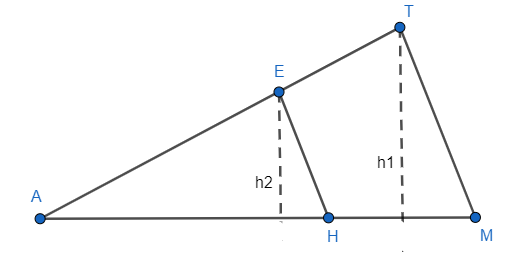
It is assumed that $\Delta AMT\sim \Delta AHE$ , and we know, two triangles are similar if their corresponding angles are equal and the corresponding sides are in proportion.
$\therefore \dfrac{MA}{HA}=\dfrac{AT}{AE}=\dfrac{TM}{EH}=k............(i)$
Also, $\angle AMT=\angle AHE.............(ii)$ .
Now we know that the area of a triangle is half of the product of the length of two sides of the triangle with the sine of the angle between these two sides.
$\therefore ar\left( \Delta AMT \right)=\dfrac{1}{2}\times MA\times TM\times \sin \left( \angle AMT \right)$
$\therefore ar\left( \Delta AHE \right)=\dfrac{1}{2}\times HA\times EH\times \sin \left( \angle AHE \right)$
Now we will find the ratio of the areas of the two triangles.
$\therefore \dfrac{ar\left( \Delta AMT \right)}{ar\left( \Delta AHE \right)}=\dfrac{\dfrac{1}{2}\times MA\times TM\times \sin \left( \angle AMT \right)}{\dfrac{1}{2}\times HA\times EH\times \sin \left( \angle AHE \right)}=\dfrac{MA}{HA}\times \dfrac{TM}{EH}\times \dfrac{\sin \left( \angle AMT \right)}{\sin \left( \angle AHE \right)}$
Now if we substitute the values of $\dfrac{MA}{HA}\text{ and }\dfrac{TM}{EH}$ from equation (i), we get
$\therefore \dfrac{ar\left( \Delta AMT \right)}{ar\left( \Delta AHE \right)}={{k}^{2}}\times \dfrac{\sin \left( \angle AMT \right)}{\sin \left( \angle AHE \right)}$
Also, from equation (ii), we know $\angle AMT=\angle AHE$ , so their sine would also be the same.
$\therefore \dfrac{ar\left( \Delta AMT \right)}{ar\left( \Delta AHE \right)}={{k}^{2}}......(iii)$
Also, we know that area of a triangle is half of the product of the base and the height.
$\therefore \dfrac{ar\left( \Delta AMT \right)}{ar\left( \Delta AHE \right)}=\dfrac{\dfrac{1}{2}\times MA\times {{h}_{1}}}{\dfrac{1}{2}\times HA\times {{h}_{2}}}=\dfrac{MA}{HA}\times \dfrac{{{h}_{1}}}{{{h}_{2}}}$
Now if we substitute the values of $\dfrac{MA}{HA}\text{ and }\dfrac{ar\left( \Delta AMT \right)}{ar\left( \Delta AHE \right)}$ from equation (i) and equation (iii), we get
$\therefore {{k}^{2}}=k\dfrac{{{h}_{1}}}{{{h}_{2}}}$
$\Rightarrow k=\dfrac{{{h}_{1}}}{{{h}_{2}}}$
$\therefore \dfrac{ar\left( \Delta AMT \right)}{ar\left( \Delta AHE \right)}={{k}^{2}}......(iii)$$\Rightarrow {{k}^{2}}={{\left( \dfrac{{{h}_{1}}}{{{h}_{2}}} \right)}^{2}}..........(iv)$
So, if we compare equation (iii) and (iv), we get
$\therefore \dfrac{ar\left( \Delta AMT \right)}{ar\left( \Delta AHE \right)}={{\left( \dfrac{{{h}_{1}}}{{{h}_{2}}} \right)}^{2}}$
Therefore, we have proved that the areas of similar triangles have the same ratio as the squares of the corresponding altitudes.
Note: While using the relation of similarity, generally the students mix up the sides while it is clearly mentioned that the relation is valid only for the corresponding sides of similar triangles. If you want, you can solve the question using the heron’s formula of area of a triangle as well, but that would be a bit lengthier.
Complete step-by-step answer:
To start with the question, let us consider two similar triangles $\Delta AMT\text{ and }\Delta AHE$ . And we let the ratio of sides of these similar triangles be k. We will also let the heights of the two triangles be ${{h}_{1}}\text{ and }{{h}_{2}}$ , respectively. Let us draw a diagram of the assumed situation for better understanding.
It is assumed that $\Delta AMT\sim \Delta AHE$ , and we know, two triangles are similar if their corresponding angles are equal and the corresponding sides are in proportion.
$\therefore \dfrac{MA}{HA}=\dfrac{AT}{AE}=\dfrac{TM}{EH}=k............(i)$
Also, $\angle AMT=\angle AHE.............(ii)$ .
Now we know that the area of a triangle is half of the product of the length of two sides of the triangle with the sine of the angle between these two sides.
$\therefore ar\left( \Delta AMT \right)=\dfrac{1}{2}\times MA\times TM\times \sin \left( \angle AMT \right)$
$\therefore ar\left( \Delta AHE \right)=\dfrac{1}{2}\times HA\times EH\times \sin \left( \angle AHE \right)$
Now we will find the ratio of the areas of the two triangles.
$\therefore \dfrac{ar\left( \Delta AMT \right)}{ar\left( \Delta AHE \right)}=\dfrac{\dfrac{1}{2}\times MA\times TM\times \sin \left( \angle AMT \right)}{\dfrac{1}{2}\times HA\times EH\times \sin \left( \angle AHE \right)}=\dfrac{MA}{HA}\times \dfrac{TM}{EH}\times \dfrac{\sin \left( \angle AMT \right)}{\sin \left( \angle AHE \right)}$
Now if we substitute the values of $\dfrac{MA}{HA}\text{ and }\dfrac{TM}{EH}$ from equation (i), we get
$\therefore \dfrac{ar\left( \Delta AMT \right)}{ar\left( \Delta AHE \right)}={{k}^{2}}\times \dfrac{\sin \left( \angle AMT \right)}{\sin \left( \angle AHE \right)}$
Also, from equation (ii), we know $\angle AMT=\angle AHE$ , so their sine would also be the same.
$\therefore \dfrac{ar\left( \Delta AMT \right)}{ar\left( \Delta AHE \right)}={{k}^{2}}......(iii)$
Also, we know that area of a triangle is half of the product of the base and the height.
$\therefore \dfrac{ar\left( \Delta AMT \right)}{ar\left( \Delta AHE \right)}=\dfrac{\dfrac{1}{2}\times MA\times {{h}_{1}}}{\dfrac{1}{2}\times HA\times {{h}_{2}}}=\dfrac{MA}{HA}\times \dfrac{{{h}_{1}}}{{{h}_{2}}}$
Now if we substitute the values of $\dfrac{MA}{HA}\text{ and }\dfrac{ar\left( \Delta AMT \right)}{ar\left( \Delta AHE \right)}$ from equation (i) and equation (iii), we get
$\therefore {{k}^{2}}=k\dfrac{{{h}_{1}}}{{{h}_{2}}}$
$\Rightarrow k=\dfrac{{{h}_{1}}}{{{h}_{2}}}$
$\therefore \dfrac{ar\left( \Delta AMT \right)}{ar\left( \Delta AHE \right)}={{k}^{2}}......(iii)$$\Rightarrow {{k}^{2}}={{\left( \dfrac{{{h}_{1}}}{{{h}_{2}}} \right)}^{2}}..........(iv)$
So, if we compare equation (iii) and (iv), we get
$\therefore \dfrac{ar\left( \Delta AMT \right)}{ar\left( \Delta AHE \right)}={{\left( \dfrac{{{h}_{1}}}{{{h}_{2}}} \right)}^{2}}$
Therefore, we have proved that the areas of similar triangles have the same ratio as the squares of the corresponding altitudes.
Note: While using the relation of similarity, generally the students mix up the sides while it is clearly mentioned that the relation is valid only for the corresponding sides of similar triangles. If you want, you can solve the question using the heron’s formula of area of a triangle as well, but that would be a bit lengthier.
Recently Updated Pages
Basicity of sulphurous acid and sulphuric acid are

Master Class 10 English: Engaging Questions & Answers for Success
Master Class 10 Social Science: Engaging Questions & Answers for Success
Master Class 10 Computer Science: Engaging Questions & Answers for Success
Class 10 Question and Answer - Your Ultimate Solutions Guide
Master Class 10 General Knowledge: Engaging Questions & Answers for Success
Trending doubts
Which country won the ICC Men's ODI World Cup in 2023?
In cricket, how many legal balls are there in a standard over?
Explain the Treaty of Vienna of 1815 class 10 social science CBSE
What does "powerplay" mean in limited-overs cricket?
What is the full form of PNG A Petrol Natural Gas B class 10 chemistry CBSE
What is the "Powerplay" in T20 cricket?