




Prove that the adjacent angles of the parallelogram are supplementary.
Answer
 Verified
657.9k+ views
Hint: Let us use the property of parallelogram that opposite sides of a parallelogram are parallel to each other.
Complete step-by-step answer:
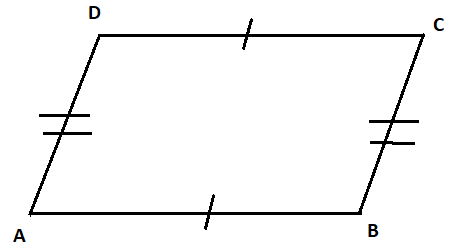
Let the above figure drawn ABCD be a parallelogram.
So, according to the properties of parallelogram.
Opposite sides of a parallelogram are parallel to each other and also equal to each other in length.
So, AB will be parallel to DC (i.e. AB || DC
And, AD will be parallel to BC (i.e. AD || DC).
As we know that if two lines are parallel and there is also a transversal to both lines then the sum of interior angles of the same side of the transversal will be equal to \[{180^0}\].
Now we can see that AD is the transversal to AB and DC. So, \[\angle {\text{A }} + {\text{ }}\angle {\text{D }} = {\text{ }}{180^0}\].
DC is the transversal to AD and BC. So, \[\angle {\text{D }} + {\text{ }}\angle {\text{C }} = {\text{ }}{180^0}\].
CB is the transversal to DC and AB. So, \[\angle {\text{C }} + {\text{ }}\angle {\text{B }} = {\text{ }}{180^0}\].
And, AB is the transversal to DA and CB. So, \[\angle {\text{A }} + {\text{ }}\angle {\text{B }} = {\text{ }}{180^0}\].
And we know that the sum of two angles is equal to \[{180^0}\]. Then those angles are supplementary to each other.
Hence, adjacent angles of parallelogram are supplementary.
Note: Whenever we come up with this type of problem then an efficient way to prove the result is by using the properties of parallelogram. And remember that if two lines are parallel then the sum of angles on the same side of the transversal of both lines is equal to \[{180^0}\].
Complete step-by-step answer:
Let the above figure drawn ABCD be a parallelogram.
So, according to the properties of parallelogram.
Opposite sides of a parallelogram are parallel to each other and also equal to each other in length.
So, AB will be parallel to DC (i.e. AB || DC
And, AD will be parallel to BC (i.e. AD || DC).
As we know that if two lines are parallel and there is also a transversal to both lines then the sum of interior angles of the same side of the transversal will be equal to \[{180^0}\].
Now we can see that AD is the transversal to AB and DC. So, \[\angle {\text{A }} + {\text{ }}\angle {\text{D }} = {\text{ }}{180^0}\].
DC is the transversal to AD and BC. So, \[\angle {\text{D }} + {\text{ }}\angle {\text{C }} = {\text{ }}{180^0}\].
CB is the transversal to DC and AB. So, \[\angle {\text{C }} + {\text{ }}\angle {\text{B }} = {\text{ }}{180^0}\].
And, AB is the transversal to DA and CB. So, \[\angle {\text{A }} + {\text{ }}\angle {\text{B }} = {\text{ }}{180^0}\].
And we know that the sum of two angles is equal to \[{180^0}\]. Then those angles are supplementary to each other.
Hence, adjacent angles of parallelogram are supplementary.
Note: Whenever we come up with this type of problem then an efficient way to prove the result is by using the properties of parallelogram. And remember that if two lines are parallel then the sum of angles on the same side of the transversal of both lines is equal to \[{180^0}\].
Recently Updated Pages
Master Class 11 English: Engaging Questions & Answers for Success

Master Class 11 Social Science: Engaging Questions & Answers for Success
Master Class 11 Maths: Engaging Questions & Answers for Success
Master Class 11 Biology: Engaging Questions & Answers for Success
Master Class 11 Physics: Engaging Questions & Answers for Success
Master Class 11 Chemistry: Engaging Questions & Answers for Success
Trending doubts
Explain the Treaty of Vienna of 1815 class 10 social science CBSE
What is the full form of POSCO class 10 social science CBSE
What planets have no moons Which one has only one moon class 10 physics CBSE
Define Potential, Developed, Stock and Reserved resources
In cricket, which Indian bowler is known as the "Yorker King"?
The diagonals of a rhombus are 10cm and 24cm Find the class 10 maths CBSE