




Prove that one cannot arrange the number from $1$ to $81$ in a $9\times 9$ table such that for each $i$ , $1\le i\le 9$ the product of the numbers in row $i$ equals the product of the numbers in column$i$.
A. This is impossible, since there are $10$ such prime numbers that: $41,43,47,53,59,61,67,71,73\text{ and 79}$.
B. This is impossible, since there are $10$ such prime numbers that: $51,63,67,23,39,61,87,91,23\text{ and 29}$
C. This is possible, since there are $10$ such prime numbers that: $41,43,47,53,59,61,67,71,73\text{ and 79}$
D. This is impossible, since there are no prime numbers.
Answer
 Verified
584.7k+ views
Hint:For these types of questions we first need to visualize a $9\times 9$ table and then observe how can you fit the numbers in each row and respective column such that their products are equal. After observing the table and analyzing the prime numbers between them we will then draw a conclusion.
Complete step by step answer:
So we need to prove that one cannot arrange the number from $1$ to $81$ in a $9\times 9$ table such that for each $i$ , $1\le i\le 9$ the product of the numbers in row $i$ equals the product of the numbers in column$i$.
Let’s see what a $9\times 9$ table means, so it means that a table where there are $9$ rows and $9$ tables, which will look like:
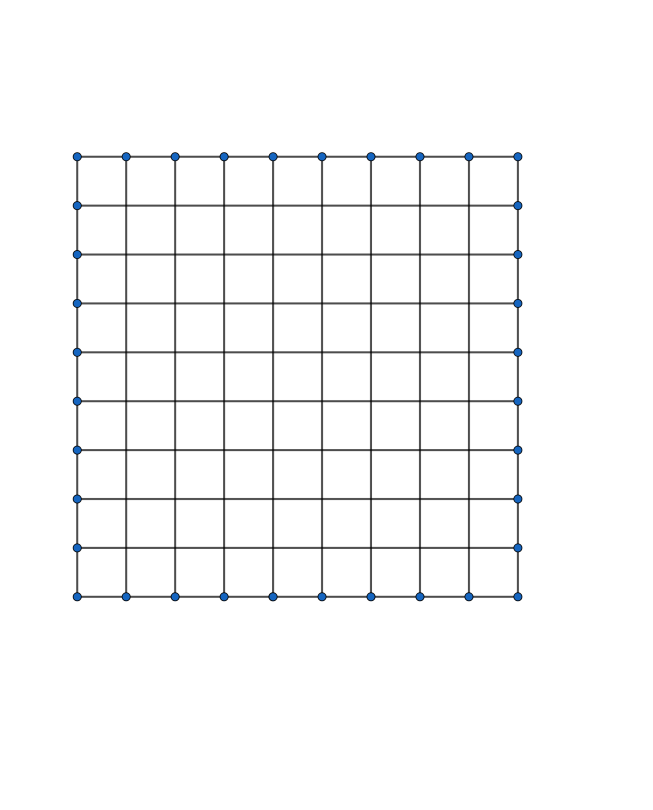
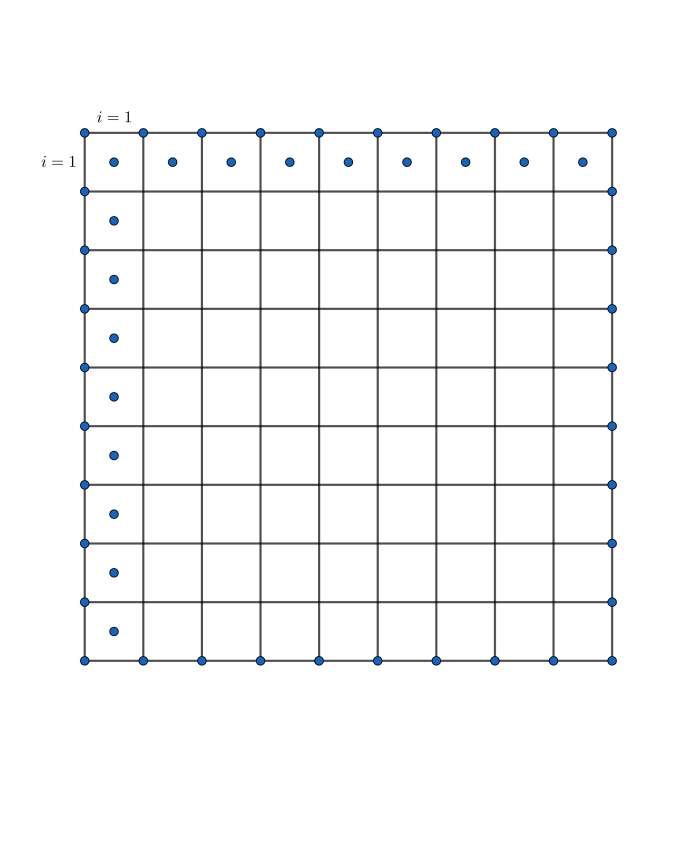
Now, we need to arrange the numbers between $1$ to $81$ in each $i$ , let’s suppose $i=1$ so we need to arrange the numbers in row one and column one such that there are products are equal :
Now, the key observation is the following: if row $k$ contains a prime number say $p>40$, then the same number must be obtained by column $k$ as well. Therefore, all prime numbers from $1\text{ to 81}$ must lie on the main diagonal of the table. Now, since there are $9$ spots on the main diagonal therefore this is impossible, since there are $10$ such prime numbers that is: $41,43,47,53,59,61,67,71,73\text{ and 79}$.
Hence, option A is correct.
Note: Although, there is no need to draw a table here but still for better observation and visualization one can draw a table. Students can make a mistake while writing the prime numbers, prime numbers are basically the numbers which do not have factors except $1$ . For example: $43=43\times 1$.
Complete step by step answer:
So we need to prove that one cannot arrange the number from $1$ to $81$ in a $9\times 9$ table such that for each $i$ , $1\le i\le 9$ the product of the numbers in row $i$ equals the product of the numbers in column$i$.
Let’s see what a $9\times 9$ table means, so it means that a table where there are $9$ rows and $9$ tables, which will look like:
Now, we need to arrange the numbers between $1$ to $81$ in each $i$ , let’s suppose $i=1$ so we need to arrange the numbers in row one and column one such that there are products are equal :
Now, the key observation is the following: if row $k$ contains a prime number say $p>40$, then the same number must be obtained by column $k$ as well. Therefore, all prime numbers from $1\text{ to 81}$ must lie on the main diagonal of the table. Now, since there are $9$ spots on the main diagonal therefore this is impossible, since there are $10$ such prime numbers that is: $41,43,47,53,59,61,67,71,73\text{ and 79}$.
Hence, option A is correct.
Note: Although, there is no need to draw a table here but still for better observation and visualization one can draw a table. Students can make a mistake while writing the prime numbers, prime numbers are basically the numbers which do not have factors except $1$ . For example: $43=43\times 1$.
Recently Updated Pages
Master Class 10 Computer Science: Engaging Questions & Answers for Success

Master Class 10 General Knowledge: Engaging Questions & Answers for Success
Master Class 10 English: Engaging Questions & Answers for Success
Master Class 10 Social Science: Engaging Questions & Answers for Success
Master Class 10 Maths: Engaging Questions & Answers for Success
Master Class 10 Science: Engaging Questions & Answers for Success
Trending doubts
What is the median of the first 10 natural numbers class 10 maths CBSE
Which women's tennis player has 24 Grand Slam singles titles?
Who is the Brand Ambassador of Incredible India?
Why is there a time difference of about 5 hours between class 10 social science CBSE
Write a letter to the principal requesting him to grant class 10 english CBSE
State and prove converse of BPT Basic Proportionality class 10 maths CBSE