




Prove that:
$\left| \begin{matrix}
-bc & {{b}^{2}}+bc & {{c}^{2}}+bc \\
{{a}^{2}}+ac & -ac & {{c}^{2}}+ac \\
{{a}^{2}}+ab & {{b}^{2}}+ab & -ab \\
\end{matrix} \right|={{\left( ab+bc+ca \right)}^{2}}$
Answer
 Verified
585.6k+ views
Hint: This question is based on determinant properties. By using the following properties, we solve LHS and get RHS.
Formula:
(i) We can multiply or divide on any one row or column of determinant, like if $\lambda $ is a constant –
$\left| \begin{matrix}
{{x}_{1}} & {{x}_{2}} & {{x}_{3}} \\
\lambda {{y}_{1}} & \lambda {{y}_{2}} & \lambda {{y}_{3}} \\
{{z}_{1}} & {{z}_{2}} & {{z}_{3}} \\
\end{matrix} \right|=\lambda \left| \begin{matrix}
{{x}_{1}} & {{x}_{2}} & {{x}_{3}} \\
{{y}_{1}} & {{y}_{2}} & {{y}_{3}} \\
{{z}_{1}} & {{z}_{2}} & {{z}_{3}} \\
\end{matrix} \right|$
(ii) We can replace any row by adding row with another row multiplied by any constant$\lambda $, like ${{R}_{1}}\to {{R}_{1}}+\lambda {{R}_{3}}$.
$\left| \begin{matrix}
{{x}_{1}} & {{x}_{2}} & {{x}_{3}} \\
{{y}_{1}} & {{y}_{2}} & {{y}_{3}} \\
{{z}_{1}} & {{z}_{2}} & {{z}_{3}} \\
\end{matrix} \right|=\left| \begin{matrix}
{{x}_{1}}+\lambda {{z}_{1}} & {{x}_{2}}+\lambda {{z}_{2}} & {{x}_{3}}+\lambda {{z}_{3}} \\
{{y}_{1}} & {{y}_{2}} & {{y}_{3}} \\
{{z}_{1}} & {{z}_{2}} & {{z}_{3}} \\
\end{matrix} \right|$
(iii) Solution of determinant –
\[\left| \begin{matrix}
{{x}_{1}} & {{x}_{2}} & {{x}_{3}} \\
{{y}_{1}} & {{y}_{2}} & {{y}_{3}} \\
{{z}_{1}} & {{z}_{2}} & {{z}_{3}} \\
\end{matrix} \right|={{x}_{1}}\left| \begin{matrix}
{{y}_{2}} & {{y}_{3}} \\
{{z}_{2}} & {{z}_{3}} \\
\end{matrix} \right|-{{x}_{2}}\left| \begin{matrix}
{{y}_{1}} & {{y}_{3}} \\
{{z}_{1}} & {{z}_{3}} \\
\end{matrix} \right|+{{x}_{3}}\left| \begin{matrix}
{{y}_{1}} & {{y}_{2}} \\
{{z}_{1}} & {{z}_{2}} \\
\end{matrix} \right|\]
$\Rightarrow \left\{ {{x}_{1}}\left( {{y}_{2}}{{z}_{3}}-{{y}_{3}}{{z}_{2}} \right)-{{x}_{2}}\left( {{y}_{1}}{{z}_{3}}-{{y}_{3}}{{z}_{1}} \right)+{{x}_{3}}\left( {{y}_{1}}{{z}_{2}}-{{y}_{2}}{{z}_{1}} \right) \right\}$
Complete step by step answer:
Basically, in this question, we have to make terms that can be taken common according to RHS using the properties of determinants.
Now, we take LHS.
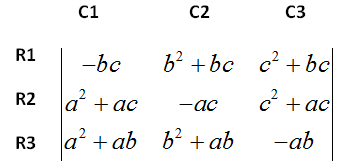
By taking common $a$ from column (1), $b$ from column (2) and $c$ from column (3), we have:
$abc\left| \begin{matrix}
\dfrac{-bc}{a} & b+c & c+b \\
a+c & \dfrac{-ac}{b} & c+a \\
a+b & b+a & \dfrac{-ab}{c} \\
\end{matrix} \right|$
Now using property of determinant, multiply row(1) with $a$, row(2) with $b$ and row(3) with $c$. We will get –
$\left| \begin{matrix}
-bc & ab+ac & ac+ab \\
ab+bc & -ac & bc+ba \\
ac+bc & bc+ac & -ab \\
\end{matrix} \right|$
Now, by property of determinant, ${{R}_{1}}\to {{R}_{1}}+{{R}_{3}}+{{R}_{3}}$
$\Rightarrow \left| \begin{matrix}
ab+bc+ac & ab+bc+ac & ab+bc+ac \\
ab+bc & -ac & bc+ba \\
ac+bc & bc+ac & -ab \\
\end{matrix} \right|$
By taking common $ab+bc+ac$ from row (1),
$\Rightarrow \left( ab+bc+ac \right)\left| \begin{matrix}
1 & 1 & 1 \\
ab+bc & -ac & bc+ba \\
ac+bc & bc+ac & -ab \\
\end{matrix} \right|$
By property of determinants,${{C}_{2}}\to {{C}_{2}}-{{C}_{1}}$ and ${{C}_{3}}\to {{C}_{3}}-{{C}_{1}}$
$\Rightarrow \left( ab+bc+ac \right)\left| \begin{matrix}
1 & 0 & 0 \\
ab+bc & -\left( ab+bc+ac \right) & 0 \\
ac+bc & 0 & -\left( ab+bc+ac \right) \\
\end{matrix} \right|$
Now, by solving determinants:
\[=\left( ab+bc+ac \right)\left\{ {{\left( ab+bc+ac \right)}^{2}}-0 \right\}\]
\[={{\left( ab+bc+ac \right)}^{3}}=RHS\].
Hence, $\left| \begin{matrix}
-bc & {{b}^{2}}+bc & {{c}^{2}}+bc \\
{{a}^{2}}+ac & -ac & {{c}^{2}}+ac \\
{{a}^{2}}+ab & {{b}^{2}}+ab & -ab \\
\end{matrix} \right|={{\left( ab+bc+ca \right)}^{3}}$ is proved.
Note:
(i) In this question, we have to take $a,b$ and $c$ common from the column and multiply to rows. But in this type of question, it can happen that we would have to take commonly from the row and multiply to the column. So students have to take care of it accordingly.
(ii) This question can also be solved by direct calculation of determinant, but it is very lengthy and there can be more possibilities of mistakes in that method.
Formula:
(i) We can multiply or divide on any one row or column of determinant, like if $\lambda $ is a constant –
$\left| \begin{matrix}
{{x}_{1}} & {{x}_{2}} & {{x}_{3}} \\
\lambda {{y}_{1}} & \lambda {{y}_{2}} & \lambda {{y}_{3}} \\
{{z}_{1}} & {{z}_{2}} & {{z}_{3}} \\
\end{matrix} \right|=\lambda \left| \begin{matrix}
{{x}_{1}} & {{x}_{2}} & {{x}_{3}} \\
{{y}_{1}} & {{y}_{2}} & {{y}_{3}} \\
{{z}_{1}} & {{z}_{2}} & {{z}_{3}} \\
\end{matrix} \right|$
(ii) We can replace any row by adding row with another row multiplied by any constant$\lambda $, like ${{R}_{1}}\to {{R}_{1}}+\lambda {{R}_{3}}$.
$\left| \begin{matrix}
{{x}_{1}} & {{x}_{2}} & {{x}_{3}} \\
{{y}_{1}} & {{y}_{2}} & {{y}_{3}} \\
{{z}_{1}} & {{z}_{2}} & {{z}_{3}} \\
\end{matrix} \right|=\left| \begin{matrix}
{{x}_{1}}+\lambda {{z}_{1}} & {{x}_{2}}+\lambda {{z}_{2}} & {{x}_{3}}+\lambda {{z}_{3}} \\
{{y}_{1}} & {{y}_{2}} & {{y}_{3}} \\
{{z}_{1}} & {{z}_{2}} & {{z}_{3}} \\
\end{matrix} \right|$
(iii) Solution of determinant –
\[\left| \begin{matrix}
{{x}_{1}} & {{x}_{2}} & {{x}_{3}} \\
{{y}_{1}} & {{y}_{2}} & {{y}_{3}} \\
{{z}_{1}} & {{z}_{2}} & {{z}_{3}} \\
\end{matrix} \right|={{x}_{1}}\left| \begin{matrix}
{{y}_{2}} & {{y}_{3}} \\
{{z}_{2}} & {{z}_{3}} \\
\end{matrix} \right|-{{x}_{2}}\left| \begin{matrix}
{{y}_{1}} & {{y}_{3}} \\
{{z}_{1}} & {{z}_{3}} \\
\end{matrix} \right|+{{x}_{3}}\left| \begin{matrix}
{{y}_{1}} & {{y}_{2}} \\
{{z}_{1}} & {{z}_{2}} \\
\end{matrix} \right|\]
$\Rightarrow \left\{ {{x}_{1}}\left( {{y}_{2}}{{z}_{3}}-{{y}_{3}}{{z}_{2}} \right)-{{x}_{2}}\left( {{y}_{1}}{{z}_{3}}-{{y}_{3}}{{z}_{1}} \right)+{{x}_{3}}\left( {{y}_{1}}{{z}_{2}}-{{y}_{2}}{{z}_{1}} \right) \right\}$
Complete step by step answer:
Basically, in this question, we have to make terms that can be taken common according to RHS using the properties of determinants.
Now, we take LHS.
By taking common $a$ from column (1), $b$ from column (2) and $c$ from column (3), we have:
$abc\left| \begin{matrix}
\dfrac{-bc}{a} & b+c & c+b \\
a+c & \dfrac{-ac}{b} & c+a \\
a+b & b+a & \dfrac{-ab}{c} \\
\end{matrix} \right|$
Now using property of determinant, multiply row(1) with $a$, row(2) with $b$ and row(3) with $c$. We will get –
$\left| \begin{matrix}
-bc & ab+ac & ac+ab \\
ab+bc & -ac & bc+ba \\
ac+bc & bc+ac & -ab \\
\end{matrix} \right|$
Now, by property of determinant, ${{R}_{1}}\to {{R}_{1}}+{{R}_{3}}+{{R}_{3}}$
$\Rightarrow \left| \begin{matrix}
ab+bc+ac & ab+bc+ac & ab+bc+ac \\
ab+bc & -ac & bc+ba \\
ac+bc & bc+ac & -ab \\
\end{matrix} \right|$
By taking common $ab+bc+ac$ from row (1),
$\Rightarrow \left( ab+bc+ac \right)\left| \begin{matrix}
1 & 1 & 1 \\
ab+bc & -ac & bc+ba \\
ac+bc & bc+ac & -ab \\
\end{matrix} \right|$
By property of determinants,${{C}_{2}}\to {{C}_{2}}-{{C}_{1}}$ and ${{C}_{3}}\to {{C}_{3}}-{{C}_{1}}$
$\Rightarrow \left( ab+bc+ac \right)\left| \begin{matrix}
1 & 0 & 0 \\
ab+bc & -\left( ab+bc+ac \right) & 0 \\
ac+bc & 0 & -\left( ab+bc+ac \right) \\
\end{matrix} \right|$
Now, by solving determinants:
\[=\left( ab+bc+ac \right)\left\{ {{\left( ab+bc+ac \right)}^{2}}-0 \right\}\]
\[={{\left( ab+bc+ac \right)}^{3}}=RHS\].
Hence, $\left| \begin{matrix}
-bc & {{b}^{2}}+bc & {{c}^{2}}+bc \\
{{a}^{2}}+ac & -ac & {{c}^{2}}+ac \\
{{a}^{2}}+ab & {{b}^{2}}+ab & -ab \\
\end{matrix} \right|={{\left( ab+bc+ca \right)}^{3}}$ is proved.
Note:
(i) In this question, we have to take $a,b$ and $c$ common from the column and multiply to rows. But in this type of question, it can happen that we would have to take commonly from the row and multiply to the column. So students have to take care of it accordingly.
(ii) This question can also be solved by direct calculation of determinant, but it is very lengthy and there can be more possibilities of mistakes in that method.
Recently Updated Pages
Master Class 10 Computer Science: Engaging Questions & Answers for Success

Master Class 10 General Knowledge: Engaging Questions & Answers for Success
Master Class 10 English: Engaging Questions & Answers for Success
Master Class 10 Social Science: Engaging Questions & Answers for Success
Master Class 10 Maths: Engaging Questions & Answers for Success
Master Class 10 Science: Engaging Questions & Answers for Success
Trending doubts
What is the median of the first 10 natural numbers class 10 maths CBSE
Which women's tennis player has 24 Grand Slam singles titles?
Who is the Brand Ambassador of Incredible India?
Why is there a time difference of about 5 hours between class 10 social science CBSE
Write a letter to the principal requesting him to grant class 10 english CBSE
State and prove converse of BPT Basic Proportionality class 10 maths CBSE