




Prove that in an isosceles trapezoid, adjacent angles at the parallel sides are equal?
Answer
 Verified
548.1k+ views
Hint: A trapezium is a cyclic quadrilateral with one pair of parallel sides. An isosceles trapezoid has one pair of parallel sides and another pair of congruent sides (means equal in length). The diagonals are of equal length in isosceles trapezoids. Using these properties, we will prove that the adjacent angles at the parallel sides are equal.
Complete solution:
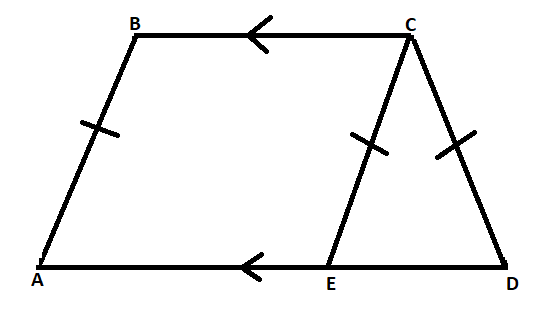
Let us consider the isosceles trapezoid $ABCD$ where $BC//AD$ and $AB = CD$ as shown below, in which we have drawn $CE//AB$.
As $CE//AB$ , we have $\angle BAE = \angle CED$.
As $CE//AB$ and $AE//BC$, $ABCE$ is a parallelogram and hence $AB = CE$ and, but as $AB = CD$, we have $CD = CE$.
Therefore, $\vartriangle CDE$ is an isosceles triangle and hence $\angle CED = \angle CDE$.
But as $\angle BAE = \angle CED$, we have $\angle BAE = \angle CDE$ or $\angle BAD = \angle ADC$.
Therefore, $\angle BAD$ is equals to $\angle ADC$.
Now, we know that two angles are supplementary if their sum is $180$ degrees.
Further as $AD//BC$, $\angle ABC$is supplementary to $\angle BAD$ and similarly $\angle ADC$ and $\angle BCD$ are supplementary.
As $\angle ABC$ and $\angle BCD$ are supplementary of equal angles, they too are equal.
Therefore, $\angle ABC$ and $\angle BCD$ are also equal.
Note:
An isosceles trapezoid can be defined as a trapezoid in which non-parallel sides and base angles are of the same measure. In other words, if two opposite sides (bases) of the trapezoid are parallel, and the two non-parallel sides are of equal lengths, then it is an isosceles trapezoid. To find the area of the isosceles trapezoid we have to add the base sides or parallel sides and divide it by $2$ and then multiply the result with height.
Complete solution:
Let us consider the isosceles trapezoid $ABCD$ where $BC//AD$ and $AB = CD$ as shown below, in which we have drawn $CE//AB$.
As $CE//AB$ , we have $\angle BAE = \angle CED$.
As $CE//AB$ and $AE//BC$, $ABCE$ is a parallelogram and hence $AB = CE$ and, but as $AB = CD$, we have $CD = CE$.
Therefore, $\vartriangle CDE$ is an isosceles triangle and hence $\angle CED = \angle CDE$.
But as $\angle BAE = \angle CED$, we have $\angle BAE = \angle CDE$ or $\angle BAD = \angle ADC$.
Therefore, $\angle BAD$ is equals to $\angle ADC$.
Now, we know that two angles are supplementary if their sum is $180$ degrees.
Further as $AD//BC$, $\angle ABC$is supplementary to $\angle BAD$ and similarly $\angle ADC$ and $\angle BCD$ are supplementary.
As $\angle ABC$ and $\angle BCD$ are supplementary of equal angles, they too are equal.
Therefore, $\angle ABC$ and $\angle BCD$ are also equal.
Note:
An isosceles trapezoid can be defined as a trapezoid in which non-parallel sides and base angles are of the same measure. In other words, if two opposite sides (bases) of the trapezoid are parallel, and the two non-parallel sides are of equal lengths, then it is an isosceles trapezoid. To find the area of the isosceles trapezoid we have to add the base sides or parallel sides and divide it by $2$ and then multiply the result with height.
Recently Updated Pages
Master Class 10 Computer Science: Engaging Questions & Answers for Success

State BPT theorem and prove it class 10 maths CBSE
A peacock is sitting on the top of a pillar which -class-10-maths-CBSE
Railways Women Helpline Number?
Explain the refraction of light through a glassslab class 10 physics CBSE
a Why did Mendel choose pea plants for his experiments class 10 biology CBSE
Trending doubts
Explain the Treaty of Vienna of 1815 class 10 social science CBSE
10 examples of evaporation in daily life with explanations
What is the full form of POSCO class 10 social science CBSE
Five things I will do to build a great India class 10 english CBSE
Write short note on buckyball class 10 chemistry CBSE
Make a sketch of the human nerve cell What function class 10 biology CBSE