




Prove that in a triangle, the angle bisector divides the side opposite to the angle in the ratio of the remaining sides.
Answer
 Verified
609k+ views
Hint: To prove this, we have to use Basic Proportionality Theorem known as Thales Theorem. According to this theorem, if a line is drawn parallel to one side of a triangle intersecting the other two sides in distinct points, then the other two sides are divided in the same ratio.
Complete step-by-step answer:
Let $\Delta ABC$ be the triangle.
Let AD be the internal bisector of $$\angle BAC$$ which meet BC at D.
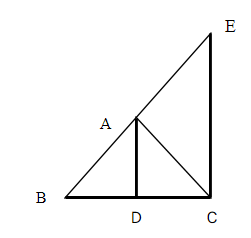
Step1:To prove: $$\dfrac{{DC}}{{BD}} = \dfrac{{AC}}{{AB}}$$ , draw $$CE\left | \right |DA$$ to meet BA produced at E.(as per above figure)
Step2:Since $$CE\left | \right |DA$$ and AC is the transversal.
$$\angle DAC = \angle ACE$$ ( alternate angle ) .... (1)
$$\angle BAD = \angle AEC$$ ( corresponding angle ) .... (2)
Step3:Since AD is the angle bisector of $$\angle A$$ ,
$$\angle BAD = \angle DAC$$ …...... (3)
Step4:From (1), (2) and (3), we have
$$\angle ACE = \angle AEC$$
Step5: In $\Delta ACE$ ,AE=AC as $$\angle ACE = \angle AEC$$ (as Sides opposite to equal angles are equal)
Step6:
In $\Delta BCE$,
$$CE\left | \right |DA$$
So, by Thales Theorem, $$\dfrac{{DC}}{{BD}} = \dfrac{{AE}}{{BA}}$$
Then $$\dfrac{{DC}}{{BD}} = \dfrac{{AC}}{{AB}}$$ (as AE =AC)
Hence, the angle bisector of a triangle divides the side opposite to the angle in the ratio of the remaining sides.
Note: Basic Proportionality theorem was introduced by a famous Greek Mathematician namely Thales. Hence it is also called Thales Theorem. According to him, for any two equiangular triangles, the ratio of any two corresponding sides is always the same. Based on this concept, he gave a theorem of basic proportionality. This concept has been introduced in similar triangles. If two triangles are similar to each other then,
i) Corresponding angles of both the triangles are equal.
ii) Corresponding sides of both the triangles are in proportion to each other.
Complete step-by-step answer:
Let $\Delta ABC$ be the triangle.
Let AD be the internal bisector of $$\angle BAC$$ which meet BC at D.
Step1:To prove: $$\dfrac{{DC}}{{BD}} = \dfrac{{AC}}{{AB}}$$ , draw $$CE\left | \right |DA$$ to meet BA produced at E.(as per above figure)
Step2:Since $$CE\left | \right |DA$$ and AC is the transversal.
$$\angle DAC = \angle ACE$$ ( alternate angle ) .... (1)
$$\angle BAD = \angle AEC$$ ( corresponding angle ) .... (2)
Step3:Since AD is the angle bisector of $$\angle A$$ ,
$$\angle BAD = \angle DAC$$ …...... (3)
Step4:From (1), (2) and (3), we have
$$\angle ACE = \angle AEC$$
Step5: In $\Delta ACE$ ,AE=AC as $$\angle ACE = \angle AEC$$ (as Sides opposite to equal angles are equal)
Step6:
In $\Delta BCE$,
$$CE\left | \right |DA$$
So, by Thales Theorem, $$\dfrac{{DC}}{{BD}} = \dfrac{{AE}}{{BA}}$$
Then $$\dfrac{{DC}}{{BD}} = \dfrac{{AC}}{{AB}}$$ (as AE =AC)
Hence, the angle bisector of a triangle divides the side opposite to the angle in the ratio of the remaining sides.
Note: Basic Proportionality theorem was introduced by a famous Greek Mathematician namely Thales. Hence it is also called Thales Theorem. According to him, for any two equiangular triangles, the ratio of any two corresponding sides is always the same. Based on this concept, he gave a theorem of basic proportionality. This concept has been introduced in similar triangles. If two triangles are similar to each other then,
i) Corresponding angles of both the triangles are equal.
ii) Corresponding sides of both the triangles are in proportion to each other.
Recently Updated Pages
Master Class 12 Economics: Engaging Questions & Answers for Success

Master Class 12 English: Engaging Questions & Answers for Success
Master Class 12 Social Science: Engaging Questions & Answers for Success
Master Class 12 Maths: Engaging Questions & Answers for Success
Master Class 12 Physics: Engaging Questions & Answers for Success
Master Class 9 General Knowledge: Engaging Questions & Answers for Success
Trending doubts
Explain the Treaty of Vienna of 1815 class 10 social science CBSE
Who Won 36 Oscar Awards? Record Holder Revealed
Why is it 530 pm in india when it is 1200 afternoon class 10 social science CBSE
Make a sketch of the human nerve cell What function class 10 biology CBSE
What is the full form of POSCO class 10 social science CBSE
Define Potential, Developed, Stock and Reserved resources