




Prove that exponential function ${e^x}$ is an increasing function.
Answer
 Verified
626.1k+ views
Hint:Here interval is not given so we will prove that ${e^x}$ is strictly increasing function in its own domain.
Complete step-by-step answer:
Let $f(x)$ is a function having ${D_f}$ as its domain. Range of exponential function is from \[(0,\infty )\].
$
f(x) = {e^x}\\
\therefore {D_f} \in R$
Now differentiating $f(x)$ with respect to $x$
${f^{'}}(x) = {e^{x}}$
Three cases arises $x > 0,x = 0,x < 0$
Case 1. When $x > 0$
${f^{'}}(x) = {e^{x}} = 1 + \dfrac{x}{{1!}} + \dfrac{{{x^2}}}{{2!}} + \dfrac{{{x^3}}}{{3!}} + .......$ Binomial expansion of exponential function ${e^{x}}$ > 0
Here we get that the overall function is greater than zero.
Case 2. When $x = 0$
$\therefore f'(x) = {e^x} = 1 > 0$ Putting value of $x = 0$ we get a function equal to 1 which again is greater than zero.
Case 3. When $x < 0$
$\therefore f'(x) = {e^x} = {e^{ - x}} = \dfrac{1}{{{e^x}}}$ = 1a positive quantity $ > 0$
Taking negative quantity and reciprocating it we will get positive quantity in denominator which is greater than zero.
In all the three cases we found out that $f'(x) = {e^x} > 0$
$\therefore $ The function ${e^x}$ is increasing.
Note: The word exponential has mathematical meaning which says extending in a natural way. It is a monotonically increasing function. A monotonous function is a function in which $x$ increases for all real values .The exponential function is one of the most important functions in mathematics somewhat lower than that of a linear function. Exponential functions provide simplest solutions to the dynamic systems. They can be related to a growth or decay of a process of a system over s period of time.
Alternative approach to this question is the Graphical method. In this we can see that function is increasing.
Putting $x = 0$, in function $y = {e^x}$ we will get $y = 1$ and by putting $x = 1$we will get $y = e$ which will be approximately equal to $2.718$
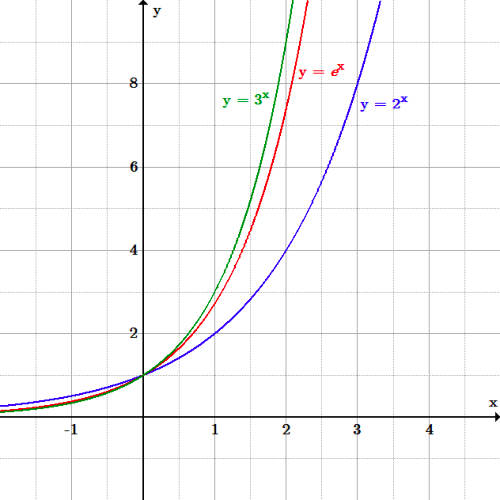
We can see that in the graph the function is increasing to infinity.
Complete step-by-step answer:
Let $f(x)$ is a function having ${D_f}$ as its domain. Range of exponential function is from \[(0,\infty )\].
$
f(x) = {e^x}\\
\therefore {D_f} \in R$
Now differentiating $f(x)$ with respect to $x$
${f^{'}}(x) = {e^{x}}$
Three cases arises $x > 0,x = 0,x < 0$
Case 1. When $x > 0$
${f^{'}}(x) = {e^{x}} = 1 + \dfrac{x}{{1!}} + \dfrac{{{x^2}}}{{2!}} + \dfrac{{{x^3}}}{{3!}} + .......$ Binomial expansion of exponential function ${e^{x}}$ > 0
Here we get that the overall function is greater than zero.
Case 2. When $x = 0$
$\therefore f'(x) = {e^x} = 1 > 0$ Putting value of $x = 0$ we get a function equal to 1 which again is greater than zero.
Case 3. When $x < 0$
$\therefore f'(x) = {e^x} = {e^{ - x}} = \dfrac{1}{{{e^x}}}$ = 1a positive quantity $ > 0$
Taking negative quantity and reciprocating it we will get positive quantity in denominator which is greater than zero.
In all the three cases we found out that $f'(x) = {e^x} > 0$
$\therefore $ The function ${e^x}$ is increasing.
Note: The word exponential has mathematical meaning which says extending in a natural way. It is a monotonically increasing function. A monotonous function is a function in which $x$ increases for all real values .The exponential function is one of the most important functions in mathematics somewhat lower than that of a linear function. Exponential functions provide simplest solutions to the dynamic systems. They can be related to a growth or decay of a process of a system over s period of time.
Alternative approach to this question is the Graphical method. In this we can see that function is increasing.
Putting $x = 0$, in function $y = {e^x}$ we will get $y = 1$ and by putting $x = 1$we will get $y = e$ which will be approximately equal to $2.718$
We can see that in the graph the function is increasing to infinity.
Recently Updated Pages
Master Class 9 General Knowledge: Engaging Questions & Answers for Success

Master Class 9 Maths: Engaging Questions & Answers for Success
Master Class 9 Science: Engaging Questions & Answers for Success
Master Class 9 English: Engaging Questions & Answers for Success
Master Class 9 Social Science: Engaging Questions & Answers for Success
Class 9 Question and Answer - Your Ultimate Solutions Guide
Trending doubts
Which are the Top 10 Largest Countries of the World?
Draw a labelled sketch of the human eye class 12 physics CBSE
Differentiate between homogeneous and heterogeneous class 12 chemistry CBSE
Sulphuric acid is known as the king of acids State class 12 chemistry CBSE
Why is the cell called the structural and functional class 12 biology CBSE
A dentist uses a small mirror that gives a magnification class 12 physics CBSE