




Prove that \[\cos ({570^ \circ })\sin ({510^ \circ }) + \sin ( - {330^ \circ })\cos ( - {390^ \circ }) = 0\]
Answer
 Verified
654k+ views
Hint: We break the angle values inside the bracket in such a way so we can relate to the quadrants in the plane and write the values for the question in a simpler way. Try to break the values as adding or subtracting from \[{360^ \circ },{180^ \circ }\]and relate to the quadrant diagram.
* We know the values of all trigonometric angles are positive in the first quadrant.
Values of only \[\sin \theta \] are positive in the second quadrant.
Values of only \[\tan \theta \] are positive in the third quadrant.
Values of only\[\cos \theta \] are positive in the fourth quadrant.
Complete step-by-step answer:
We solve for all the trigonometric terms separately.
For better understanding we draw the quadrant division
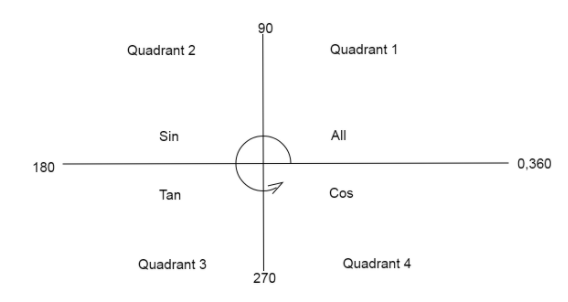
Firstly we solve for \[\cos ({570^ \circ })\]
We can write
\[\cos ({570^ \circ }) = \cos ({360^ \circ } + {210^ \circ })\]
Since \[{360^ \circ } + \] goes to the first quadrant where all trigonometric angles are positive
\[ \Rightarrow \cos ({360^ \circ } + {210^ \circ }) = \cos ({210^ \circ })\]
Now we can write
\[\cos ({210^ \circ }) = \cos ({180^ \circ } + {30^ \circ })\]
Since \[{180^ \circ } + \] goes to the third quadrant where all \[\tan \] angles are positive, so all \[\cos \] angles are negative.
\[ \Rightarrow \cos ({180^ \circ } + {30^ \circ }) = - \cos ({30^ \circ }) = \dfrac{{ - \sqrt 3 }}{2}\]
So, \[\cos ({570^ \circ }) = \dfrac{{ - \sqrt 3 }}{2}\] … (1)
Now we solve for \[\sin ({510^ \circ })\]
We can write
\[\sin ({510^ \circ }) = \sin ({360^ \circ } + {150^ \circ })\]
Since \[{360^ \circ } + \] goes to the first quadrant where all trigonometric angles are positive
\[ \Rightarrow \sin ({360^ \circ } + {150^ \circ }) = \sin ({150^ \circ })\]
Now we can write
\[\sin ({150^ \circ }) = \sin ({180^ \circ } - {30^ \circ })\]
Since \[{180^ \circ } - \] goes to the second quadrant where all \[\sin \] angles are positive.
\[ \Rightarrow \sin ({180^ \circ } - {30^ \circ }) = \sin ({30^ \circ }) = \dfrac{1}{2}\]
So, \[\sin ({510^ \circ }) = \dfrac{1}{2}\] … (2)
Now we solve for \[\sin ( - {330^ \circ })\]
Since, \[\sin \] is an odd function therefore, \[\sin ( - \theta ) = - \sin \theta \]
\[ \Rightarrow \sin ( - {330^ \circ }) = - \sin ({330^ \circ })\]
We can write
\[ - \sin ({330^ \circ }) = - \sin ({360^ \circ } - {30^ \circ })\]
Since \[{360^ \circ } - \] goes to the fourth quadrant where all \[\cos \] angles are only positive.
\[ \Rightarrow - \sin ({360^ \circ } - {30^ \circ }) = - \sin ( - {30^ \circ })\]
Since, \[\sin \] is an odd function therefore, \[\sin ( - \theta ) = - \sin \theta \]
\[ \Rightarrow - \sin ({360^ \circ } - {30^ \circ }) = \sin ({30^ \circ }) = \dfrac{1}{2}\]
So, \[\sin ({-330^ \circ }) = \dfrac{1}{2}\] … (3)
Now we solve for \[\cos ( - {390^ \circ })\]
Since, \[\cos \] is an even function therefore, \[\cos ( - \theta ) = \cos \theta \]
\[ \Rightarrow \cos ( - {390^ \circ }) = \cos ({390^ \circ })\]
We can write
\[\cos ({390^ \circ }) = \cos ({360^ \circ } + {30^ \circ })\]
Since \[{360^ \circ } + \] goes to the first quadrant where all trigonometric angles are positive
\[ \Rightarrow \cos ({360^ \circ } + {30^ \circ }) = \cos ({30^ \circ }) = \dfrac{{\sqrt 3 }}{2}\]
So, \[\cos ( - {390^ \circ }) = \dfrac{{\sqrt 3 }}{2}\] … (4)
Substitute values from equation (1), (2), (3) and (4) in the following equation
\[\cos ({570^ \circ })\sin ({510^ \circ }) + \sin ( - {330^ \circ })\cos ( - {390^ \circ }) = 0\]
\[
\dfrac{{ - \sqrt 3 }}{2} \times \dfrac{1}{2} + \dfrac{1}{2} \times \dfrac{{\sqrt 3 }}{2} = 0 \\
\dfrac{{ - \sqrt 3 }}{4} + \dfrac{{\sqrt 3 }}{4} = 0 \\
0 = 0 \\
\]
Therefore, LHS=RHS
Hence Proved
Note: Students can many times make mistakes when the angle between the brackets is negative, so always check first if the trigonometric function alone is an even or odd function. An odd function brings out the negative sign while an even function eradicates the negative sign.
* We know the values of all trigonometric angles are positive in the first quadrant.
Values of only \[\sin \theta \] are positive in the second quadrant.
Values of only \[\tan \theta \] are positive in the third quadrant.
Values of only\[\cos \theta \] are positive in the fourth quadrant.
Complete step-by-step answer:
We solve for all the trigonometric terms separately.
For better understanding we draw the quadrant division
Firstly we solve for \[\cos ({570^ \circ })\]
We can write
\[\cos ({570^ \circ }) = \cos ({360^ \circ } + {210^ \circ })\]
Since \[{360^ \circ } + \] goes to the first quadrant where all trigonometric angles are positive
\[ \Rightarrow \cos ({360^ \circ } + {210^ \circ }) = \cos ({210^ \circ })\]
Now we can write
\[\cos ({210^ \circ }) = \cos ({180^ \circ } + {30^ \circ })\]
Since \[{180^ \circ } + \] goes to the third quadrant where all \[\tan \] angles are positive, so all \[\cos \] angles are negative.
\[ \Rightarrow \cos ({180^ \circ } + {30^ \circ }) = - \cos ({30^ \circ }) = \dfrac{{ - \sqrt 3 }}{2}\]
So, \[\cos ({570^ \circ }) = \dfrac{{ - \sqrt 3 }}{2}\] … (1)
Now we solve for \[\sin ({510^ \circ })\]
We can write
\[\sin ({510^ \circ }) = \sin ({360^ \circ } + {150^ \circ })\]
Since \[{360^ \circ } + \] goes to the first quadrant where all trigonometric angles are positive
\[ \Rightarrow \sin ({360^ \circ } + {150^ \circ }) = \sin ({150^ \circ })\]
Now we can write
\[\sin ({150^ \circ }) = \sin ({180^ \circ } - {30^ \circ })\]
Since \[{180^ \circ } - \] goes to the second quadrant where all \[\sin \] angles are positive.
\[ \Rightarrow \sin ({180^ \circ } - {30^ \circ }) = \sin ({30^ \circ }) = \dfrac{1}{2}\]
So, \[\sin ({510^ \circ }) = \dfrac{1}{2}\] … (2)
Now we solve for \[\sin ( - {330^ \circ })\]
Since, \[\sin \] is an odd function therefore, \[\sin ( - \theta ) = - \sin \theta \]
\[ \Rightarrow \sin ( - {330^ \circ }) = - \sin ({330^ \circ })\]
We can write
\[ - \sin ({330^ \circ }) = - \sin ({360^ \circ } - {30^ \circ })\]
Since \[{360^ \circ } - \] goes to the fourth quadrant where all \[\cos \] angles are only positive.
\[ \Rightarrow - \sin ({360^ \circ } - {30^ \circ }) = - \sin ( - {30^ \circ })\]
Since, \[\sin \] is an odd function therefore, \[\sin ( - \theta ) = - \sin \theta \]
\[ \Rightarrow - \sin ({360^ \circ } - {30^ \circ }) = \sin ({30^ \circ }) = \dfrac{1}{2}\]
So, \[\sin ({-330^ \circ }) = \dfrac{1}{2}\] … (3)
Now we solve for \[\cos ( - {390^ \circ })\]
Since, \[\cos \] is an even function therefore, \[\cos ( - \theta ) = \cos \theta \]
\[ \Rightarrow \cos ( - {390^ \circ }) = \cos ({390^ \circ })\]
We can write
\[\cos ({390^ \circ }) = \cos ({360^ \circ } + {30^ \circ })\]
Since \[{360^ \circ } + \] goes to the first quadrant where all trigonometric angles are positive
\[ \Rightarrow \cos ({360^ \circ } + {30^ \circ }) = \cos ({30^ \circ }) = \dfrac{{\sqrt 3 }}{2}\]
So, \[\cos ( - {390^ \circ }) = \dfrac{{\sqrt 3 }}{2}\] … (4)
Substitute values from equation (1), (2), (3) and (4) in the following equation
\[\cos ({570^ \circ })\sin ({510^ \circ }) + \sin ( - {330^ \circ })\cos ( - {390^ \circ }) = 0\]
\[
\dfrac{{ - \sqrt 3 }}{2} \times \dfrac{1}{2} + \dfrac{1}{2} \times \dfrac{{\sqrt 3 }}{2} = 0 \\
\dfrac{{ - \sqrt 3 }}{4} + \dfrac{{\sqrt 3 }}{4} = 0 \\
0 = 0 \\
\]
Therefore, LHS=RHS
Hence Proved
Note: Students can many times make mistakes when the angle between the brackets is negative, so always check first if the trigonometric function alone is an even or odd function. An odd function brings out the negative sign while an even function eradicates the negative sign.
Recently Updated Pages
Master Class 11 Social Science: Engaging Questions & Answers for Success

Master Class 11 English: Engaging Questions & Answers for Success
Master Class 11 Accountancy: Engaging Questions & Answers for Success
Master Class 11 Physics: Engaging Questions & Answers for Success
Master Class 11 Computer Science: Engaging Questions & Answers for Success
Master Class 11 Business Studies: Engaging Questions & Answers for Success
Trending doubts
Find the value of the expression given below sin 30circ class 11 maths CBSE
One Metric ton is equal to kg A 10000 B 1000 C 100 class 11 physics CBSE
Draw a diagram of nephron and explain its structur class 11 biology CBSE
10 examples of friction in our daily life
Proton was discovered by A Thomson B Rutherford C Chadwick class 11 chemistry CBSE
The teeth used for biting and cutting food are called class 11 biology CBSE