




How is propene converted into 1−bromopropane and 2−bromopropane?
Answer
 Verified
645k+ views
Hint: To answer this question, you should recall the concept of an electrophilic addition of halogens to a double bond. Markovnikov rule is an important rule for the prediction of products of addition reaction of unsymmetrical alkenes in organic chemistry.
Complete step by step solution:
Addition of \[HBr\] to propene gives 2-bromopropane. The hydrogen of \[HBr\] adds to carbon 1 of propene and bromine adds to carbon 2.
The addition of hydrogen halide to an unsymmetrical alkene gives two products. Propene when undergoes reaction with hydrogen bromide forms \[80{\text{ }}\% \] 2- bromopropane (isopropyl bromide) and \[20\% \] 1-bromopropane (n-propyl bromide) due to Markovnikov rule.
When reacted with \[HBr\] in the presence of peroxide, it gives 1-Bromopropane. The addition is according to Anti Markovnikov's rule.
Addition of \[HBr\] to propene without the presence of peroxides gives 2- bromopropane. The hydrogen of \[HBr\] adds to Carbon 1 of propene and bromine adds to Carbon 2. According to Markovnikov rule, addition reaction of alkenes follows the electrophilic addition reaction mechanism. The general mechanism is explained below:
1. An electrophile, H+ is generated from hydrogen bromide which attacks the double bond to form a carbocation.
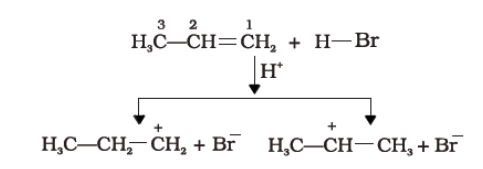
2. Since the secondary carbocation is more stable than the primary carbocation, the secondary carbocation predominates the formation of ions.

3. Finally,\[B{r^-}\] attacks the carbocation to form alkyl halides.
Note: Anti-Markovnikov rule explains the regiochemistry where the substituent is bonded to a less substituted carbon, rather than the more substituted carbon. This process is quite unusual, as carbocations which are commonly formed during alkene, or alkyne reactions tend to favour the more substituted carbon. Anti Markovnikov addition reaction is found to follow a free radical mechanism. The peroxide compound involved helps in the generation of free radicals. A general mechanism of anti-Markovnikov addition reaction is discussed below:
1. Generation of free radical through homolytic cleavage of peroxide compound.
2. Attack of generated free radical on hydrogen halide to form halide radical through homolysis
3. Attack of generated halide radical on alkene molecule to form alkyl radical through homolysis.
4. Attack of a generated alkyl radical on hydrogen halide to form alkyl halide through homolytic cleavage of hydrogen halide bond.
Complete step by step solution:
Addition of \[HBr\] to propene gives 2-bromopropane. The hydrogen of \[HBr\] adds to carbon 1 of propene and bromine adds to carbon 2.
The addition of hydrogen halide to an unsymmetrical alkene gives two products. Propene when undergoes reaction with hydrogen bromide forms \[80{\text{ }}\% \] 2- bromopropane (isopropyl bromide) and \[20\% \] 1-bromopropane (n-propyl bromide) due to Markovnikov rule.
When reacted with \[HBr\] in the presence of peroxide, it gives 1-Bromopropane. The addition is according to Anti Markovnikov's rule.
Addition of \[HBr\] to propene without the presence of peroxides gives 2- bromopropane. The hydrogen of \[HBr\] adds to Carbon 1 of propene and bromine adds to Carbon 2. According to Markovnikov rule, addition reaction of alkenes follows the electrophilic addition reaction mechanism. The general mechanism is explained below:
1. An electrophile, H+ is generated from hydrogen bromide which attacks the double bond to form a carbocation.
2. Since the secondary carbocation is more stable than the primary carbocation, the secondary carbocation predominates the formation of ions.
3. Finally,\[B{r^-}\] attacks the carbocation to form alkyl halides.
Note: Anti-Markovnikov rule explains the regiochemistry where the substituent is bonded to a less substituted carbon, rather than the more substituted carbon. This process is quite unusual, as carbocations which are commonly formed during alkene, or alkyne reactions tend to favour the more substituted carbon. Anti Markovnikov addition reaction is found to follow a free radical mechanism. The peroxide compound involved helps in the generation of free radicals. A general mechanism of anti-Markovnikov addition reaction is discussed below:
1. Generation of free radical through homolytic cleavage of peroxide compound.
2. Attack of generated free radical on hydrogen halide to form halide radical through homolysis
3. Attack of generated halide radical on alkene molecule to form alkyl radical through homolysis.
4. Attack of a generated alkyl radical on hydrogen halide to form alkyl halide through homolytic cleavage of hydrogen halide bond.
Recently Updated Pages
If x a + bt + ct2 where x is in meters and t is in class 11 physics CBSE

A car covers the first half distance between two places class 11 physics CBSE
The resultant of two vectors overrightarrow P and overrightarrow class 11 physics CBSE
Find the value of cos 135 class 11 maths CBSE
A mass M is held in place by an applied force F and class 11 physics CBSE
A solution of glucose in water is labelled as 10 dfracwv class 11 chemistry CBSE
Trending doubts
One Metric ton is equal to kg A 10000 B 1000 C 100 class 11 physics CBSE
Find the value of the expression given below sin 30circ class 11 maths CBSE
Draw a diagram of nephron and explain its structur class 11 biology CBSE
10 examples of friction in our daily life
Proton was discovered by A Thomson B Rutherford C Chadwick class 11 chemistry CBSE
Bond order ofO2 O2+ O2 and O22 is in order A O2 langle class 11 chemistry CBSE