




Projection of uniform circular motion on a diameter is
A. Simple harmonic motion.
B. Angular simple harmonic motion.
C. Both A and B.
D. None of these.
Answer
 Verified
522k+ views
Hint:Simple harmonic motion or linear simple harmonic motion occurs when a particle moving along a straight line with acceleration whose direction is always towards a fixed point on the line and whose magnitude is proportional to the distance from the fixed point. Angular simple harmonic motion occurs when a body’s angular acceleration is proportional to its angular displacement from a fixed angular position and directed towards that position
Complete step by step answer:
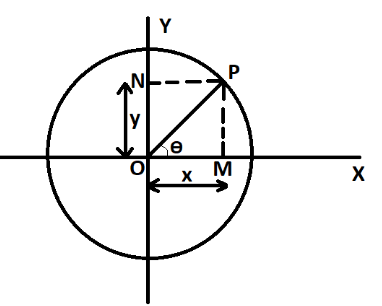
Let us consider a particle $P$ moving in a uniform circular motion about a point $O$ in the $XY$ plane as shown in the above figure.
Let $OP = r$
Splitting into horizontal and vertical component we can write $x$ and $y$ as
$x = rcos\theta $ and $y = r\sin \theta $ ……….. $\left( 1 \right)$
Since it is uniform circular motion then, $\theta $ increase in constant rate.
Therefore, $\theta = \omega t$ ……….. $\left( 2 \right)$
Substituting equation $\left( 2 \right)$ in equation $\left( 1 \right)$ we can write $x$ and $y$
$x = r\cos \omega t$ ………. $\left( 3 \right)$ and
$y = r\sin \omega t$ ……….. $\left( 4 \right)$
Differentiating equation $\left( 3 \right)$ two times that is on double differentiating with respect to $t$ , we get
$\dfrac{{{d^2}x}}{{d{t^2}}} = - {\omega ^2}r\cos \omega t = - {\omega ^2}x$ ……….. $\left( 5 \right)$
We know that acceleration is given by, $\dfrac{{{d^2}x}}{{d{t^2}}} = a$ ………… $\left( 6 \right)$
Where, $a$ is the acceleration along $x$ - axis
Comparing equation $\left( 5 \right)$ and $\left( 6 \right)$
$a = - {\omega ^2}x$ ………… $\left( 7 \right)$
We know that according to Newton’s second law,
$F = ma$ ………….. $\left( 8 \right)$
Substituting equation $\left( 7 \right)$ in equation$\left( 8 \right)$, we get
$F = - m{\omega ^2}x$
Let us assume, constant $K = m{\omega ^2}$, then $F = - Kx$
This force is directly proportional to the displacement, then the motion is said to be simple harmonic motion (S H M).Therefore projection of uniform circular motion on any diameter is linear simple harmonic motion (S H M).
Hence, the correct option is A.
Note: It should be noted that if the projection of uniform circular motion on a diameter is angular simple harmonic motion the force will be equal to \[\left( T \right) = - K\theta \] .Where, $T$ is the torque acting on the body
Complete step by step answer:
Let us consider a particle $P$ moving in a uniform circular motion about a point $O$ in the $XY$ plane as shown in the above figure.
Let $OP = r$
Splitting into horizontal and vertical component we can write $x$ and $y$ as
$x = rcos\theta $ and $y = r\sin \theta $ ……….. $\left( 1 \right)$
Since it is uniform circular motion then, $\theta $ increase in constant rate.
Therefore, $\theta = \omega t$ ……….. $\left( 2 \right)$
Substituting equation $\left( 2 \right)$ in equation $\left( 1 \right)$ we can write $x$ and $y$
$x = r\cos \omega t$ ………. $\left( 3 \right)$ and
$y = r\sin \omega t$ ……….. $\left( 4 \right)$
Differentiating equation $\left( 3 \right)$ two times that is on double differentiating with respect to $t$ , we get
$\dfrac{{{d^2}x}}{{d{t^2}}} = - {\omega ^2}r\cos \omega t = - {\omega ^2}x$ ……….. $\left( 5 \right)$
We know that acceleration is given by, $\dfrac{{{d^2}x}}{{d{t^2}}} = a$ ………… $\left( 6 \right)$
Where, $a$ is the acceleration along $x$ - axis
Comparing equation $\left( 5 \right)$ and $\left( 6 \right)$
$a = - {\omega ^2}x$ ………… $\left( 7 \right)$
We know that according to Newton’s second law,
$F = ma$ ………….. $\left( 8 \right)$
Substituting equation $\left( 7 \right)$ in equation$\left( 8 \right)$, we get
$F = - m{\omega ^2}x$
Let us assume, constant $K = m{\omega ^2}$, then $F = - Kx$
This force is directly proportional to the displacement, then the motion is said to be simple harmonic motion (S H M).Therefore projection of uniform circular motion on any diameter is linear simple harmonic motion (S H M).
Hence, the correct option is A.
Note: It should be noted that if the projection of uniform circular motion on a diameter is angular simple harmonic motion the force will be equal to \[\left( T \right) = - K\theta \] .Where, $T$ is the torque acting on the body
Recently Updated Pages
Master Class 11 Social Science: Engaging Questions & Answers for Success

Master Class 11 Physics: Engaging Questions & Answers for Success
Master Class 11 Maths: Engaging Questions & Answers for Success
Master Class 11 Economics: Engaging Questions & Answers for Success
Master Class 11 Computer Science: Engaging Questions & Answers for Success
Master Class 11 Chemistry: Engaging Questions & Answers for Success
Trending doubts
One Metric ton is equal to kg A 10000 B 1000 C 100 class 11 physics CBSE
There are 720 permutations of the digits 1 2 3 4 5 class 11 maths CBSE
1 Quintal is equal to a 110 kg b 10 kg c 100kg d 1000 class 11 physics CBSE
State and prove Bernoullis theorem class 11 physics CBSE
Difference Between Prokaryotic Cells and Eukaryotic Cells
Which among the following are examples of coming together class 11 social science CBSE