




What is the production of hydrogenation of trans-2-butene?
Answer
 Verified
586.2k+ views
Hint :In hydrogenation, double and triple bonds get broken to single bonds. Thus, the double bond in trans-2-butene gets reduced to a single bond.
Complete Step By Step Answer:
The product of hydrogenation of trans-2-butene is simple butane.
Hydrogenation is a reaction in which triple bonds get reduced to double bonds, and double bonds get reduced to single bonds. It is a chemical reaction in which molecular hydrogen and any other compound are subjected to a chemical reaction under the presence of a catalyst such as nickel, palladium or platinum.
Now, there is a double bond in the given compound i.e. trans-2-butene. As hydrogenation reduces the double bond to single, here also the same will happen.
The below given figure is of trans-2-butene.
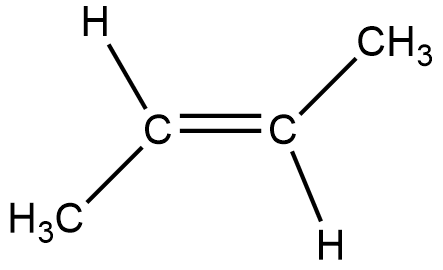
Now, after hydrogenation the double bond gets broken into a single bond, and thus both the carbon atoms get an extra hydrogen to comply with the reduced double bond.
The below given is the product after hydrogenation, which is just simple butane.

Thus, if any element or compound is subjected to a chemical reaction with molecular hydrogen, it undergoes hydrogenation and loses its triple bond to double bond and its double bond to single bond. Double hydrogenation on triple bonds can make it a single bond.
Note :
Any compound can reduce its double or triple bond to single through hydrogenation. There are other methods too, but this method is more reliable on most of the compounds.
Complete Step By Step Answer:
The product of hydrogenation of trans-2-butene is simple butane.
Hydrogenation is a reaction in which triple bonds get reduced to double bonds, and double bonds get reduced to single bonds. It is a chemical reaction in which molecular hydrogen and any other compound are subjected to a chemical reaction under the presence of a catalyst such as nickel, palladium or platinum.
Now, there is a double bond in the given compound i.e. trans-2-butene. As hydrogenation reduces the double bond to single, here also the same will happen.
The below given figure is of trans-2-butene.
Now, after hydrogenation the double bond gets broken into a single bond, and thus both the carbon atoms get an extra hydrogen to comply with the reduced double bond.
The below given is the product after hydrogenation, which is just simple butane.
Thus, if any element or compound is subjected to a chemical reaction with molecular hydrogen, it undergoes hydrogenation and loses its triple bond to double bond and its double bond to single bond. Double hydrogenation on triple bonds can make it a single bond.
Note :
Any compound can reduce its double or triple bond to single through hydrogenation. There are other methods too, but this method is more reliable on most of the compounds.
Recently Updated Pages
Which will be the least stable resonating structure class 11 chemistry CBSE

How many 5 digit telephone numbers can be construc-class-11-maths-CBSE
How do you find the angle of the resultant vector class 11 physics CBSE
Draw labelled diagram of the following i Gram seed class 11 biology CBSE
What is the need and importance of classification class 11 biology CBSE
The way in which the sparrows expressed their sorrow class 11 english CBSE
Trending doubts
One Metric ton is equal to kg A 10000 B 1000 C 100 class 11 physics CBSE
Find the value of the expression given below sin 30circ class 11 maths CBSE
1 Quintal is equal to a 110 kg b 10 kg c 100kg d 1000 class 11 physics CBSE
Draw a diagram of nephron and explain its structur class 11 biology CBSE
10 examples of friction in our daily life
Proton was discovered by A Thomson B Rutherford C Chadwick class 11 chemistry CBSE