




What product is formed in the treatment of cyclopentene with the bromine water?
(A) trans-3-bromocyclopentanol
(B) cis-2-bromocyclopentanol
(C) trans-2-bromocyclopentanol
(D) cis-3-bromocyclopentanol
Answer
 Verified
634.8k+ views
Hint: In order to answer the question, we must have an idea about different organic reactions that will be taking place. So, it will become easier to answer what will be the product formed when cyclopentene is treated with the bromine water. This reaction will be following Markovnikov’s rule.
Complete Solution :
The treatment of the cyclopentene with the bromine water is an electrophilic substitution reaction.
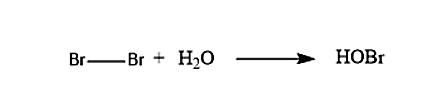
In the first step when the Bromine molecule and the water molecule reacts with each other, it will lead to the formation of the Bromohydrins. The reaction of the formation of the Bromohydrin is given below:
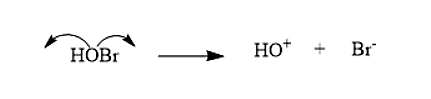
- The bromohydrin will break in such a way that the Halide is the negative species, i.e. \[B{r^ - }\], while the hydrin is the positive species i.e. \[H{O^ + }\]
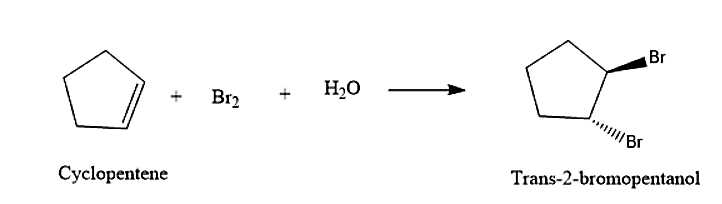
- The cyclopentene will react with the formed bromohydrin to give Trans-2-bromopentanol. The and will attack across the double bond. This reaction will be following Markovnikov’s rule. Formation of the Trans-2-bromopentanol is given below:
So, the correct answer is “Option C”.
Note: - Bromine water is usually used to test whether the given compound is saturated or unsaturated.
- Organic compounds such as alkene, phenols and aniline will undergo reaction with bromine water readily.
- When the colour of the bromine water changes, it will indicate the presence of an unsaturated compound.
Complete Solution :
The treatment of the cyclopentene with the bromine water is an electrophilic substitution reaction.
In the first step when the Bromine molecule and the water molecule reacts with each other, it will lead to the formation of the Bromohydrins. The reaction of the formation of the Bromohydrin is given below:
- The bromohydrin will break in such a way that the Halide is the negative species, i.e. \[B{r^ - }\], while the hydrin is the positive species i.e. \[H{O^ + }\]
- The cyclopentene will react with the formed bromohydrin to give Trans-2-bromopentanol. The and will attack across the double bond. This reaction will be following Markovnikov’s rule. Formation of the Trans-2-bromopentanol is given below:
So, the correct answer is “Option C”.
Note: - Bromine water is usually used to test whether the given compound is saturated or unsaturated.
- Organic compounds such as alkene, phenols and aniline will undergo reaction with bromine water readily.
- When the colour of the bromine water changes, it will indicate the presence of an unsaturated compound.
Recently Updated Pages
Which of the following graphs shows the variation of class 12 physics CBSE

Draw a labelled diagram of the human male reproductive class 12 biology CBSE
Describe the experiment to compare the emf of two cells class 12 physics CBSE
What is standard hydrogen electrode
What is conventional current and electric current class 12 physics CBSE
2Bromopentane is treated with an alcoholic KOH solution class 12 chemistry CBSE
Trending doubts
Draw a labelled sketch of the human eye class 12 physics CBSE
Which are the Top 10 Largest Countries of the World?
Differentiate between homogeneous and heterogeneous class 12 chemistry CBSE
Draw ray diagrams each showing i myopic eye and ii class 12 physics CBSE
Which is the correct genotypic ratio of mendel dihybrid class 12 biology CBSE
What is the Full Form of PVC, PET, HDPE, LDPE, PP and PS ?