




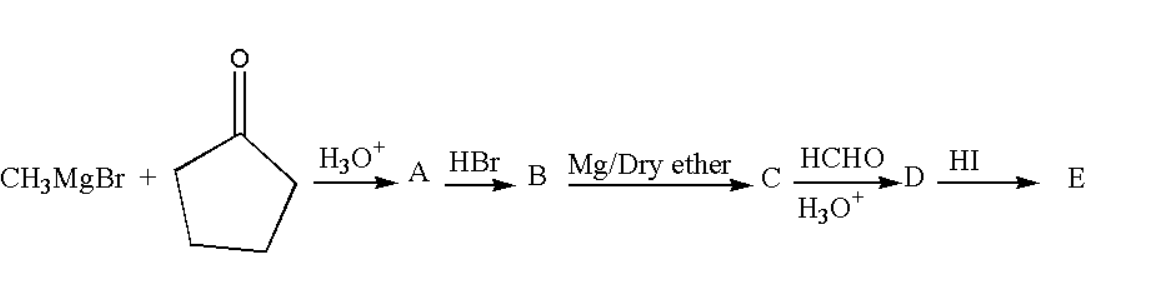
What is the product E in the following reaction?
Answer
 Verified
548.4k+ views
Hint: Here the sequence of reactions takes place. To solve such problems we have to start from the first product and then follow the steps and then predict the final product. There are various reagents in this sequence which behave in different manners. Solve them step by step.
Complete answer:
There is a sequence of reactions that takes place. Each forward reaction is connected to its preceding product. Thus we will solve each product and then reach the final product E.
Formation of A:
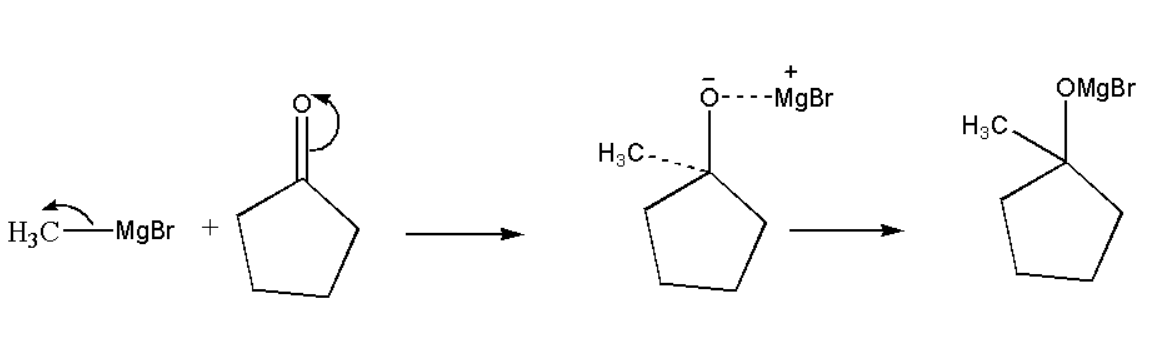
Methyl magnesium bromide is made to react with cyclopentanone to give product A. Methyl magnesium bromide is a Grignard reagent. Since cyclopentanone contains carboxyl group, therefore it will be an addition reaction as,
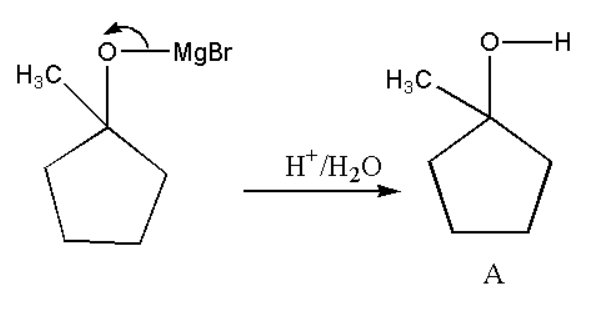
Now the formed product will react with \[{H_3}{O^ + }\] to form product A. This reaction is also known as hydrolysis reaction.
Formation of B:
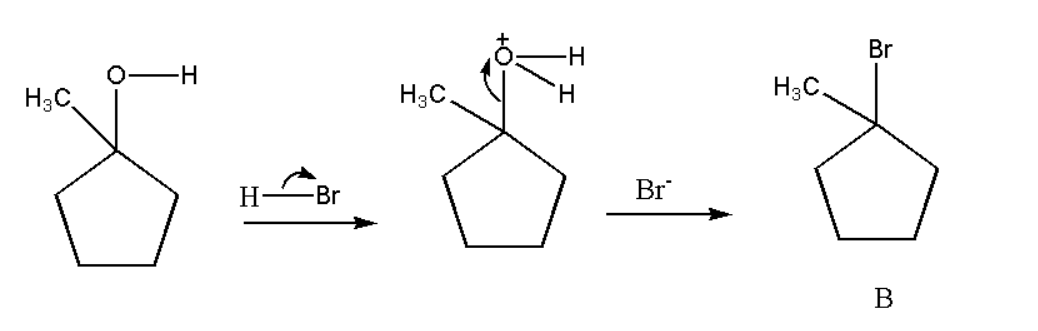
Now there will be replacement of the hydroxyl group with bromine when \[HBr\] is added to A.
Formation of C:
Since there is presence of bromine atom on the ring and when it react with magnesium in presence of dry ether it will again become a Grignard reagent as,
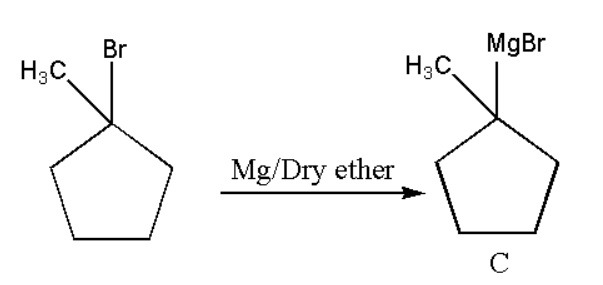
Formation of D:
Now the product C will react with formaldehyde in the presence of \[{H_3}{O^ + }\] which give us the following product,
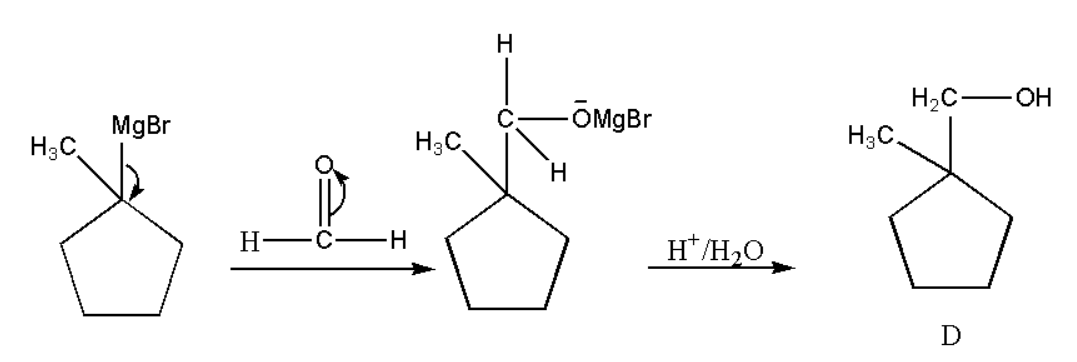
Formation of E:
Now when alcohol react with hydrogen iodide then it forms an alkyl halide which can be shown as,
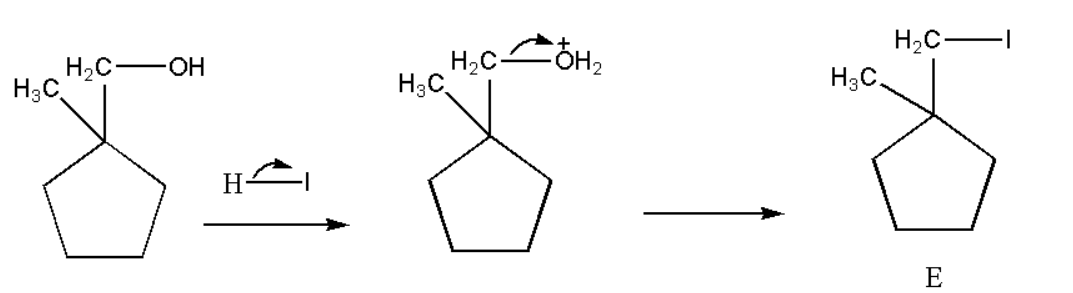
Hence the product formed E is identified.
Note:
We cannot skip any step to find the product E. We cannot directly find the termination step as this would give us the wrong answer. Hydrogen halides when reacted with alcohol give alkyl halides. Here alkyl iodide is formed. By understanding the mechanism of each reaction we can easily understand the product formation of each step.
Complete answer:
There is a sequence of reactions that takes place. Each forward reaction is connected to its preceding product. Thus we will solve each product and then reach the final product E.
Formation of A:
Methyl magnesium bromide is made to react with cyclopentanone to give product A. Methyl magnesium bromide is a Grignard reagent. Since cyclopentanone contains carboxyl group, therefore it will be an addition reaction as,
Now the formed product will react with \[{H_3}{O^ + }\] to form product A. This reaction is also known as hydrolysis reaction.
Formation of B:
Now there will be replacement of the hydroxyl group with bromine when \[HBr\] is added to A.
Formation of C:
Since there is presence of bromine atom on the ring and when it react with magnesium in presence of dry ether it will again become a Grignard reagent as,
Formation of D:
Now the product C will react with formaldehyde in the presence of \[{H_3}{O^ + }\] which give us the following product,
Formation of E:
Now when alcohol react with hydrogen iodide then it forms an alkyl halide which can be shown as,
Hence the product formed E is identified.
Note:
We cannot skip any step to find the product E. We cannot directly find the termination step as this would give us the wrong answer. Hydrogen halides when reacted with alcohol give alkyl halides. Here alkyl iodide is formed. By understanding the mechanism of each reaction we can easily understand the product formation of each step.
Recently Updated Pages
Basicity of sulphurous acid and sulphuric acid are

Master Class 11 English: Engaging Questions & Answers for Success
Master Class 11 Physics: Engaging Questions & Answers for Success
Master Class 11 Computer Science: Engaging Questions & Answers for Success
Master Class 11 Chemistry: Engaging Questions & Answers for Success
Master Class 11 Social Science: Engaging Questions & Answers for Success
Trending doubts
Difference Between Prokaryotic Cells and Eukaryotic Cells
Two of the body parts which do not appear in MRI are class 11 biology CBSE
One Metric ton is equal to kg A 10000 B 1000 C 100 class 11 physics CBSE
10 examples of friction in our daily life
Draw a diagram of nephron and explain its structur class 11 biology CBSE
What will happen if the mucus is not secreted by the class 11 biology CBSE