




What is the principle of electric motors?
Answer
 Verified
566.6k+ views
Hint: As the name suggests, an electric motor runs through electricity flowing through a wire, which creates a magnetic field and that magnetic field induces emf in the motor due to which a current starts to flow and the motor shaft starts to rotate.
Complete step by step solution:
An electrical machine through which we can convert electrical energy into mechanical energy is called an electric motor. A force is generated due to the interaction between the magnetic field of the motor and the current flowing through a wire winding. This force acts as a torque on the motor shaft and makes it rotate.
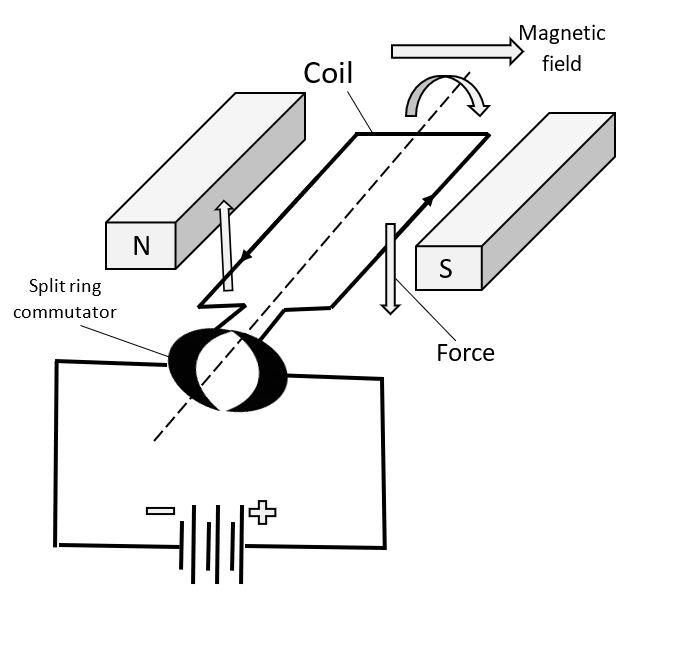
The functioning of an electric motor is primarily based on Ampere’s law, that a force will act on a conductor having a current flowing through it and has been placed in a magnetic field. If we bend a conductor into a frame and place it in a magnetic field such that the two sides of the frame at right angles to the magnetic field will experience a force F directed opposite to each other. Thus, these forces will generate a moment of force or torque due to which the frame will start to rotate. To provide greater constant torque, the armature of the motor has several turns.
The generation of magnetic fields can be done by both magnets or electromagnets. The electromagnets are generally composed of a wire wound over a core. And thus, according to Faraday's law of induction, a current in the windings of the electromagnet will be induced by the current flowing through the frames which will then generate a magnetic field.
Hence, an electric motor works on the principle which states that when a rectangular coil is placed in a magnetic field with current passing through it, a torque is generated on the coil making it rotate.
Note: Contrary to an electric motor, a generator converts mechanical energy to electrical energy and in motors also, a back emf is generated due to the magnetic field inside the coil and it acts against the applied voltage.
Complete step by step solution:
An electrical machine through which we can convert electrical energy into mechanical energy is called an electric motor. A force is generated due to the interaction between the magnetic field of the motor and the current flowing through a wire winding. This force acts as a torque on the motor shaft and makes it rotate.
The functioning of an electric motor is primarily based on Ampere’s law, that a force will act on a conductor having a current flowing through it and has been placed in a magnetic field. If we bend a conductor into a frame and place it in a magnetic field such that the two sides of the frame at right angles to the magnetic field will experience a force F directed opposite to each other. Thus, these forces will generate a moment of force or torque due to which the frame will start to rotate. To provide greater constant torque, the armature of the motor has several turns.
The generation of magnetic fields can be done by both magnets or electromagnets. The electromagnets are generally composed of a wire wound over a core. And thus, according to Faraday's law of induction, a current in the windings of the electromagnet will be induced by the current flowing through the frames which will then generate a magnetic field.
Hence, an electric motor works on the principle which states that when a rectangular coil is placed in a magnetic field with current passing through it, a torque is generated on the coil making it rotate.
Note: Contrary to an electric motor, a generator converts mechanical energy to electrical energy and in motors also, a back emf is generated due to the magnetic field inside the coil and it acts against the applied voltage.
Recently Updated Pages
Master Class 12 Business Studies: Engaging Questions & Answers for Success

Master Class 12 Chemistry: Engaging Questions & Answers for Success
Master Class 12 Biology: Engaging Questions & Answers for Success
Class 12 Question and Answer - Your Ultimate Solutions Guide
Master Class 11 English: Engaging Questions & Answers for Success
Master Class 11 Social Science: Engaging Questions & Answers for Success
Trending doubts
Explain the Treaty of Vienna of 1815 class 10 social science CBSE
What is the full form of CNG A Complete Natural Gas class 10 social science CBSE
In cricket, what is a "Yorker" designed to do?
What is the full form of POSCO class 10 social science CBSE
Define Potential, Developed, Stock and Reserved resources
What were the majoritarian measures taken in Sri Lanka class 10 social science CBSE