




How to prepare 1-phenyl-3-methyl-2-butanol?
Answer
 Verified
586.8k+ views
Hint: Aromatic compounds (benzene) can have carbon chain added through Friedal-crafts reactions. Organolithium reagents help in nucleophilic addition reactions. Sodium borohydrides are used as reducing agents for carbonyl compounds.
Complete answer:
We have been given to write about the preparation method of 1-phenyl-3-methyl-2-butanol. As the name suggests, this compound contains a benzene ring with a 4-carbon chain on the first carbon of benzene. This 4-carbon chain has a methyl group on carbon-3 and a hydroxyl group on carbon-2, which makes it a secondary alcohol.
The preparation of 1-phenyl-3-methyl-2-butanol involves friedel-craft acylation of benzene employing a catalyst used to synthesis organic compounds called oxalyl chloride\[(COC{{l}_{2}})\] that helps its formation into a carbon chain on position-1. Then the carbonyl adjacent from the benzene on this carbon chain is reduced, while the other carbonyl is unaffected. Then an organolithium reagent $({{C}_{3}}{{H}_{8}}Li)$ is used to carry a nucleophilic addition that removes the chloride group. The last step involves the use of a reducing agent, sodium borohydride $(NaB{{H}_{4}})$ and water that converts the carbonyl into secondary alcohol. Water helps in the addition of the hydrogen to the oxygen anion. The reaction is as follows:
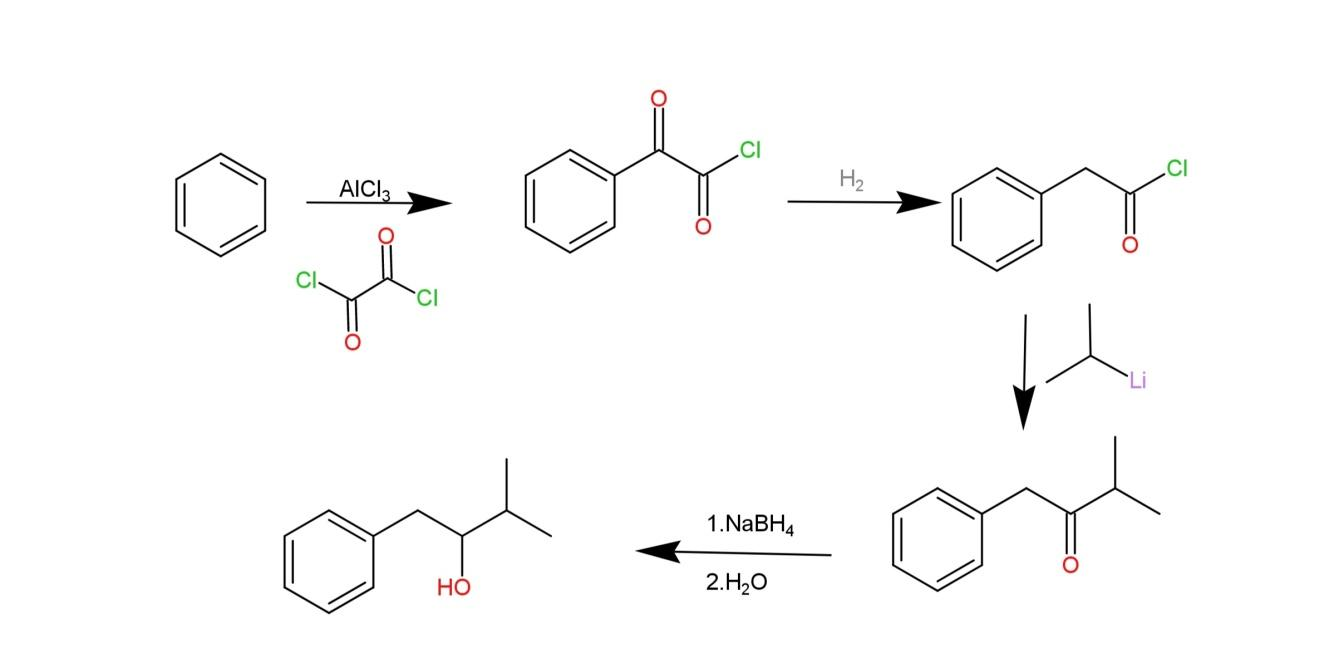
Hence, through the above reaction we can prepare 1-phenyl-3-methyl-2-butanol.
Note:
Friedel-crafts acylation is used in this reaction because; we have to obtain a secondary alcohol, which can be formed from the acyl group. While, friedel-crafts alkylation will be involved if we have to add up only a carbon chain to the benzene ring.
Complete answer:
We have been given to write about the preparation method of 1-phenyl-3-methyl-2-butanol. As the name suggests, this compound contains a benzene ring with a 4-carbon chain on the first carbon of benzene. This 4-carbon chain has a methyl group on carbon-3 and a hydroxyl group on carbon-2, which makes it a secondary alcohol.
The preparation of 1-phenyl-3-methyl-2-butanol involves friedel-craft acylation of benzene employing a catalyst used to synthesis organic compounds called oxalyl chloride\[(COC{{l}_{2}})\] that helps its formation into a carbon chain on position-1. Then the carbonyl adjacent from the benzene on this carbon chain is reduced, while the other carbonyl is unaffected. Then an organolithium reagent $({{C}_{3}}{{H}_{8}}Li)$ is used to carry a nucleophilic addition that removes the chloride group. The last step involves the use of a reducing agent, sodium borohydride $(NaB{{H}_{4}})$ and water that converts the carbonyl into secondary alcohol. Water helps in the addition of the hydrogen to the oxygen anion. The reaction is as follows:
Hence, through the above reaction we can prepare 1-phenyl-3-methyl-2-butanol.
Note:
Friedel-crafts acylation is used in this reaction because; we have to obtain a secondary alcohol, which can be formed from the acyl group. While, friedel-crafts alkylation will be involved if we have to add up only a carbon chain to the benzene ring.
Recently Updated Pages
Master Class 11 English: Engaging Questions & Answers for Success

Master Class 11 Physics: Engaging Questions & Answers for Success
Master Class 11 Computer Science: Engaging Questions & Answers for Success
Master Class 11 Chemistry: Engaging Questions & Answers for Success
Master Class 11 Social Science: Engaging Questions & Answers for Success
Master Class 11 Accountancy: Engaging Questions & Answers for Success
Trending doubts
Difference Between Prokaryotic Cells and Eukaryotic Cells
Two of the body parts which do not appear in MRI are class 11 biology CBSE
One Metric ton is equal to kg A 10000 B 1000 C 100 class 11 physics CBSE
10 examples of friction in our daily life
Draw a diagram of nephron and explain its structur class 11 biology CBSE
Draw a diagram of a plant cell and label at least eight class 11 biology CBSE