




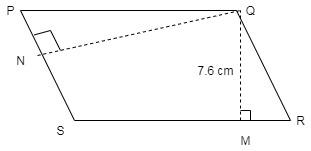
PQRS is a parallelogram. QM is the height from Q to SR and QN is the height from Q to PS. If SR = 12 cm and QM = 7.6 cm. Find the area of the parallelogram PQRS.
Answer
 Verified
629.1k+ views
Hint: We will solve this question by noting down all the given information in the question. By using the given figure and the formula of Area of the Parallelogram, i.e., Base \[ \times \] Height, and by putting the values in formula. We will get the result.
Complete step-by-step answer:
Given, PQRS is a Parallelogram, in which QM is the height from Q to SR and QN is the height from Q to PS.
We have SR = 12 cm and QM = 7.6cm.
Now, we have to find the area of parallelogram PQRS.
As the area of the parallelogram can be calculated by the formula i.e.
Area Of The Parallelogram = Base \[ \times \] Height
As shown in the figure,
Base = SR,
Height = QM
Therefore, the formula becomes,
Area of the Parallelogram = SR \[ \times \] QM
Now, by substituting the values of SR and QM from the question, we obtain
Area of the Parallelogram = 12 \[ \times \] 7.6
= 12 \[ \times \] \[\dfrac{{76}}{{10}}\]
By multiplication, we get
= \[\dfrac{{912}}{{10}}\]
= \[91.2c{m^2}\]
Hence, the area of the Parallelogram is \[91.2c{m^2}\].
Note – A Parallelogram is a four-sided rectilinear figure whose opposite or facing sides are of equal length and the opposite angles are of equal measure. While solving these kinds of questions, one should be clear and sure about the formula, otherwise there are chances of mixing up the different formulas. Hence, we don’t know the value of QN and PS so this is the only way to obtain the answer.
Complete step-by-step answer:
Given, PQRS is a Parallelogram, in which QM is the height from Q to SR and QN is the height from Q to PS.
We have SR = 12 cm and QM = 7.6cm.
Now, we have to find the area of parallelogram PQRS.
As the area of the parallelogram can be calculated by the formula i.e.
Area Of The Parallelogram = Base \[ \times \] Height
As shown in the figure,
Base = SR,
Height = QM
Therefore, the formula becomes,
Area of the Parallelogram = SR \[ \times \] QM
Now, by substituting the values of SR and QM from the question, we obtain
Area of the Parallelogram = 12 \[ \times \] 7.6
= 12 \[ \times \] \[\dfrac{{76}}{{10}}\]
By multiplication, we get
= \[\dfrac{{912}}{{10}}\]
= \[91.2c{m^2}\]
Hence, the area of the Parallelogram is \[91.2c{m^2}\].
Note – A Parallelogram is a four-sided rectilinear figure whose opposite or facing sides are of equal length and the opposite angles are of equal measure. While solving these kinds of questions, one should be clear and sure about the formula, otherwise there are chances of mixing up the different formulas. Hence, we don’t know the value of QN and PS so this is the only way to obtain the answer.
Recently Updated Pages
Master Class 10 Social Science: Engaging Questions & Answers for Success

Master Class 10 Science: Engaging Questions & Answers for Success
Master Class 10 Maths: Engaging Questions & Answers for Success
Master Class 10 General Knowledge: Engaging Questions & Answers for Success
Master Class 10 Computer Science: Engaging Questions & Answers for Success
Class 10 Question and Answer - Your Ultimate Solutions Guide
Trending doubts
What is the full form of PNG A Petrol Natural Gas B class 10 chemistry CBSE
Explain the Treaty of Vienna of 1815 class 10 social science CBSE
In cricket, how many legal balls are there in a standard over?
Why is there a time difference of about 5 hours between class 10 social science CBSE
Who Won 36 Oscar Awards? Record Holder Revealed
What is the median of the first 10 natural numbers class 10 maths CBSE