




PQR is a triangular park with $PQ=PR=200\text{ m}$ . A T.V. tower stands in the mid-point of $QR$. If the angles of elevation of the top of the tower at $P, Q$ and $R$ are respectively ${{45}^{0}},{{30}^{0}}$ and ${{30}^{0}}$, then the height of the tower (in m) is.
(a) $100\sqrt{3}$
(b) $50\sqrt{2}$
(c) $100$
(d) $50$
Answer
 Verified
640.5k+ views
Hint: For solving this question first we will plot the geometrical figures as per the given condition then we will try to solve for the height of the tower by using some trigonometric ratios and Pythagoras theorem.
Complete step-by-step solution
Given:
It is given that $PQR$ is a triangular park with $PQ=PR=200\text{ m}$ . A T.V. tower stands in the mid-point of $QR$.
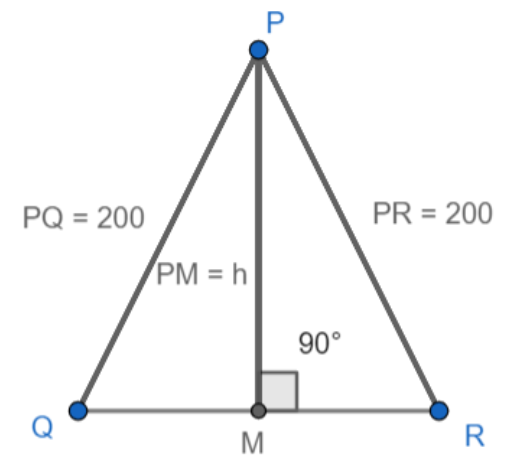
Now, let $M$ is the midpoint of $QR$ then, $PM$ will be perpendicular to the side $QR$ as $\Delta PQR$ is an isosceles triangle in which $PQ=PR=200\text{ m}$.
Now, the figure of the triangular park is shown below:
Now, before proceeding further just take a look at the result of the Pythagoras Theorem. The Pythagoras Theorem states that in a right-angled triangle as shown below $\Delta ABC$, the square of the hypotenuse is equal to the sum of the squares of the other two sides.
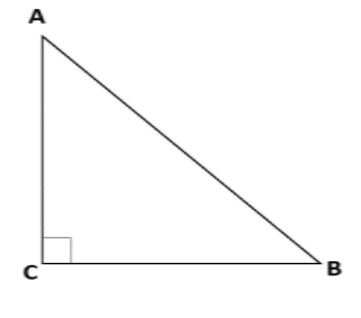
In the $\Delta ABC$ , $\angle ACB={{90}^{0}}$ and AB is the hypotenuse, BC is the base and AC is the perpendicular. From Pythagoras Theorem, we have:
${{\left( BC \right)}^{2}}+{{\left( AC \right)}^{2}}={{\left( AB \right)}^{2}}$
Then, we can write, ${{\left( base \right)}^{2}}+{{\left( perpendicular \right)}^{2}}={{\left( hypotenuse \right)}^{2}}$ .
Now, as $\Delta PMQ$ is a right-angled triangle, we can apply the result of Pythagoras theorem in that triangle. In the $\Delta PMR$ , $\angle PMQ={{90}^{0}}$ and the side $PQ=200$ is the hypotenuse. Then,
$\begin{align}
& {{\left( PQ \right)}^{2}}={{\left( PM \right)}^{2}}+{{\left( MQ \right)}^{2}} \\
& \Rightarrow {{200}^{2}}={{\left( PM \right)}^{2}}+{{\left( MQ \right)}^{2}}..............\left( 1 \right) \\
\end{align}$
Now, let the height of the tower is $h$ m and it is given that If the angles of elevation of the top of the tower at $P, Q$ and $R$ are respectively ${{45}^{0}},{{30}^{0}}$ and ${{30}^{0}}$. Let, $T$ is the top point of the tower. Then, we can plot the following figures:
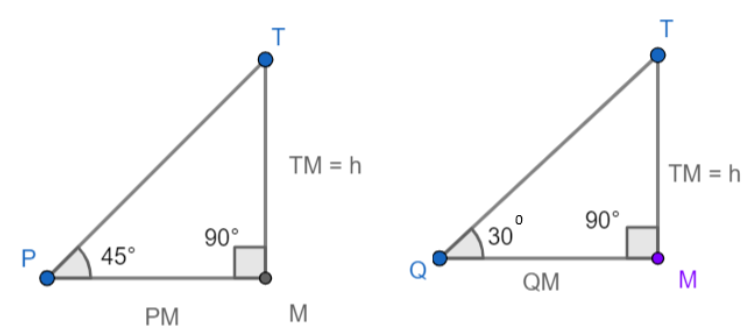
Now, we can find the length of $PM$ and $MQ$ in terms of h. Then,
$\begin{align}
& \tan {{45}^{0}}=\dfrac{TM}{PM}=1 \\
& \Rightarrow PM=TM=h..........\left( 2 \right) \\
& \tan {{30}^{0}}=\dfrac{TM}{MQ}=\dfrac{1}{\sqrt{3}} \\
& \Rightarrow MQ=TM\sqrt{3}=h\sqrt{3}..........\left( 3 \right) \\
\end{align}$
Now, substituting $PM=h$ from equation (2) and $MQ=h\sqrt{3}$ from equation (3) in equation (1). Then,
$\begin{align}
& {{200}^{2}}={{\left( PM \right)}^{2}}+{{\left( MQ \right)}^{2}} \\
& \Rightarrow {{200}^{2}}={{h}^{2}}+3{{h}^{2}} \\
& \Rightarrow {{200}^{2}}=4{{h}^{2}} \\
& \Rightarrow {{\left( 2h \right)}^{2}}={{200}^{2}} \\
& \Rightarrow 2h=200 \\
& \Rightarrow h=100 \\
\end{align}$
Thus, from the above result, we can say that height of the T.V. the tower will be 100 m.
Hence, (c) is the correct option.
Note: Here, the student should use the geometrical properties of the isosceles triangle and we should know how to apply Pythagoras Theorem in case of any right-angled triangle and then apply every formula very carefully and find the answer.
Complete step-by-step solution
Given:
It is given that $PQR$ is a triangular park with $PQ=PR=200\text{ m}$ . A T.V. tower stands in the mid-point of $QR$.
Now, let $M$ is the midpoint of $QR$ then, $PM$ will be perpendicular to the side $QR$ as $\Delta PQR$ is an isosceles triangle in which $PQ=PR=200\text{ m}$.
Now, the figure of the triangular park is shown below:
Now, before proceeding further just take a look at the result of the Pythagoras Theorem. The Pythagoras Theorem states that in a right-angled triangle as shown below $\Delta ABC$, the square of the hypotenuse is equal to the sum of the squares of the other two sides.
In the $\Delta ABC$ , $\angle ACB={{90}^{0}}$ and AB is the hypotenuse, BC is the base and AC is the perpendicular. From Pythagoras Theorem, we have:
${{\left( BC \right)}^{2}}+{{\left( AC \right)}^{2}}={{\left( AB \right)}^{2}}$
Then, we can write, ${{\left( base \right)}^{2}}+{{\left( perpendicular \right)}^{2}}={{\left( hypotenuse \right)}^{2}}$ .
Now, as $\Delta PMQ$ is a right-angled triangle, we can apply the result of Pythagoras theorem in that triangle. In the $\Delta PMR$ , $\angle PMQ={{90}^{0}}$ and the side $PQ=200$ is the hypotenuse. Then,
$\begin{align}
& {{\left( PQ \right)}^{2}}={{\left( PM \right)}^{2}}+{{\left( MQ \right)}^{2}} \\
& \Rightarrow {{200}^{2}}={{\left( PM \right)}^{2}}+{{\left( MQ \right)}^{2}}..............\left( 1 \right) \\
\end{align}$
Now, let the height of the tower is $h$ m and it is given that If the angles of elevation of the top of the tower at $P, Q$ and $R$ are respectively ${{45}^{0}},{{30}^{0}}$ and ${{30}^{0}}$. Let, $T$ is the top point of the tower. Then, we can plot the following figures:
Now, we can find the length of $PM$ and $MQ$ in terms of h. Then,
$\begin{align}
& \tan {{45}^{0}}=\dfrac{TM}{PM}=1 \\
& \Rightarrow PM=TM=h..........\left( 2 \right) \\
& \tan {{30}^{0}}=\dfrac{TM}{MQ}=\dfrac{1}{\sqrt{3}} \\
& \Rightarrow MQ=TM\sqrt{3}=h\sqrt{3}..........\left( 3 \right) \\
\end{align}$
Now, substituting $PM=h$ from equation (2) and $MQ=h\sqrt{3}$ from equation (3) in equation (1). Then,
$\begin{align}
& {{200}^{2}}={{\left( PM \right)}^{2}}+{{\left( MQ \right)}^{2}} \\
& \Rightarrow {{200}^{2}}={{h}^{2}}+3{{h}^{2}} \\
& \Rightarrow {{200}^{2}}=4{{h}^{2}} \\
& \Rightarrow {{\left( 2h \right)}^{2}}={{200}^{2}} \\
& \Rightarrow 2h=200 \\
& \Rightarrow h=100 \\
\end{align}$
Thus, from the above result, we can say that height of the T.V. the tower will be 100 m.
Hence, (c) is the correct option.
Note: Here, the student should use the geometrical properties of the isosceles triangle and we should know how to apply Pythagoras Theorem in case of any right-angled triangle and then apply every formula very carefully and find the answer.
Recently Updated Pages
Differentiate between voluntary action and reflex class 10 biology CBSE

The uses of bleaching powder are A It is used bleaching class 10 chemistry CBSE
Fill in the blanks with abstract nouns of the words class 10 english CBSE
How many threedigit numbers are there class 10 maths CBSE
What is a reflex arc class 10 biology CBSE
Construct a square whose diagonal is 6cm Measure the class 10 maths CBSE
Trending doubts
Explain the Treaty of Vienna of 1815 class 10 social science CBSE
The slogan Jai Hind was given by A Lal Bahadur Shastri class 10 social science CBSE
10 examples of evaporation in daily life with explanations
Identify the feminine form of noun nephew a shenephew class 10 english CBSE
CSIR full form?
Make a sketch of the human nerve cell What function class 10 biology CBSE