




Polymorphism is well marked in the members of class
(a)Anthozoa
(b)Scyphozoa
(c)Sporozoa
(d)Hydrozoa
Answer
 Verified
610.8k+ views
Hint: The phenomenon of occurrence of an individual in two or more distinct morphological and functional forms is termed as polymorphism. Additionally, it is an important feature of phylum coelenterata. Their life-cycle consists of two main forms called polyp and medusa.
Complete answer:
Coelenterates are classified into four different classes:
-Class Anthozoa: Contains all cnidarians that display a polyp body plan only, meaning there’s no medusa stage within their life cycle. Examples: sea anemones, sea pens, and corals.
-Class Hydrozoa: Mostly contains marine species although some freshwater species are also known. Animals belonging to this class are polymorphs, that display both polypoid and medusoid forms in their lifecycle.
-Class Cubozoa: This class includes jellies that have a box-shaped medusa hence, are referred to as “box jellyfish.” Some species of box jellyfish produce extremely potent venom: Chironex fleckeri, Carukia barnesi and Malo kingi
-Class Scyphozoa: Mostly contains all the jellies. The defining characteristic of this class is that the medusa is the prominent stage within the life cycle, although there’s a polyp stage present. Only Hydrozoa and Scyphozoa show polymorphic forms in their life cycle ( i.e they exist in two forms: polyp and medusa).
Additional information:
Hydrozoa exists in two forms- polyps and medusa
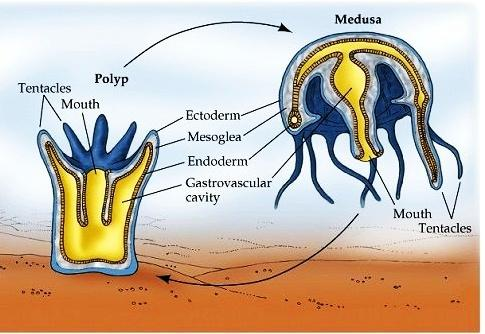
In Hydrozoa, polyps feature a tubular body with a mouth surrounded by tentacles at one end. Another end is generally attached to the pedal disc to the substratum. They exist commonly as sessile organisms and are asexual whereas medusa features a bowl or umbrella- shaped body with marginal tentacles and mouth centrally located on a projection called manubrium. They’re generally motile and reproduce sexually.
So, the correct answer is option ‘Hydrozoa’.
Notes: Importance of polymorphism:
Different functions are assigned to different forms. For examples; polyps are usually concerned with feeding, protection and asexual reproduction whereas medusa are concerned with sexual reproduction.
Complete answer:
Coelenterates are classified into four different classes:
-Class Anthozoa: Contains all cnidarians that display a polyp body plan only, meaning there’s no medusa stage within their life cycle. Examples: sea anemones, sea pens, and corals.
-Class Hydrozoa: Mostly contains marine species although some freshwater species are also known. Animals belonging to this class are polymorphs, that display both polypoid and medusoid forms in their lifecycle.
-Class Cubozoa: This class includes jellies that have a box-shaped medusa hence, are referred to as “box jellyfish.” Some species of box jellyfish produce extremely potent venom: Chironex fleckeri, Carukia barnesi and Malo kingi
-Class Scyphozoa: Mostly contains all the jellies. The defining characteristic of this class is that the medusa is the prominent stage within the life cycle, although there’s a polyp stage present. Only Hydrozoa and Scyphozoa show polymorphic forms in their life cycle ( i.e they exist in two forms: polyp and medusa).
Additional information:
Hydrozoa exists in two forms- polyps and medusa
In Hydrozoa, polyps feature a tubular body with a mouth surrounded by tentacles at one end. Another end is generally attached to the pedal disc to the substratum. They exist commonly as sessile organisms and are asexual whereas medusa features a bowl or umbrella- shaped body with marginal tentacles and mouth centrally located on a projection called manubrium. They’re generally motile and reproduce sexually.
So, the correct answer is option ‘Hydrozoa’.
Notes: Importance of polymorphism:
Different functions are assigned to different forms. For examples; polyps are usually concerned with feeding, protection and asexual reproduction whereas medusa are concerned with sexual reproduction.
Recently Updated Pages
Master Class 5 English: Engaging Questions & Answers for Success

Master Class 5 Maths: Engaging Questions & Answers for Success
Master Class 5 Social Science: Engaging Questions & Answers for Success
Master Class 5 Science: Engaging Questions & Answers for Success
Class 5 Question and Answer - Your Ultimate Solutions Guide
Master Class 9 General Knowledge: Engaging Questions & Answers for Success
Trending doubts
One Metric ton is equal to kg A 10000 B 1000 C 100 class 11 physics CBSE
What is cell theory Who formulated it class 11 biology CBSE
Phyllotaxy is the arrangement of ALeaflets BLeaves class 11 biology CBSE
Difference Between Prokaryotic Cells and Eukaryotic Cells
The symbiotic association of fungi and algae is called class 11 biology CBSE
Cell theory was formulated by A Schleiden and Schwann class 11 biology CBSE