




What is polygenic inheritance? explain with the help of a suitable example.
How are pleiotropy and Mendelian patterns of inheritance different from polygenic inheritance?
Answer
 Verified
514.8k+ views
Hint: When more than one gene controls a character, it is called polygenic inheritance. The Mendelian pattern of inheritance revolves around the law of segregation of gametes, the law of independent assortment, and the law of dominance, providing a clear ratio. There is no statement regarding the mixing of two characters. So, one gene controls one trait. Pleiotropy is a concept when multiple characters are controlled by one gene.
Complete answer:
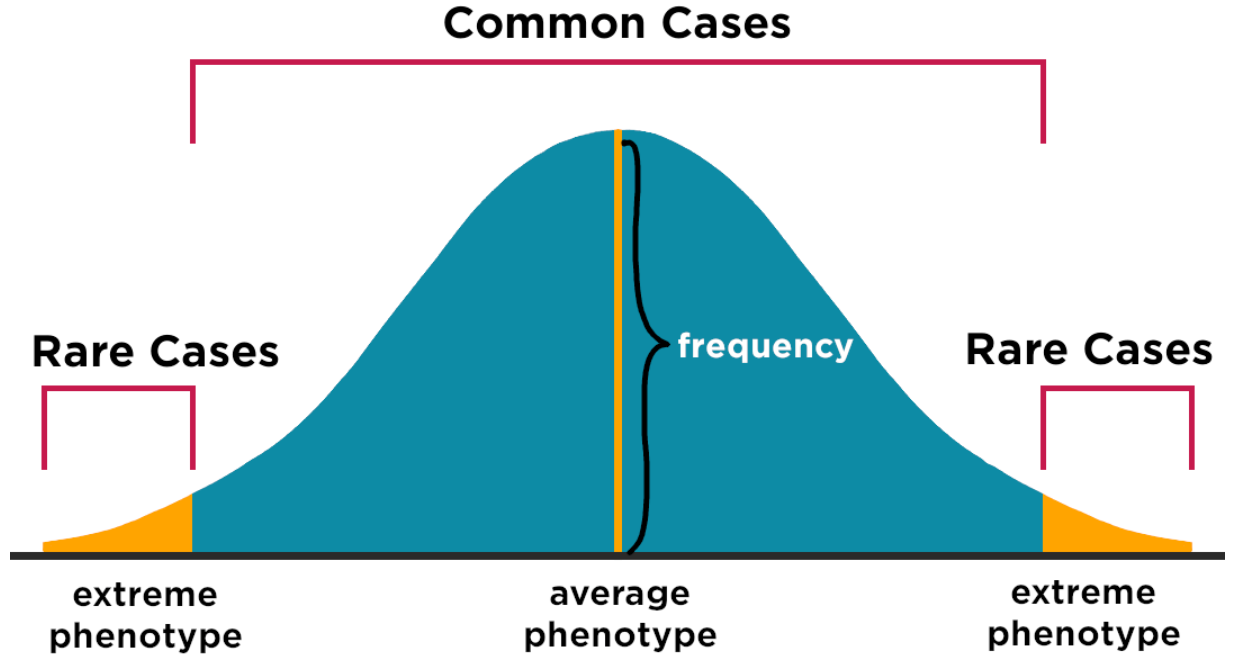
Fig: Distribution of Polygenic Traits
When two or more different pairs of alleles have a cumulative effect on governing quantitative characters, polygenic inheritance becomes quantitative inheritance. The green color in wheat and white spots in mice are examples of polygenic inheritance.
Human skin color is caused by a pigment called melanin. The melanin’s quantity is because of three pairs of polygenes (A, B, C). Due to the presence of dominant alleles (AABBCC), the color of the skin is black or very dark. Very light color is caused by recessive alleles (aabbcc). Intermediate color is due to the marriage between dark color and light color individuals, which is observed in generation. The offspring is called mulatto. When two individuals of intermediate colors marry, the skin color of offspring will vary from very dark to white.
The following table exhibits the differences between pleiotropy, Mendelian pattern of inheritance, and polygenic inheritance:
Note:
Another example of polygenic inheritance is the growth rate. The growth rate is controlled by several genes, which act in a complex cascade. Another example of pleiotropy is the gene that controls the level of testosterone. For the development of secondary sexual characteristics, testosterone is primarily responsible. Besides, it is also a reason for both behavioral and morphological traits.
Complete answer:
Fig: Distribution of Polygenic Traits
When two or more different pairs of alleles have a cumulative effect on governing quantitative characters, polygenic inheritance becomes quantitative inheritance. The green color in wheat and white spots in mice are examples of polygenic inheritance.
Human skin color is caused by a pigment called melanin. The melanin’s quantity is because of three pairs of polygenes (A, B, C). Due to the presence of dominant alleles (AABBCC), the color of the skin is black or very dark. Very light color is caused by recessive alleles (aabbcc). Intermediate color is due to the marriage between dark color and light color individuals, which is observed in generation. The offspring is called mulatto. When two individuals of intermediate colors marry, the skin color of offspring will vary from very dark to white.
The following table exhibits the differences between pleiotropy, Mendelian pattern of inheritance, and polygenic inheritance:
| Pleiotropy | Mendelian pattern of inheritance | Polygenic inheritance |
| It is a concept where a single gene displays multiple phenotypic expressions. | It is a kind of inheritance, in which traits are controlled by a pair of genes. | It is a type of inheritance, where traits are controlled by three or more genes. |
| Metabolic pathways are affected by the pleiotropic gene, which results in generation of different phenotypes. | Without any blending, the phenotype is of either a dominant allele or recessive allele. | There is a contribution of each allele along with the influence of environment in the phenotype. |
| Example is phenylketonuria. | Example: Tall plant and short plant. | Example: Skin color in humans. |
Note:
Another example of polygenic inheritance is the growth rate. The growth rate is controlled by several genes, which act in a complex cascade. Another example of pleiotropy is the gene that controls the level of testosterone. For the development of secondary sexual characteristics, testosterone is primarily responsible. Besides, it is also a reason for both behavioral and morphological traits.
Recently Updated Pages
Master Class 12 Business Studies: Engaging Questions & Answers for Success

Master Class 12 Biology: Engaging Questions & Answers for Success
Master Class 12 Chemistry: Engaging Questions & Answers for Success
Class 12 Question and Answer - Your Ultimate Solutions Guide
Master Class 11 English: Engaging Questions & Answers for Success
Master Class 11 Social Science: Engaging Questions & Answers for Success
Trending doubts
Which are the Top 10 Largest Countries of the World?
Draw a labelled sketch of the human eye class 12 physics CBSE
Differentiate between homogeneous and heterogeneous class 12 chemistry CBSE
Why is the cell called the structural and functional class 12 biology CBSE
Draw ray diagrams each showing i myopic eye and ii class 12 physics CBSE
Which is the correct genotypic ratio of mendel dihybrid class 12 biology CBSE