




Point charge (+q) is kept in the vicinity of an uncharged conducting plate, sketch electric field lines between the charge and the plate.
Answer
 Verified
510.6k+ views
Hint: Conductors are basically the materials which contain free electrons. They are electrically neutral, but the electrons are free to move inside the conductors. This feature is something which differentiates them from nonmetals which do not contain free electrons. Due to this the free electron moves toward or away from the charges put in front of them.
Complete answer:
When the Positive charge is placed in front of the metal i.e., the conducting material the electron inside the material tries to move toward the positive charge placed outside the material. Since electrons cannot jump outside the material, they move towards the face of the material facing the positive charge.
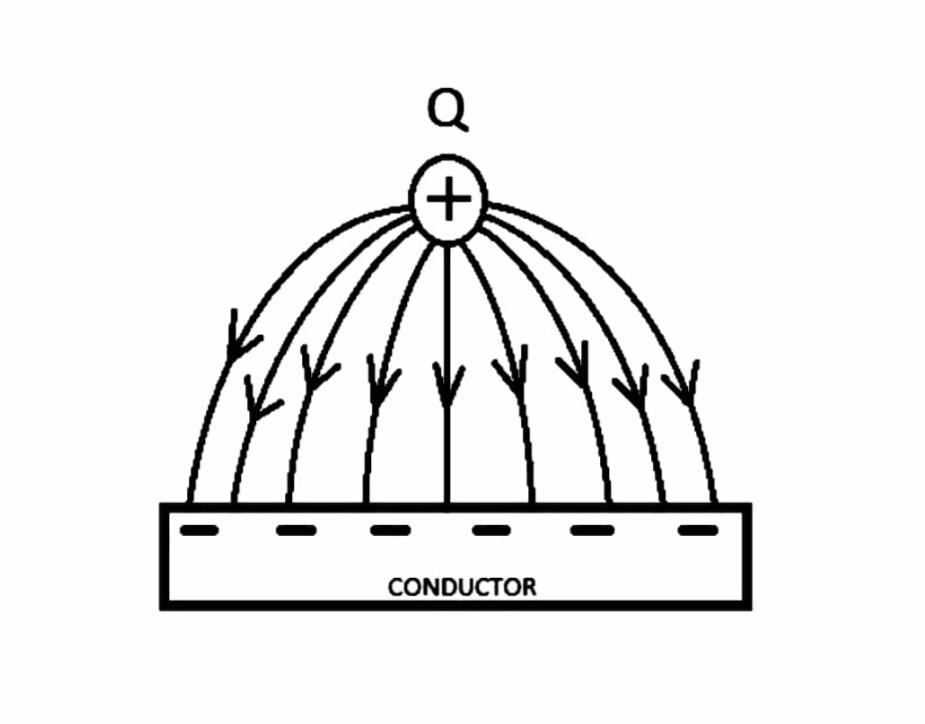
The above picture suggests that the positive charge Q is placed above the conductor and there for the electrons inside the conductor moves towards the surface of the conductor and due to this the positive charge Q and the metal plate i.e. the conductor attracts each other and the electric lines of force seem to be formed as shown in the figure above.
Note:
Any kind of conductor having no net charge when introduced to a positive or negative charge they acquire opposite charges in front and at the end of their faces, which leads to the attraction between charges and conductor. If they have a negative or a positive charge before introduction to conductors, then they may get attracted or repelled depending upon the magnitude of the charge introduced and the charge on the conductor.
Complete answer:
When the Positive charge is placed in front of the metal i.e., the conducting material the electron inside the material tries to move toward the positive charge placed outside the material. Since electrons cannot jump outside the material, they move towards the face of the material facing the positive charge.
The above picture suggests that the positive charge Q is placed above the conductor and there for the electrons inside the conductor moves towards the surface of the conductor and due to this the positive charge Q and the metal plate i.e. the conductor attracts each other and the electric lines of force seem to be formed as shown in the figure above.
Note:
Any kind of conductor having no net charge when introduced to a positive or negative charge they acquire opposite charges in front and at the end of their faces, which leads to the attraction between charges and conductor. If they have a negative or a positive charge before introduction to conductors, then they may get attracted or repelled depending upon the magnitude of the charge introduced and the charge on the conductor.
Recently Updated Pages
Master Class 12 Economics: Engaging Questions & Answers for Success

Master Class 12 English: Engaging Questions & Answers for Success
Master Class 12 Social Science: Engaging Questions & Answers for Success
Master Class 12 Maths: Engaging Questions & Answers for Success
Master Class 12 Physics: Engaging Questions & Answers for Success
Master Class 11 Social Science: Engaging Questions & Answers for Success
Trending doubts
One Metric ton is equal to kg A 10000 B 1000 C 100 class 11 physics CBSE
Difference Between Prokaryotic Cells and Eukaryotic Cells
Find the value of the expression given below sin 30circ class 11 maths CBSE
Two of the body parts which do not appear in MRI are class 11 biology CBSE
Draw a diagram of nephron and explain its structur class 11 biology CBSE
10 examples of friction in our daily life