




Pneumatophores are covered by cork. How do these roots help in gaseous exchange?
Answer
 Verified
605.1k+ views
Hint: Roots are the important organ of the plants. This helps in absorbing the minerals and the water from the soil with the help of root hairs present in them. The water from the roots are transported to the leaves with the help of xylem for the use of photosynthesis.
Complete answer:
The pneumatophores are the respiratory root or the knee roots that are in the modified form of the tap root system. These are mainly seen in the crops that are mainly located in the saline soil and the mangrove regions. These roots present upright and aerial in nature. They grow two to three centimeters above the water. Hence it resembles the negative geotropism by growing in the direction opposite to the gravity. These roots are covered by the cap like substance at the tip called cork. The cork layer has the small size pores in them which are called lenticels.
These lenticels are made up of parenchyma cells and have the characteristics of a woody stem. They help in the gaseous exchange between the atmosphere and the inner cells of the plants. They absorb the oxygen from the atmosphere and help in the root respiration. These pores help in the gaseous exchange in the root.
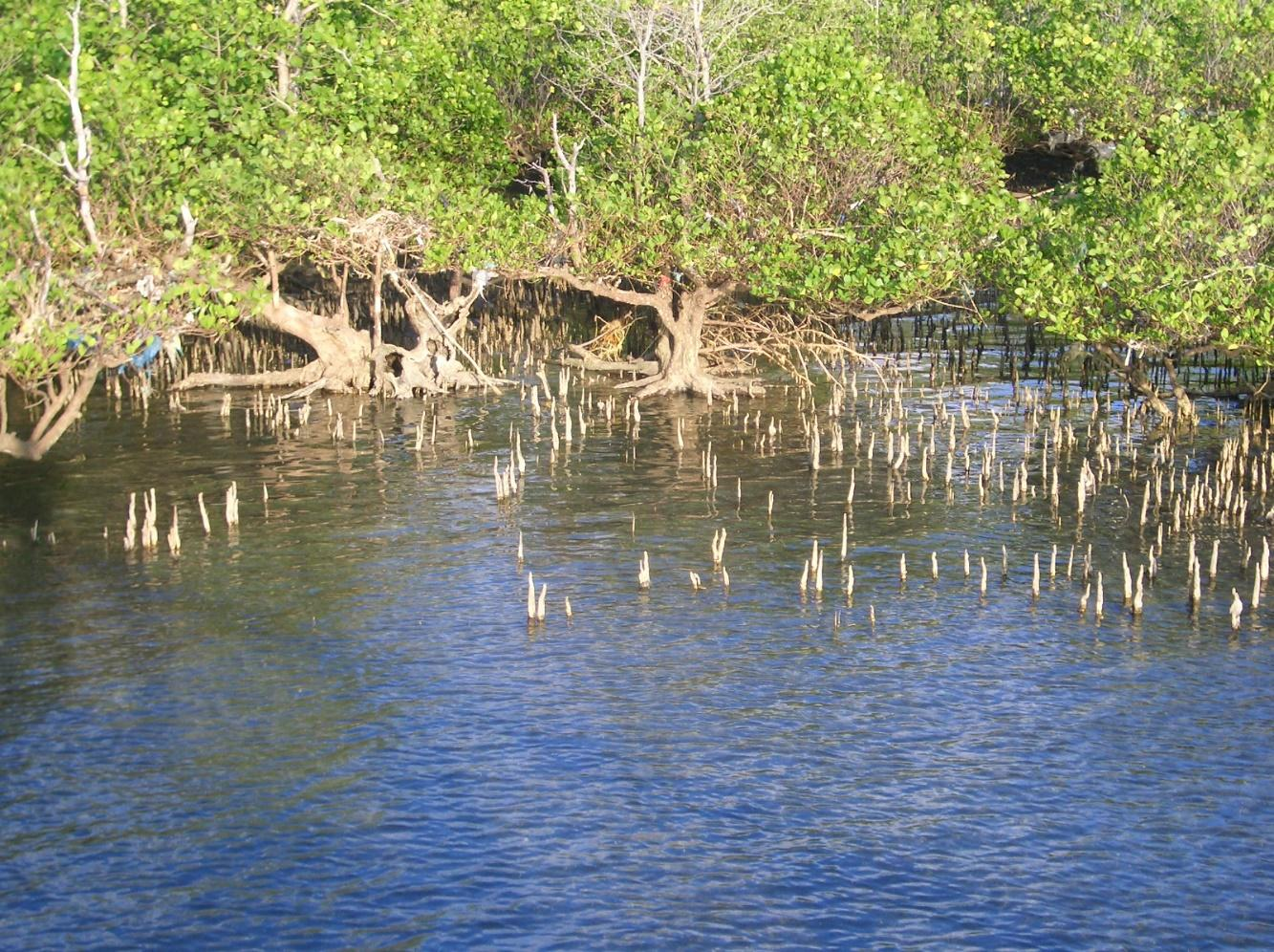
Note: These types of roots are mainly present in the mangrove trees and are found above the saline soil or water surface for the purpose of the gaseous exchange. This is because in the mangrove forest, the soil is fully dissolved in the water and hence there is no oxygen in the soil for the root respiration. These roots are also called by the name breathing roots.
Complete answer:
The pneumatophores are the respiratory root or the knee roots that are in the modified form of the tap root system. These are mainly seen in the crops that are mainly located in the saline soil and the mangrove regions. These roots present upright and aerial in nature. They grow two to three centimeters above the water. Hence it resembles the negative geotropism by growing in the direction opposite to the gravity. These roots are covered by the cap like substance at the tip called cork. The cork layer has the small size pores in them which are called lenticels.
These lenticels are made up of parenchyma cells and have the characteristics of a woody stem. They help in the gaseous exchange between the atmosphere and the inner cells of the plants. They absorb the oxygen from the atmosphere and help in the root respiration. These pores help in the gaseous exchange in the root.
Note: These types of roots are mainly present in the mangrove trees and are found above the saline soil or water surface for the purpose of the gaseous exchange. This is because in the mangrove forest, the soil is fully dissolved in the water and hence there is no oxygen in the soil for the root respiration. These roots are also called by the name breathing roots.
Recently Updated Pages
Master Class 11 Social Science: Engaging Questions & Answers for Success

Master Class 11 Chemistry: Engaging Questions & Answers for Success
Master Class 9 General Knowledge: Engaging Questions & Answers for Success
Master Class 9 Maths: Engaging Questions & Answers for Success
Master Class 9 Science: Engaging Questions & Answers for Success
Master Class 9 English: Engaging Questions & Answers for Success
Trending doubts
One Metric ton is equal to kg A 10000 B 1000 C 100 class 11 physics CBSE
Difference Between Prokaryotic Cells and Eukaryotic Cells
Two of the body parts which do not appear in MRI are class 11 biology CBSE
1 ton equals to A 100 kg B 1000 kg C 10 kg D 10000 class 11 physics CBSE
Explain zero factorial class 11 maths CBSE
10 examples of friction in our daily life