




PN is an ordinate of the parabola ; a straight line is drawn parallel to the axis to bisect NP and meets the curve in Q ; prove that NQ meets the tangent at the vertex in appoint T such that ${\text{AT = }}\dfrac{2}{3}{\text{NP}}$, where A is the vertex.
Answer
 Verified
645.9k+ views
Hint: To solve this question we will first draw a figure according to the conditions given in the question. After it, we proceed by finding the coordinates of points P, N and Q. We will also use the formula to find the equation of line NQ. The formula is $({\text{y - }}{{\text{y}}_1}) = {\text{ }}\dfrac{{({{\text{y}}_2}{\text{ - }}{{\text{y}}_1})}}{{({{\text{x}}_2}{\text{ - }}{{\text{x}}_1})}}({\text{x - }}{{\text{x}}_1})$.
Complete step by step answer:
Now it is given that PN is the ordinate of the parabola. Let the equation of parabola be ${{\text{y}}^2}{\text{ = 4ax}}$. Also, A is the vertex of the parabola. So, we will draw the figure according to the question.
The figure of parabola is shown below.
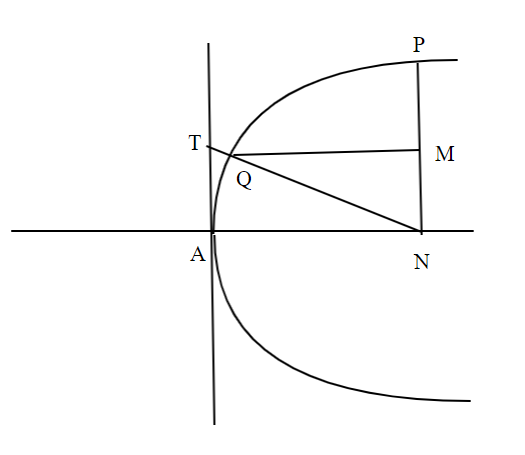
In this figure the coordinates of P are $({\text{a}}{{\text{t}}^2},{\text{ 2at)}}$ and that of C are $({\text{a}}{{\text{t}}^2},{\text{ 0)}}$. A is the vertex of parabola and it is at origin, so its coordinates are (0,0). Also, QM bisects PN so the coordinates of M are $({\text{a}}{{\text{t}}^2},{\text{ at)}}$. So, the equation of line QM is y = at. Since, QM cuts the parabola at point Q so, it must satisfy the equation of parabola. So, putting value of y in the equation of parabola, we get
${\text{x = }}\dfrac{{{\text{a}}{{\text{t}}^2}}}{4}{\text{ }}$
So, coordinates of Q are $(\dfrac{{{\text{a}}{{\text{t}}^2}}}{4}{\text{, at) }}$
Now, the line NQ meets the tangent of parabola at point T. So, equation of line NQ is
${\text{y - y}}{}_1{\text{ = }}\dfrac{{{{\text{y}}_2}{\text{ - }}{{\text{y}}_1}}}{{{{\text{x}}_2}{\text{ - }}{{\text{x}}_1}}}({\text{x - }}{{\text{x}}_1})$
Applying value in the above equation we get
${\text{y = }}\dfrac{{ - 4}}{{3{\text{t}}}}({\text{x - a}}{{\text{t}}^2})$
Now the point T lies on y – axis, so its x - coordinate = 0. So,
${\text{y = }}\dfrac{{4{\text{at}}}}{3}$
So, the coordinates of point T are $(0,{\text{ }}\dfrac{{4{\text{at}}}}{3})$.
Now length of PN = $\sqrt {{{({{\text{x}}_2}{\text{ - }}{{\text{x}}_1})}^2}{\text{ + (}}{{\text{y}}_2}{\text{ - }}{{\text{y}}_1}{)^2}} $ = $2{\text{at}}$
Similarly, length of AT = $\dfrac{{4{\text{at}}}}{3}$
So, ${\text{AT = }}\dfrac{2}{3}{\text{NP}}$. Hence proved.
Note: When we come up with such a type of question, we will follow a few steps to solve the given problem. First, we will draw a figure with the help of given conditions in the question. After it, we will find the required coordinates and equations of lines to solve the question. While finding the equation of a line we have to use the formula $({\text{y - }}{{\text{y}}_1}) = {\text{ }}\dfrac{{({{\text{y}}_2}{\text{ - }}{{\text{y}}_1})}}{{({{\text{x}}_2}{\text{ - }}{{\text{x}}_1})}}({\text{x - }}{{\text{x}}_1})$. Most students make mistakes by applying the incorrect formula. Carefully apply the formula to get the correct answer.
Complete step by step answer:
Now it is given that PN is the ordinate of the parabola. Let the equation of parabola be ${{\text{y}}^2}{\text{ = 4ax}}$. Also, A is the vertex of the parabola. So, we will draw the figure according to the question.
The figure of parabola is shown below.
In this figure the coordinates of P are $({\text{a}}{{\text{t}}^2},{\text{ 2at)}}$ and that of C are $({\text{a}}{{\text{t}}^2},{\text{ 0)}}$. A is the vertex of parabola and it is at origin, so its coordinates are (0,0). Also, QM bisects PN so the coordinates of M are $({\text{a}}{{\text{t}}^2},{\text{ at)}}$. So, the equation of line QM is y = at. Since, QM cuts the parabola at point Q so, it must satisfy the equation of parabola. So, putting value of y in the equation of parabola, we get
${\text{x = }}\dfrac{{{\text{a}}{{\text{t}}^2}}}{4}{\text{ }}$
So, coordinates of Q are $(\dfrac{{{\text{a}}{{\text{t}}^2}}}{4}{\text{, at) }}$
Now, the line NQ meets the tangent of parabola at point T. So, equation of line NQ is
${\text{y - y}}{}_1{\text{ = }}\dfrac{{{{\text{y}}_2}{\text{ - }}{{\text{y}}_1}}}{{{{\text{x}}_2}{\text{ - }}{{\text{x}}_1}}}({\text{x - }}{{\text{x}}_1})$
Applying value in the above equation we get
${\text{y = }}\dfrac{{ - 4}}{{3{\text{t}}}}({\text{x - a}}{{\text{t}}^2})$
Now the point T lies on y – axis, so its x - coordinate = 0. So,
${\text{y = }}\dfrac{{4{\text{at}}}}{3}$
So, the coordinates of point T are $(0,{\text{ }}\dfrac{{4{\text{at}}}}{3})$.
Now length of PN = $\sqrt {{{({{\text{x}}_2}{\text{ - }}{{\text{x}}_1})}^2}{\text{ + (}}{{\text{y}}_2}{\text{ - }}{{\text{y}}_1}{)^2}} $ = $2{\text{at}}$
Similarly, length of AT = $\dfrac{{4{\text{at}}}}{3}$
So, ${\text{AT = }}\dfrac{2}{3}{\text{NP}}$. Hence proved.
Note: When we come up with such a type of question, we will follow a few steps to solve the given problem. First, we will draw a figure with the help of given conditions in the question. After it, we will find the required coordinates and equations of lines to solve the question. While finding the equation of a line we have to use the formula $({\text{y - }}{{\text{y}}_1}) = {\text{ }}\dfrac{{({{\text{y}}_2}{\text{ - }}{{\text{y}}_1})}}{{({{\text{x}}_2}{\text{ - }}{{\text{x}}_1})}}({\text{x - }}{{\text{x}}_1})$. Most students make mistakes by applying the incorrect formula. Carefully apply the formula to get the correct answer.
Recently Updated Pages
Basicity of sulphurous acid and sulphuric acid are

Master Class 11 English: Engaging Questions & Answers for Success
Master Class 11 Physics: Engaging Questions & Answers for Success
Master Class 11 Computer Science: Engaging Questions & Answers for Success
Master Class 11 Chemistry: Engaging Questions & Answers for Success
Master Class 11 Social Science: Engaging Questions & Answers for Success
Trending doubts
Difference Between Prokaryotic Cells and Eukaryotic Cells
Two of the body parts which do not appear in MRI are class 11 biology CBSE
One Metric ton is equal to kg A 10000 B 1000 C 100 class 11 physics CBSE
10 examples of friction in our daily life
Draw a diagram of nephron and explain its structur class 11 biology CBSE
What will happen if the mucus is not secreted by the class 11 biology CBSE