




Plot the graph of ${{\sin }^{-1}}\left( \sin x \right)$ and write its domain and range.
Answer
 Verified
566.4k+ views
Hint: To draw the graph of ${{\sin }^{-1}}\left( \sin x \right)$, we must know about the following concepts,
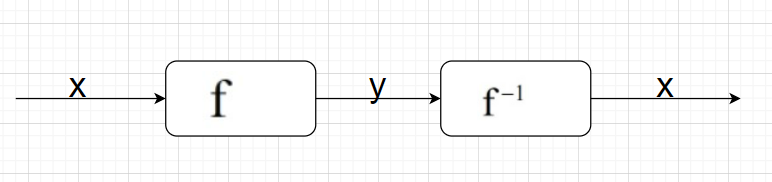
Inverse of a function means a function which returns back the original value applied on the given function. Inverse of a particular function exists if the function is bijective.i.e., for each unique value from the domain of the function, we should have a corresponding unique value from the range of the function.
Complete step-by-step solution:
For a function $f$ , if its inverse exists, then
${{f}^{-1}}\left( f\left( x \right) \right)=x\text{ where }x\in Range\text{ of }{{f}^{-1}}\left( x \right)$
Another point to be noted is
$\begin{align}
& \text{If, }\sin y=\sin x \\
& \Rightarrow y=n\pi +{{\left( -1 \right)}^{n}}x \\
\end{align}$
Range of $y={{\sin }^{-1}}x$ $\forall x\in \left( -1,1 \right),y\in \left( \dfrac{-\pi }{2},\dfrac{\pi }{2} \right)$
Now, let us proceed with the question,
We have, $f\left( x \right)={{\sin }^{-1}}\left( \sin x \right)$
Let us assume $f\left( x \right)=\theta $
$\begin{align}
& \Rightarrow {{\sin }^{-1}}\left( \sin x \right)=\theta \\
& \Rightarrow \sin x=\sin \theta \\
\end{align}$
Using,
$\begin{align}
& \text{If, }\sin y=\sin x \\
& \Rightarrow y=n\pi +{{\left( -1 \right)}^{n}}x \\
\end{align}$
We get
$\Rightarrow \theta =n\pi +{{\left( -1 \right)}^{n}}x$
For different values of $x$ , we will get different values of $\theta $ .i.e., for different values of $x$, we will get different values of $f\left( x \right)$ .
For $n=-1$
$\theta ={{\sin }^{-1}}\left( \sin \left( -\pi -x \right) \right)$
For $\theta $ to exist,
$\begin{align}
& \dfrac{-\pi }{2}\le -\pi -x\le \dfrac{\pi }{2} \\
& \Rightarrow \dfrac{\pi }{2}\le -x\le \dfrac{3\pi }{2} \\
& \Rightarrow \dfrac{-\pi }{2}\ge x\ge \dfrac{-3\pi }{2} \\
\end{align}$
For $n=0,$
$\theta ={{\sin }^{-1}}\left( \sin x \right)$
For $\theta $ to exist,
$\dfrac{-\pi }{2}\le x\le \dfrac{\pi }{2}$
For $n=1,$
$\theta ={{\sin }^{-1}}\left( \sin \left( \pi -x \right) \right)$
For $\theta $ to exist,
$\begin{align}
& \dfrac{-\pi }{2}\le \pi -x\le \dfrac{\pi }{2} \\
& \Rightarrow \dfrac{-3\pi }{2}\le -x\le \dfrac{-\pi }{2} \\
& \Rightarrow \dfrac{3\pi }{2}\ge x\ge \dfrac{\pi }{2} \\
\end{align}$
So, we can redefine the function $f\left( x \right)$ as
$f\left( x \right)=\left\{ \begin{matrix}
& -\pi -x &\dfrac{-3\pi }{2}\le x\le \dfrac{-\pi }{2} \\
& x & \dfrac{-\pi }{2}\le x\le \dfrac{\pi }{2} \\
& \pi -x & \dfrac{\pi }{2}\le x\le \dfrac{3\pi }{2} \\
\end{matrix} \right.$
Now, using these inequalities we will draw the graph of $f\left( x \right)={{\sin }^{-1}}\left( \sin x \right)$
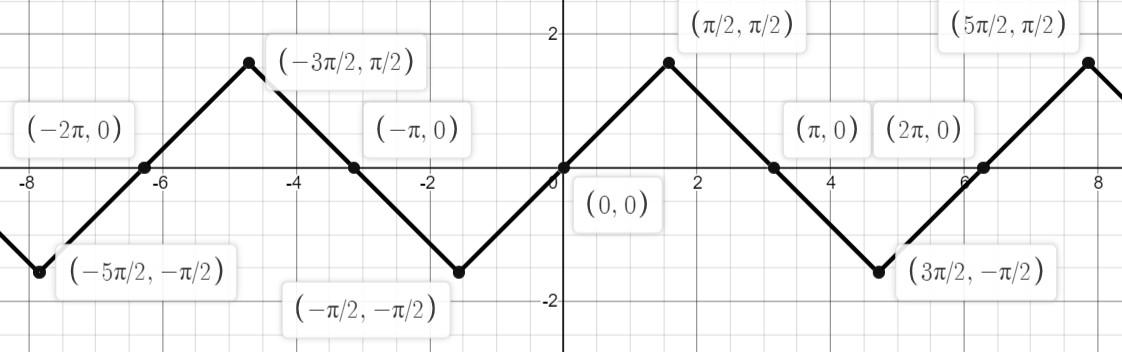
So, for the function $f\left( x \right)={{\sin }^{-1}}\left( \sin x \right)$
$Domain:x\in R$
$Range:x\in \left( \dfrac{-\pi }{2},\dfrac{\pi }{2} \right)$
The graph is periodic with a fundamental period of $2\pi $.
Note: While drawing the graph of $f\left( x \right)={{\sin }^{-1}}\left( \sin x \right)$, remember that the different values of $x$ should correspond to the range of ${{\sin }^{-1}}x$ .i.e.,$x\in \left( \dfrac{-\pi }{2},\dfrac{\pi }{2} \right)$. Here, since $x$ is the domain of $\sin x$, hence $x\in R$. This means that $\sin x\in \left( -1,1 \right)$ and hence ${{\sin }^{-1}}\left( \sin x \right)\in \left( \dfrac{-\pi }{2},\dfrac{\pi }{2} \right)$. So, the given function has a range of $\left( \dfrac{-\pi }{2},\dfrac{\pi }{2} \right)$ for every $x\in R$.
Inverse of a function means a function which returns back the original value applied on the given function. Inverse of a particular function exists if the function is bijective.i.e., for each unique value from the domain of the function, we should have a corresponding unique value from the range of the function.
Complete step-by-step solution:
For a function $f$ , if its inverse exists, then
${{f}^{-1}}\left( f\left( x \right) \right)=x\text{ where }x\in Range\text{ of }{{f}^{-1}}\left( x \right)$
Another point to be noted is
$\begin{align}
& \text{If, }\sin y=\sin x \\
& \Rightarrow y=n\pi +{{\left( -1 \right)}^{n}}x \\
\end{align}$
Range of $y={{\sin }^{-1}}x$ $\forall x\in \left( -1,1 \right),y\in \left( \dfrac{-\pi }{2},\dfrac{\pi }{2} \right)$
Now, let us proceed with the question,
We have, $f\left( x \right)={{\sin }^{-1}}\left( \sin x \right)$
Let us assume $f\left( x \right)=\theta $
$\begin{align}
& \Rightarrow {{\sin }^{-1}}\left( \sin x \right)=\theta \\
& \Rightarrow \sin x=\sin \theta \\
\end{align}$
Using,
$\begin{align}
& \text{If, }\sin y=\sin x \\
& \Rightarrow y=n\pi +{{\left( -1 \right)}^{n}}x \\
\end{align}$
We get
$\Rightarrow \theta =n\pi +{{\left( -1 \right)}^{n}}x$
For different values of $x$ , we will get different values of $\theta $ .i.e., for different values of $x$, we will get different values of $f\left( x \right)$ .
For $n=-1$
$\theta ={{\sin }^{-1}}\left( \sin \left( -\pi -x \right) \right)$
For $\theta $ to exist,
$\begin{align}
& \dfrac{-\pi }{2}\le -\pi -x\le \dfrac{\pi }{2} \\
& \Rightarrow \dfrac{\pi }{2}\le -x\le \dfrac{3\pi }{2} \\
& \Rightarrow \dfrac{-\pi }{2}\ge x\ge \dfrac{-3\pi }{2} \\
\end{align}$
For $n=0,$
$\theta ={{\sin }^{-1}}\left( \sin x \right)$
For $\theta $ to exist,
$\dfrac{-\pi }{2}\le x\le \dfrac{\pi }{2}$
For $n=1,$
$\theta ={{\sin }^{-1}}\left( \sin \left( \pi -x \right) \right)$
For $\theta $ to exist,
$\begin{align}
& \dfrac{-\pi }{2}\le \pi -x\le \dfrac{\pi }{2} \\
& \Rightarrow \dfrac{-3\pi }{2}\le -x\le \dfrac{-\pi }{2} \\
& \Rightarrow \dfrac{3\pi }{2}\ge x\ge \dfrac{\pi }{2} \\
\end{align}$
So, we can redefine the function $f\left( x \right)$ as
$f\left( x \right)=\left\{ \begin{matrix}
& -\pi -x &\dfrac{-3\pi }{2}\le x\le \dfrac{-\pi }{2} \\
& x & \dfrac{-\pi }{2}\le x\le \dfrac{\pi }{2} \\
& \pi -x & \dfrac{\pi }{2}\le x\le \dfrac{3\pi }{2} \\
\end{matrix} \right.$
Now, using these inequalities we will draw the graph of $f\left( x \right)={{\sin }^{-1}}\left( \sin x \right)$
So, for the function $f\left( x \right)={{\sin }^{-1}}\left( \sin x \right)$
$Domain:x\in R$
$Range:x\in \left( \dfrac{-\pi }{2},\dfrac{\pi }{2} \right)$
The graph is periodic with a fundamental period of $2\pi $.
Note: While drawing the graph of $f\left( x \right)={{\sin }^{-1}}\left( \sin x \right)$, remember that the different values of $x$ should correspond to the range of ${{\sin }^{-1}}x$ .i.e.,$x\in \left( \dfrac{-\pi }{2},\dfrac{\pi }{2} \right)$. Here, since $x$ is the domain of $\sin x$, hence $x\in R$. This means that $\sin x\in \left( -1,1 \right)$ and hence ${{\sin }^{-1}}\left( \sin x \right)\in \left( \dfrac{-\pi }{2},\dfrac{\pi }{2} \right)$. So, the given function has a range of $\left( \dfrac{-\pi }{2},\dfrac{\pi }{2} \right)$ for every $x\in R$.
Recently Updated Pages
Master Class 12 Business Studies: Engaging Questions & Answers for Success

Master Class 12 Biology: Engaging Questions & Answers for Success
Master Class 12 Chemistry: Engaging Questions & Answers for Success
Class 12 Question and Answer - Your Ultimate Solutions Guide
Master Class 11 Social Science: Engaging Questions & Answers for Success
Master Class 11 English: Engaging Questions & Answers for Success
Trending doubts
Which are the Top 10 Largest Countries of the World?
Draw a labelled sketch of the human eye class 12 physics CBSE
Differentiate between homogeneous and heterogeneous class 12 chemistry CBSE
Why is the cell called the structural and functional class 12 biology CBSE
Draw ray diagrams each showing i myopic eye and ii class 12 physics CBSE
Which is the correct genotypic ratio of mendel dihybrid class 12 biology CBSE