




Plot the corresponding reference circle for each of the following simple harmonic motions. Indicate the initial $(t = 0)$ position of the particle, the radius of the circle, and the angular speed of the rotating particle. For simplicity, the sense of rotation may be fixed to be anticlockwise in every case: ( $x$ is in $cm$ and $t$ is in $\sec $ ).
(A). $x = - 2\sin \left( {3t + \dfrac{\pi }{3}} \right)$
(B). $x = \cos \left( {\dfrac{\pi }{6} - t} \right)$
(C). $x = 3\sin \left( {2\pi t + \dfrac{\pi }{4}} \right)$
(D). $x = 2\cos \pi t$
Answer
 Verified
623.7k+ views
Hint: You can start the solution by defining what simple harmonic motion is. Then define the standard equation for simple harmonic motion, i.e. $x = A\cos \left( {\dfrac{{2\pi }}{T}t + \phi } \right)$. Then compare this equation with all of the four cases converting all of the equations in the $\cos $ form.
Complete step by step answer:
Simple Harmonic Motion – It is a periodic motion which is caused due to a restoring force which is directly proportional to the distance of the object from the mean position and the direction of this force is always towards the equilibrium position.
In the problem we are given four particles and their respective SHM equation. The standard SHM equation is
$x = A\cos \left( {\dfrac{{2\pi }}{T}t + \phi } \right)$
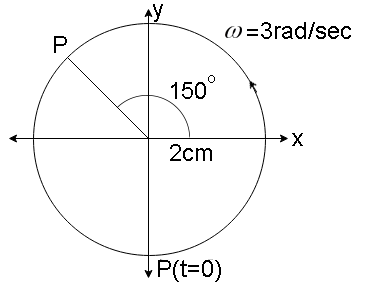
(A). \[x = - 2\sin \left( {3t + \dfrac{\pi }{3}} \right) = 2\cos \left( {3t + \dfrac{\pi }{3} + \dfrac{\pi }{2}} \right)\]
Comparing this equation with the standard SHM equation,
\[x = A\cos \left( {\dfrac{{2\pi }}{T}t + \phi } \right)\]
Amplitude \[A = 2cm\]
Phase angle \[\phi = \dfrac{{5\pi }}{6}\]
Angular velocity \[\omega = \dfrac{{2\pi }}{T} = 3rad/\sec \]
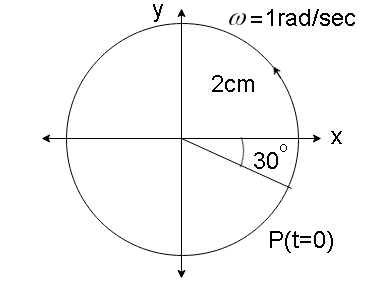
(b) \[x = \cos \left( {\dfrac{\pi }{6} - t} \right) = \cos \left( {t - \dfrac{\pi }{6}} \right)\]
Comparing this equation with the standard SHM equation
Amplitude \[A = 1\]
Phase angle \[\phi = - \dfrac{\pi }{6}\]
Angular velocity \[\omega = \dfrac{{2\pi }}{T} = 1rad/\sec \]
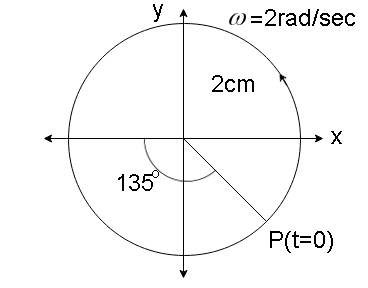
(c) \[x = 3\sin \left( {2\pi t + \dfrac{\pi }{4}} \right)\]
\[ = - \cos \left[ {\left( {2\pi t + \dfrac{\pi }{4}} \right) + \dfrac{\pi }{2}} \right] = - 3\cos \left( {2\pi t + \dfrac{{3\pi }}{4}} \right)\]
Comparing this equation with the standard SHM equation
Amplitude \[A = 3cm\]
Phase angle \[\phi = \dfrac{{3\pi }}{4}\]
Angular velocity \[\omega = \dfrac{{2\pi }}{T} = 2\pi rad/\sec \]
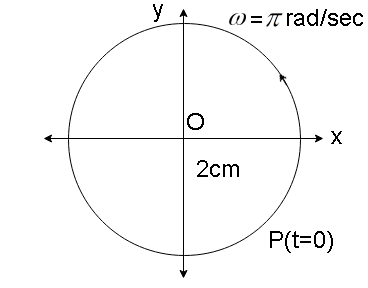
(d) \[x = 2\cos \pi t\]
Comparing this equation with the standard SHM equation
Amplitude\[A = 2cm\]
Phase angle \[\phi = 0\]
Angular velocity \[\omega = \dfrac{{2\pi }}{T} = \pi rad/\sec \]
Note:
Simple harmonic motion is a great example of conservation of energy. When the object from its equilibrium position it only has potential energy. While reaching the extreme positions this energy is converted into kinetic energy and then again back into potential energy as the objects start moving back to equilibrium.
Complete step by step answer:
Simple Harmonic Motion – It is a periodic motion which is caused due to a restoring force which is directly proportional to the distance of the object from the mean position and the direction of this force is always towards the equilibrium position.
In the problem we are given four particles and their respective SHM equation. The standard SHM equation is
$x = A\cos \left( {\dfrac{{2\pi }}{T}t + \phi } \right)$
(A). \[x = - 2\sin \left( {3t + \dfrac{\pi }{3}} \right) = 2\cos \left( {3t + \dfrac{\pi }{3} + \dfrac{\pi }{2}} \right)\]
Comparing this equation with the standard SHM equation,
\[x = A\cos \left( {\dfrac{{2\pi }}{T}t + \phi } \right)\]
Amplitude \[A = 2cm\]
Phase angle \[\phi = \dfrac{{5\pi }}{6}\]
Angular velocity \[\omega = \dfrac{{2\pi }}{T} = 3rad/\sec \]
(b) \[x = \cos \left( {\dfrac{\pi }{6} - t} \right) = \cos \left( {t - \dfrac{\pi }{6}} \right)\]
Comparing this equation with the standard SHM equation
Amplitude \[A = 1\]
Phase angle \[\phi = - \dfrac{\pi }{6}\]
Angular velocity \[\omega = \dfrac{{2\pi }}{T} = 1rad/\sec \]
(c) \[x = 3\sin \left( {2\pi t + \dfrac{\pi }{4}} \right)\]
\[ = - \cos \left[ {\left( {2\pi t + \dfrac{\pi }{4}} \right) + \dfrac{\pi }{2}} \right] = - 3\cos \left( {2\pi t + \dfrac{{3\pi }}{4}} \right)\]
Comparing this equation with the standard SHM equation
Amplitude \[A = 3cm\]
Phase angle \[\phi = \dfrac{{3\pi }}{4}\]
Angular velocity \[\omega = \dfrac{{2\pi }}{T} = 2\pi rad/\sec \]
(d) \[x = 2\cos \pi t\]
Comparing this equation with the standard SHM equation
Amplitude\[A = 2cm\]
Phase angle \[\phi = 0\]
Angular velocity \[\omega = \dfrac{{2\pi }}{T} = \pi rad/\sec \]
Note:
Simple harmonic motion is a great example of conservation of energy. When the object from its equilibrium position it only has potential energy. While reaching the extreme positions this energy is converted into kinetic energy and then again back into potential energy as the objects start moving back to equilibrium.
Recently Updated Pages
Master Class 11 Social Science: Engaging Questions & Answers for Success

Master Class 11 Chemistry: Engaging Questions & Answers for Success
Master Class 12 Business Studies: Engaging Questions & Answers for Success
Master Class 12 Chemistry: Engaging Questions & Answers for Success
Master Class 12 Biology: Engaging Questions & Answers for Success
Class 12 Question and Answer - Your Ultimate Solutions Guide
Trending doubts
One Metric ton is equal to kg A 10000 B 1000 C 100 class 11 physics CBSE
Difference Between Prokaryotic Cells and Eukaryotic Cells
How many of the following diseases can be studied with class 11 biology CBSE
Two of the body parts which do not appear in MRI are class 11 biology CBSE
Which of the following enzymes is used for carboxylation class 11 biology CBSE
Explain zero factorial class 11 maths CBSE