




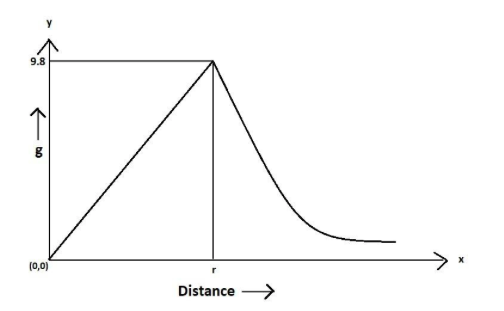
Plot a graph showing the variation of acceleration due to gravity with the distance from the centre of the earth.
Answer
 Verified
644.1k+ views
Hint:We have to take distance from earth on the x-axis as it is an independent value, and acceleration due to gravity on y-axis as it is dependent on the distance from the centre of the earth for this graph.
Complete step by step solution:
We need to plot this graph between two quantities – distance and acceleration due to gravity, called $g$. Since acceleration due to gravity is a dependent function, being dependent on distance from the centre of the earth, it will be plotted over the y-axis and distance, being an independent quantity, will be plotted over the x-axis.
We need to take the centre of the earth as a reference for measuring distance, as given in the question. This means that the centre of the earth will be taken as an initial distance. In other words, at the centre of the earth, distance will be equal to zero. Also, we know that at the centre of the earth acceleration due to gravity is zero. Therefore, we get the coordinates $\left( {0,0} \right)$ to satisfy the graph, indicating that at the centre of the earth acceleration due to gravity will be zero.
Now, we know that the value of acceleration due to gravity on the surface of the earth, i.e. at a distance equal to the radius of the earth, is equal to $9.8\,m{s^{ - 2}}$ and also that the value of the acceleration due to gravity is highest at a distance equal to the radius of the earth. Hence, if we take the radius of the earth to be $r$, we get the point $(r,9.8)$ for our graph.
Now, it has been proven that the acceleration due to gravity increases uniformly till a distance equal to the radius of the earth, where it becomes highest, and then decreases exponentially. Hence, from the origin to the point $(r,9.8)$ graph will be a straight line and after the point $(r,9.8)$ the graph will decrease exponentially, tending to zero as distance tends to infinity.
Therefore, the graph will be as below:
Note:It has been scientifically proven that acceleration due to gravity increases uniformly till a distance equal to the radius of the earth, where it becomes highest, and then decreases exponentially. The acceleration due to gravity never becomes zero. No matter how far we go from earth, there will always be some of it acting on us except for when we reach the centre of earth, where it becomes zero.
Complete step by step solution:
We need to plot this graph between two quantities – distance and acceleration due to gravity, called $g$. Since acceleration due to gravity is a dependent function, being dependent on distance from the centre of the earth, it will be plotted over the y-axis and distance, being an independent quantity, will be plotted over the x-axis.
We need to take the centre of the earth as a reference for measuring distance, as given in the question. This means that the centre of the earth will be taken as an initial distance. In other words, at the centre of the earth, distance will be equal to zero. Also, we know that at the centre of the earth acceleration due to gravity is zero. Therefore, we get the coordinates $\left( {0,0} \right)$ to satisfy the graph, indicating that at the centre of the earth acceleration due to gravity will be zero.
Now, we know that the value of acceleration due to gravity on the surface of the earth, i.e. at a distance equal to the radius of the earth, is equal to $9.8\,m{s^{ - 2}}$ and also that the value of the acceleration due to gravity is highest at a distance equal to the radius of the earth. Hence, if we take the radius of the earth to be $r$, we get the point $(r,9.8)$ for our graph.
Now, it has been proven that the acceleration due to gravity increases uniformly till a distance equal to the radius of the earth, where it becomes highest, and then decreases exponentially. Hence, from the origin to the point $(r,9.8)$ graph will be a straight line and after the point $(r,9.8)$ the graph will decrease exponentially, tending to zero as distance tends to infinity.
Therefore, the graph will be as below:
Note:It has been scientifically proven that acceleration due to gravity increases uniformly till a distance equal to the radius of the earth, where it becomes highest, and then decreases exponentially. The acceleration due to gravity never becomes zero. No matter how far we go from earth, there will always be some of it acting on us except for when we reach the centre of earth, where it becomes zero.
Recently Updated Pages
Write structures of the following compounds i 2 Chloro3methylpentane class 11 chemistry CBSE

What is BLO What is the full form of BLO class 8 social science CBSE
Explain the Treaty of Vienna of 1815 class 10 social science CBSE
A Paragraph on Pollution in about 100-150 Words
XIX+XXX A 49 B 51 C 55 D 44 class 5 maths CBSE
If x a + bt + ct2 where x is in meters and t is in class 11 physics CBSE
Trending doubts
One Metric ton is equal to kg A 10000 B 1000 C 100 class 11 physics CBSE
What do you mean by retardation What is its SI uni class 11 physics CBSE
Draw a diagram of nephron and explain its structur class 11 biology CBSE
10 examples of friction in our daily life
Difference between physical and chemical change class 11 chemistry CBSE
Proton was discovered by A Thomson B Rutherford C Chadwick class 11 chemistry CBSE