




Plants requiring exposure to light for less than the critical photoperiod for flowering are
(a)LDP
(b)DNP
(c)IDP
(d)SDP
Answer
 Verified
602.7k+ views
Hint: These plants flower when the days are shorter. They need less than the critical duration of light (about 8-10 hours) for flowering and a continuous dark period (about 14-16 hours) as part of the flowering. The dark period is very critical for this type of plant and has to be continuous.
Complete answer:
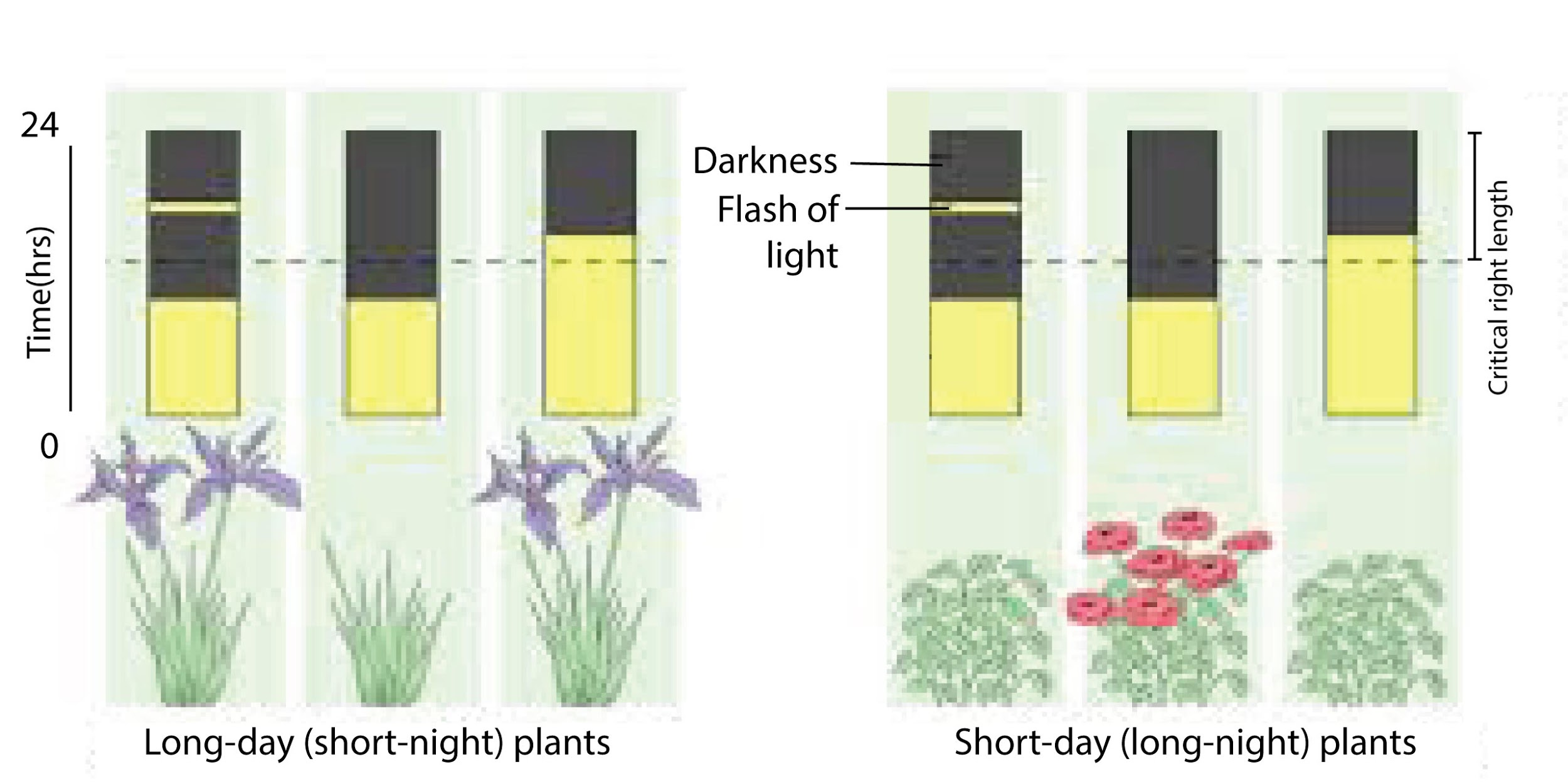
Short day plants(SDP) are those plants that begin flowering when the days are shorter than their critical day length. They require a long period of darkness and a short period of light for flowering. Long day plants(LDP) are those plants that begin flowering when the days are longer than their critical day length. They will only flower when they are exposed to a short period of darkness and a long period of light. Long day plants will flower in summer while short-day plants flower in spring.
Additional Information: -The Physiological process occurring in the plants and the animals according to the period of lightness and darkness.
-The process of development of plants based on the period of light and dark is known as photoperiodism.
-On the basis of photoperiods, plants are divided into three categories:
Short-day plants(SDP)
Long-day plants(LDP)
Day-neutral plants(DNP)
-Long-day plants occur when the night period is less than the critical photoperiod. These plants require larger day lengths and light and lesser dark or night periods to bloom. Example: Pea, Wheat, Braley, etc.
-Short-day plants occur when the night period is larger than the critical photoperiod. These plants require a large night or a large darker period and a smaller light period. The light produced by the moon is natural and very low so they will not interrupt the dark period of the plants. Example: Rice, Cotton, Soybeans, etc.
-Day-neutral plants do not depend upon photoperiodism. Their flowering occurs at a definite stage after their growth period. Example: Cucumbers, tomatoes, roses, etc.
So, the correct answer is ‘SDP.’
Note: The changes in photoperiod occur due to the presence of photoreceptors that act as the sensory reec[tors in plants and animals. These photoreceptors include phytochrome and cytochrome. They send signals to the plants as the night r day period changes. The process of photoperiodism was first discovered by Graner and Allard in 1912.
Complete answer:
Short day plants(SDP) are those plants that begin flowering when the days are shorter than their critical day length. They require a long period of darkness and a short period of light for flowering. Long day plants(LDP) are those plants that begin flowering when the days are longer than their critical day length. They will only flower when they are exposed to a short period of darkness and a long period of light. Long day plants will flower in summer while short-day plants flower in spring.
Additional Information: -The Physiological process occurring in the plants and the animals according to the period of lightness and darkness.
-The process of development of plants based on the period of light and dark is known as photoperiodism.
-On the basis of photoperiods, plants are divided into three categories:
Short-day plants(SDP)
Long-day plants(LDP)
Day-neutral plants(DNP)
-Long-day plants occur when the night period is less than the critical photoperiod. These plants require larger day lengths and light and lesser dark or night periods to bloom. Example: Pea, Wheat, Braley, etc.
-Short-day plants occur when the night period is larger than the critical photoperiod. These plants require a large night or a large darker period and a smaller light period. The light produced by the moon is natural and very low so they will not interrupt the dark period of the plants. Example: Rice, Cotton, Soybeans, etc.
-Day-neutral plants do not depend upon photoperiodism. Their flowering occurs at a definite stage after their growth period. Example: Cucumbers, tomatoes, roses, etc.
So, the correct answer is ‘SDP.’
Note: The changes in photoperiod occur due to the presence of photoreceptors that act as the sensory reec[tors in plants and animals. These photoreceptors include phytochrome and cytochrome. They send signals to the plants as the night r day period changes. The process of photoperiodism was first discovered by Graner and Allard in 1912.
Recently Updated Pages
Master Class 11 Social Science: Engaging Questions & Answers for Success

Master Class 11 Physics: Engaging Questions & Answers for Success
Master Class 11 Maths: Engaging Questions & Answers for Success
Master Class 11 Economics: Engaging Questions & Answers for Success
Master Class 11 Computer Science: Engaging Questions & Answers for Success
Master Class 11 Chemistry: Engaging Questions & Answers for Success
Trending doubts
One Metric ton is equal to kg A 10000 B 1000 C 100 class 11 physics CBSE
There are 720 permutations of the digits 1 2 3 4 5 class 11 maths CBSE
1 Quintal is equal to a 110 kg b 10 kg c 100kg d 1000 class 11 physics CBSE
State and prove Bernoullis theorem class 11 physics CBSE
Difference Between Prokaryotic Cells and Eukaryotic Cells
Which among the following are examples of coming together class 11 social science CBSE