




Phyllodes are seen in
I)Nepenthes
II)Australian acacia
III)Opuntia
(a)I only
(b)I and II only
(c)II only
(d)I and III only
Answer
 Verified
618k+ views
Hint: Nepenthes is a genus of carnivorous plants that are commonly known as tropical pitcher plants. Opuntia is a genus in the cactus family that is commonly known as the prickly pear cactus. Australian acacia is the largest genus of flowering plants in Australia.
Complete answer:
Phyllode is a modified petiole (leaf stalk by which leaf is attached to the stem) which becomes widened, flattened and green, and leaf-like in order to perform photosynthesis. This is a xerophytic adaptation in order to prevent water loss through transpiration from the stomata of the leaves. Phyllodes are seen in the case of Australian acacia. A structure similar to this known as phylloclade is seen in Opuntia where the stem becomes modified and green in color to perform the functions of a leaf such as photosynthesis.
Additional Information: Nepenthes: It is a genus of plants known that belong to the family Nepenthaceae. They are mostly found in China, Malaysia, Indonesia, Borneo, Sumatra, Philippines, etc. They are insectivorous plants that trap insects inside their pitcher which is a modification of the leaf.
Australian acacia: Acacia is commonly known as the wattles and it is a large group of shrubs and trees that belong to the subfamily Mimosoideae of the family Fabaceae which is commonly known as the pea family.
Opuntia: Opuntia is a group within the cactus family that is found in the United States and Mexico and is eaten as fruits as they are very sweet. This plant is also used to treat diabetes, high cholesterol, obesity, etc.
So, the correct option is ‘II only’.
Note: Cladode is also a term used for stem modification but in cladode, a branch of the stem is modified whereas in phylloclade the entire stem is modified. Examples of cladode include Asparagus, Ruscus.
Since phylloclade and cladode are modifications of the stem, nodes and internodes are present in them.
Insectivorous plants like the pitcher plant perform photosynthesis and eat insects to fulfill their demands of nutrients such as nitrogen, phosphorus, etc.
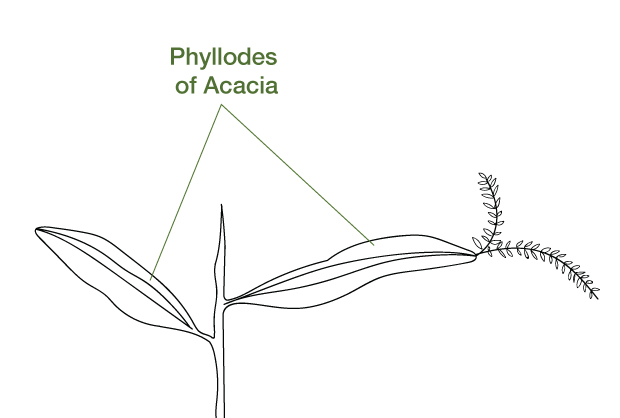
Complete answer:
Phyllode is a modified petiole (leaf stalk by which leaf is attached to the stem) which becomes widened, flattened and green, and leaf-like in order to perform photosynthesis. This is a xerophytic adaptation in order to prevent water loss through transpiration from the stomata of the leaves. Phyllodes are seen in the case of Australian acacia. A structure similar to this known as phylloclade is seen in Opuntia where the stem becomes modified and green in color to perform the functions of a leaf such as photosynthesis.
Additional Information: Nepenthes: It is a genus of plants known that belong to the family Nepenthaceae. They are mostly found in China, Malaysia, Indonesia, Borneo, Sumatra, Philippines, etc. They are insectivorous plants that trap insects inside their pitcher which is a modification of the leaf.
Australian acacia: Acacia is commonly known as the wattles and it is a large group of shrubs and trees that belong to the subfamily Mimosoideae of the family Fabaceae which is commonly known as the pea family.
Opuntia: Opuntia is a group within the cactus family that is found in the United States and Mexico and is eaten as fruits as they are very sweet. This plant is also used to treat diabetes, high cholesterol, obesity, etc.
So, the correct option is ‘II only’.
Note: Cladode is also a term used for stem modification but in cladode, a branch of the stem is modified whereas in phylloclade the entire stem is modified. Examples of cladode include Asparagus, Ruscus.
Since phylloclade and cladode are modifications of the stem, nodes and internodes are present in them.
Insectivorous plants like the pitcher plant perform photosynthesis and eat insects to fulfill their demands of nutrients such as nitrogen, phosphorus, etc.
Recently Updated Pages
Basicity of sulphurous acid and sulphuric acid are

Master Class 11 English: Engaging Questions & Answers for Success
Master Class 11 Physics: Engaging Questions & Answers for Success
Master Class 11 Computer Science: Engaging Questions & Answers for Success
Master Class 11 Chemistry: Engaging Questions & Answers for Success
Master Class 11 Social Science: Engaging Questions & Answers for Success
Trending doubts
Difference Between Prokaryotic Cells and Eukaryotic Cells
Two of the body parts which do not appear in MRI are class 11 biology CBSE
One Metric ton is equal to kg A 10000 B 1000 C 100 class 11 physics CBSE
10 examples of friction in our daily life
Draw a diagram of nephron and explain its structur class 11 biology CBSE
What will happen if the mucus is not secreted by the class 11 biology CBSE