




${\text{Phthalic acid}} + {\text{N}}{{\text{H}}_3} \to {\text{D}}\xrightarrow{{{\Delta }}}{\text{E}}$
Answer
 Verified
583.2k+ views
Hint:To solve this we must know the structure of phthalic acid. Phthalic acid in reaction with ammonia gives an ammonium salt. The ammonium salt on heating gives phthalimide. Write the reaction along with the proper structures.
Complete step by step answer:We are given that phthalic acid reacts with ammonia.
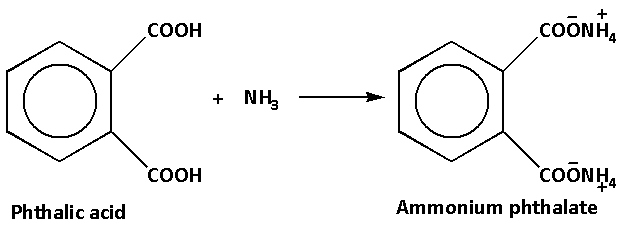
Phthalic acid is a carboxylic acid. The structure of phthalic acid has two carboxyl groups attached to the benzene ring.
Phthalic acid is a weak acid and ammonia is a weak base. Thus, ammonia accepts a proton and forms ammonium phthalate.
Phthalic acid has a carboxyl group and ammonia is a base. The acid donates a hydrogen ion and the ammonia molecule accepts hydrogen ions. This produces ammonium salt of phthalic acid. The salt is known as ammonium phthalate.
The reaction of phthalic acid with ammonia is as follows:
Ammonium phthalate on heating further loses two water molecules. When ammonium phthalate loses water molecules phthalimide is produced. Phthalimide is an imide derivative of phthalic anhydride.
The reaction when ammonium phthalate is heated is as follows:
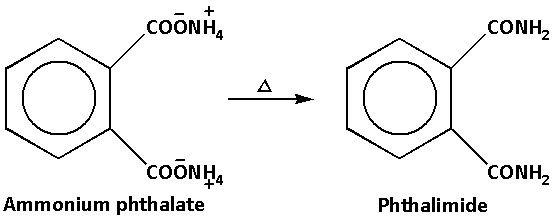
Thus, product D is ammonium phthalate and product E is phthalimide.
Thus, ${\text{Phthalic acid}} + {\text{N}}{{\text{H}}_3} \to {\text{Ammonium phthalate}}\xrightarrow{{{\Delta }}}{\text{Phthalimide}}$.
Note: Phthalic acid is weak acid and ammonia is a weak base. The acid reacts with base and forms salt and water. The weak phthalic acid donates a proton to ammonia which is a weak base. The weak base ammonia accepts a proton to form ammonium phthalate. Further heating of ammonium phthalate leads to loss of water and leads to the formation of phthalimide.
Complete step by step answer:We are given that phthalic acid reacts with ammonia.
Phthalic acid is a carboxylic acid. The structure of phthalic acid has two carboxyl groups attached to the benzene ring.
Phthalic acid is a weak acid and ammonia is a weak base. Thus, ammonia accepts a proton and forms ammonium phthalate.
Phthalic acid has a carboxyl group and ammonia is a base. The acid donates a hydrogen ion and the ammonia molecule accepts hydrogen ions. This produces ammonium salt of phthalic acid. The salt is known as ammonium phthalate.
The reaction of phthalic acid with ammonia is as follows:
Ammonium phthalate on heating further loses two water molecules. When ammonium phthalate loses water molecules phthalimide is produced. Phthalimide is an imide derivative of phthalic anhydride.
The reaction when ammonium phthalate is heated is as follows:
Thus, product D is ammonium phthalate and product E is phthalimide.
Thus, ${\text{Phthalic acid}} + {\text{N}}{{\text{H}}_3} \to {\text{Ammonium phthalate}}\xrightarrow{{{\Delta }}}{\text{Phthalimide}}$.
Note: Phthalic acid is weak acid and ammonia is a weak base. The acid reacts with base and forms salt and water. The weak phthalic acid donates a proton to ammonia which is a weak base. The weak base ammonia accepts a proton to form ammonium phthalate. Further heating of ammonium phthalate leads to loss of water and leads to the formation of phthalimide.
Recently Updated Pages
Explain the structure of megasporangium class 12 biology CBSE

Why is chloroform kept in dark coloured bottles class 12 chemistry CBSE
Derive the balancing condition of a Wheatstone bri class 12 physics CBSE
Draw VI characteristics of a pn junction diode Explain class 12 physics CBSE
Is it possible to carry pride in ones language too class 12 english CBSE
In a population at Hardy Weinberg equilibrium the allele class 12 biology CBSE
Trending doubts
Draw a labelled sketch of the human eye class 12 physics CBSE
Which are the Top 10 Largest Countries of the World?
Draw ray diagrams each showing i myopic eye and ii class 12 physics CBSE
Which is the correct genotypic ratio of mendel dihybrid class 12 biology CBSE
Differentiate between homogeneous and heterogeneous class 12 chemistry CBSE
Which animal never drinks water in its entire life class 12 biology CBSE