




What is phototropism? How does it occur in plants? Describe an activity to demonstrate phototropism.
Answer
 Verified
618.9k+ views
Hint:- Tropism is a movement observed in plants in response to certain environmental stimuli. Tropisms are generally associated with plants, but not limited to them. Tropisms in plants can be in response to gravity, water or light.
Complete step-by-step solution:-
The biological phenomenon that involves movement of plants and certain pathogens in response to specific stimuli of the environment. Tropism can be either positive or negative. Positive tropisms take place when the plant or pathogen moves towards the direction of the stimulus, and negative tropism, if they move away from it.
Phototropism is derived from two words – ‘photo’ meaning light and ‘tropism’ meaning movement. Thus, we can say that Phototropism is the movement of plants in the direction of light or towards the source of light. Plants are positively phototropic in nature.
The mechanism of phototropism involves plant growth hormones called auxins. Auxin is present in parts of the plant in different concentrations. Phototropism is known to take in one of the following ways stated below:
Light can cause deactivation of auxins present on the side of the leaf exposed to light. This causes activation of auxins on the shaded part, and the plant grows towards light.
Auxin synthesis is activated on the shaded part of the plant allowing the plant to grow towards light.
Auxin flows between the light exposed area and the shaded area is equal. When light falls on the exposed part of the plant, movement of auxin from the light exposed part to the shaded part increases causing the growth of the plant towards light.
Phototropism in plants can be demonstrated with the following experiment.
Aim of the experiment – To prove the phenomenon of phototropism in plants.
Materials required - Two potted plants, two glasses boxes, two electric bulbs.
Procedure – Two potted plants are taken and kept in each of the two glass boxes. In the first setup, the electric bulb is placed on top of the box in such a way that light falls on the plant from top. In the second setup, the electric bulb is fitted on one side of the box, so that the plant gets light from a side.
Observation – After a few days, it is observed that in the first setup, the plant has grown vertically. However, in the second setup, the plant has grown towards the direction of light.
Inference – It can be thus deduced from the experiment that plants are positively phototropic in nature.
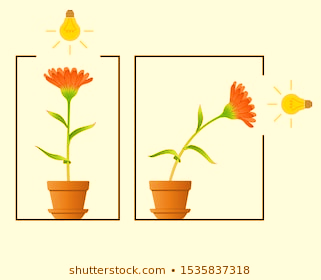
Fig: An experiment to demonstrate phototropism in plants
Note:- Tropism is movement of plants in response to a stimulus, usually environmental. The stimuli can be gravity, light chemicals or water. Plants are phototropic in nature. This means that plants tend to move towards the source of light. The process of phototropism is mediated with the help of plant growth regulators called auxins.
Complete step-by-step solution:-
The biological phenomenon that involves movement of plants and certain pathogens in response to specific stimuli of the environment. Tropism can be either positive or negative. Positive tropisms take place when the plant or pathogen moves towards the direction of the stimulus, and negative tropism, if they move away from it.
Phototropism is derived from two words – ‘photo’ meaning light and ‘tropism’ meaning movement. Thus, we can say that Phototropism is the movement of plants in the direction of light or towards the source of light. Plants are positively phototropic in nature.
The mechanism of phototropism involves plant growth hormones called auxins. Auxin is present in parts of the plant in different concentrations. Phototropism is known to take in one of the following ways stated below:
Light can cause deactivation of auxins present on the side of the leaf exposed to light. This causes activation of auxins on the shaded part, and the plant grows towards light.
Auxin synthesis is activated on the shaded part of the plant allowing the plant to grow towards light.
Auxin flows between the light exposed area and the shaded area is equal. When light falls on the exposed part of the plant, movement of auxin from the light exposed part to the shaded part increases causing the growth of the plant towards light.
Phototropism in plants can be demonstrated with the following experiment.
Aim of the experiment – To prove the phenomenon of phototropism in plants.
Materials required - Two potted plants, two glasses boxes, two electric bulbs.
Procedure – Two potted plants are taken and kept in each of the two glass boxes. In the first setup, the electric bulb is placed on top of the box in such a way that light falls on the plant from top. In the second setup, the electric bulb is fitted on one side of the box, so that the plant gets light from a side.
Observation – After a few days, it is observed that in the first setup, the plant has grown vertically. However, in the second setup, the plant has grown towards the direction of light.
Inference – It can be thus deduced from the experiment that plants are positively phototropic in nature.
Fig: An experiment to demonstrate phototropism in plants
Note:- Tropism is movement of plants in response to a stimulus, usually environmental. The stimuli can be gravity, light chemicals or water. Plants are phototropic in nature. This means that plants tend to move towards the source of light. The process of phototropism is mediated with the help of plant growth regulators called auxins.
Recently Updated Pages
Master Class 12 Business Studies: Engaging Questions & Answers for Success

Master Class 12 Chemistry: Engaging Questions & Answers for Success
Master Class 12 Biology: Engaging Questions & Answers for Success
Class 12 Question and Answer - Your Ultimate Solutions Guide
Master Class 11 English: Engaging Questions & Answers for Success
Master Class 11 Social Science: Engaging Questions & Answers for Success
Trending doubts
Which are the Top 10 Largest Countries of the World?
Draw a labelled sketch of the human eye class 12 physics CBSE
Differentiate between homogeneous and heterogeneous class 12 chemistry CBSE
In order to find out the different types of gametes class 12 biology NEET_UG
Why is the cell called the structural and functional class 12 biology CBSE
Draw ray diagrams each showing i myopic eye and ii class 12 physics CBSE