




Phenylmethanol can be prepared by reducing the benzaldehyde with:
A. $C{H_3}Br$
B. $Zn$ and $HCl$
C. $C{H_3}Br$ and $Na$
D. $C{H_3}I$ and $Mg$
Answer
 Verified
612.9k+ views
Hint: Phenylmethanol or Benzyl alcohol is an aromatic alcohol with formula, \[{C_6}{H_5}C{H_2}OH\]. The structure of phenylmethanol is shown below. It is generally found in fruits and teas. It is a colourless liquid and has pleasant mild odour. It is generally used as an organic solvent.

Attribution: Leyo, Public domain, via Wikimedia Commons
Benzaldehyde is an aromatic aldehyde and can be converted into diphenylmethanol by reduction reaction.
Complete step by step answer:
Phenylmethanol can be prepared from benzaldehyde by treating it with zinc in presence of \[HCl\].This is categorised as a reduction reaction as hydrogen is added to the molecule during this reaction.
Given below is the chemical reaction for the same.
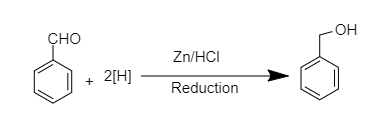
So, the correct answer is Option B.
Note: Benzaldehyde \[({C_6}{H_5}CHO)\] – It is a compound containing formyl group. This is a colourless liquid. Benzaldehyde can be extracted from other natural sources which can be used to flavour cakes and baked goods.
There are a variety of methods used for reducing carbonyl compounds (aldehydes and ketones). One of the methods used is use of Grignard Reagent.
When Grignard reagents react with aldehydes and ketones, it forms additional products which decompose with dil. \[HCl\] or dil. \[{H_2}S{O_4}\] to give primary, secondary and tertiary alcohols. Formaldehyde gives primary alcohol whereas all other aldehydes give secondary alcohols and ketones furnish tertiary alcohols.
Here, students might be confused about the fact that the reduction of benzaldehyde can also be carried out using Grignard reagent, $C{H_3}I$ and $Mg$ to produce benzyl alcohol. But, remember Phenyl methanol is an aromatic primary alcohol hence, it cannot be produced by reduction of benzaldehyde using Grignard reagent. The reaction between benzaldehyde with Grignard reagent will yield secondary alcohol.
Attribution: Leyo, Public domain, via Wikimedia Commons
Benzaldehyde is an aromatic aldehyde and can be converted into diphenylmethanol by reduction reaction.
Complete step by step answer:
Phenylmethanol can be prepared from benzaldehyde by treating it with zinc in presence of \[HCl\].This is categorised as a reduction reaction as hydrogen is added to the molecule during this reaction.
Given below is the chemical reaction for the same.
So, the correct answer is Option B.
Note: Benzaldehyde \[({C_6}{H_5}CHO)\] – It is a compound containing formyl group. This is a colourless liquid. Benzaldehyde can be extracted from other natural sources which can be used to flavour cakes and baked goods.
There are a variety of methods used for reducing carbonyl compounds (aldehydes and ketones). One of the methods used is use of Grignard Reagent.
When Grignard reagents react with aldehydes and ketones, it forms additional products which decompose with dil. \[HCl\] or dil. \[{H_2}S{O_4}\] to give primary, secondary and tertiary alcohols. Formaldehyde gives primary alcohol whereas all other aldehydes give secondary alcohols and ketones furnish tertiary alcohols.
Here, students might be confused about the fact that the reduction of benzaldehyde can also be carried out using Grignard reagent, $C{H_3}I$ and $Mg$ to produce benzyl alcohol. But, remember Phenyl methanol is an aromatic primary alcohol hence, it cannot be produced by reduction of benzaldehyde using Grignard reagent. The reaction between benzaldehyde with Grignard reagent will yield secondary alcohol.
Recently Updated Pages
Explain the structure of megasporangium class 12 biology CBSE

Why is chloroform kept in dark coloured bottles class 12 chemistry CBSE
Derive the balancing condition of a Wheatstone bri class 12 physics CBSE
Draw VI characteristics of a pn junction diode Explain class 12 physics CBSE
Is it possible to carry pride in ones language too class 12 english CBSE
In a population at Hardy Weinberg equilibrium the allele class 12 biology CBSE
Trending doubts
Draw a labelled sketch of the human eye class 12 physics CBSE
Which are the Top 10 Largest Countries of the World?
Draw ray diagrams each showing i myopic eye and ii class 12 physics CBSE
Which is the correct genotypic ratio of mendel dihybrid class 12 biology CBSE
Differentiate between homogeneous and heterogeneous class 12 chemistry CBSE
Give 10 examples of unisexual and bisexual flowers