




Pendulum A is a physical pendulum made from a thin, rigid and uniform rod whose length is d. One end of this rod is attached to the ceiling by a frictionless hinge, so that the rod is free to swing back and forth. Pendulum B is a simple pendulum whose length is also d. Obtain the ratio $\dfrac{{{T_A}}}{{{T_B}}}$ of their periods for small angle oscillations.
A. 1:2
B. 2:1
C. 1:1
D. 1:3
Answer
 Verified
597.3k+ views
Hint: To find the solution of the given question first find the time period experienced by a physical pendulum and a simple pendulum. Then find the ratio of the time period of both pendulum A and B, which is the required answer.
Formula Used:
$T = 2\pi \sqrt {\dfrac{I}{{mgL}}} $
$T = 2\pi \sqrt {\dfrac{L}{g}} $
Complete answer:
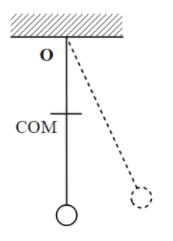
A physical pendulum is known as any object whose oscillations are similar to that of a simple pendulum, but it cannot be modelled as a point mass on a string, and the mass distribution is included in the equation of motion. The period of a physical pendulum mathematically is given as, $T = 2\pi \sqrt {\dfrac{I}{{mgL}}} $
where ‘I’ is the moment of inertia about its point, ‘L’ is the length of the string of the pendulum.
According to the question, Pendulum A is a physical pendulum which is made from a thin, rigid and uniform rod whose length is ‘d’ and one end of this rod is attached to the ceiling by a frictionless hinge, so that the rod is free to swing back and forth. So, period of pendulum A is given by,
${T_A} = 2\pi \sqrt {\dfrac{{2d}}{{3g}}} $
A simple pendulum is known to have a point mass, which is also known as the pendulum bob, which is suspended from ‘L’ length of string. Here, the mass of the string is considered negligible as compared to the mass of the bob. Mathematically, time period of a simple pendulum is given as,
$T = 2\pi \sqrt {\dfrac{L}{g}} $
Similarly, Pendulum B is a simple pendulum whose length is also ‘d’. So, period of pendulum B is given by,
${T_B} = 2\pi \sqrt {\dfrac{d}{g}} $
Now, the ratio of the period of pendulum A and pendulum B will be given as,
$\dfrac{{{T_A}}}{{{T_B}}} = \dfrac{{2\pi \sqrt {2d/3g} }}{{2\pi \sqrt {d/g} }}$
$ \Rightarrow \dfrac{{{T_A}}}{{{T_B}}} = \sqrt {\dfrac{2}{3}} $
$ \Rightarrow \dfrac{{{T_A}}}{{{T_B}}} = 0.816 \sim 1$
Therefore, the ratio $\dfrac{{{T_A}}}{{{T_B}}}$ of their periods for small angle oscillations is 1:1.
Hence, option (C) is the correct answer.
Note:
The time period of a simple pendulum depends on its length and the acceleration experienced due to gravity. It is independent of the other factors such as the mass and the maximum acceleration. In a physical pendulum, the force of the gravity acts on the centre of mass of the object.
Formula Used:
$T = 2\pi \sqrt {\dfrac{I}{{mgL}}} $
$T = 2\pi \sqrt {\dfrac{L}{g}} $
Complete answer:
A physical pendulum is known as any object whose oscillations are similar to that of a simple pendulum, but it cannot be modelled as a point mass on a string, and the mass distribution is included in the equation of motion. The period of a physical pendulum mathematically is given as, $T = 2\pi \sqrt {\dfrac{I}{{mgL}}} $
where ‘I’ is the moment of inertia about its point, ‘L’ is the length of the string of the pendulum.
According to the question, Pendulum A is a physical pendulum which is made from a thin, rigid and uniform rod whose length is ‘d’ and one end of this rod is attached to the ceiling by a frictionless hinge, so that the rod is free to swing back and forth. So, period of pendulum A is given by,
${T_A} = 2\pi \sqrt {\dfrac{{2d}}{{3g}}} $
A simple pendulum is known to have a point mass, which is also known as the pendulum bob, which is suspended from ‘L’ length of string. Here, the mass of the string is considered negligible as compared to the mass of the bob. Mathematically, time period of a simple pendulum is given as,
$T = 2\pi \sqrt {\dfrac{L}{g}} $
Similarly, Pendulum B is a simple pendulum whose length is also ‘d’. So, period of pendulum B is given by,
${T_B} = 2\pi \sqrt {\dfrac{d}{g}} $
Now, the ratio of the period of pendulum A and pendulum B will be given as,
$\dfrac{{{T_A}}}{{{T_B}}} = \dfrac{{2\pi \sqrt {2d/3g} }}{{2\pi \sqrt {d/g} }}$
$ \Rightarrow \dfrac{{{T_A}}}{{{T_B}}} = \sqrt {\dfrac{2}{3}} $
$ \Rightarrow \dfrac{{{T_A}}}{{{T_B}}} = 0.816 \sim 1$
Therefore, the ratio $\dfrac{{{T_A}}}{{{T_B}}}$ of their periods for small angle oscillations is 1:1.
Hence, option (C) is the correct answer.
Note:
The time period of a simple pendulum depends on its length and the acceleration experienced due to gravity. It is independent of the other factors such as the mass and the maximum acceleration. In a physical pendulum, the force of the gravity acts on the centre of mass of the object.
Recently Updated Pages
Master Class 11 Social Science: Engaging Questions & Answers for Success

Master Class 11 Physics: Engaging Questions & Answers for Success
Master Class 11 Maths: Engaging Questions & Answers for Success
Master Class 11 Economics: Engaging Questions & Answers for Success
Master Class 11 Computer Science: Engaging Questions & Answers for Success
Master Class 11 Chemistry: Engaging Questions & Answers for Success
Trending doubts
One Metric ton is equal to kg A 10000 B 1000 C 100 class 11 physics CBSE
There are 720 permutations of the digits 1 2 3 4 5 class 11 maths CBSE
1 Quintal is equal to a 110 kg b 10 kg c 100kg d 1000 class 11 physics CBSE
State and prove Bernoullis theorem class 11 physics CBSE
Difference Between Prokaryotic Cells and Eukaryotic Cells
Which among the following are examples of coming together class 11 social science CBSE