




Paurometabolous type of metamorphosis occurs in
(a) Cockroach
(b) Mosquito
(c) Housefly
(d) Honeybee
Answer
 Verified
653.4k+ views
Hint: The insects that belong to the arthropod phylum have a paurometabolous type of metamorphosis. In warm, dark, wet places, including sewers and basements, they tend to live. Via drains and pipes, they also penetrate into the buildings.
Complete step by step answer:
Paurometabolous is the process of gradual metamorphosis. Paurometabolous is the type of growth that occurs in insects such as cockroaches, which includes just three stages, i.e. egg, nymph, and adult. It is called incomplete metamorphosis or paurometabolous since it lacks the pupa stage. This implies that through nymphal phases, there is growth from young to adult. Nymphs are very much like adults. The nymph develops to reach the adult form by moulting approximately 13 times. The second-last nymphal stage shows the presence of wing pads, which shows the presence of wings later in the last stage (adult).
Small adults resemble growth at immature stages and live in the same habitat as adults and eat the same food.
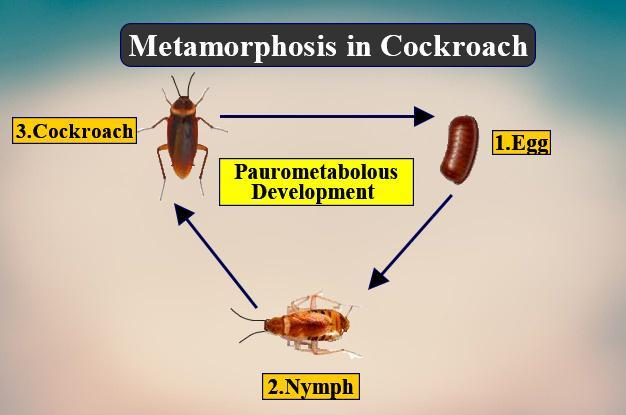
So, the correct answer is, 'Cockroach'.
Additional information:
From post-birth or hatching to the adult stage, metamorphosis is characterized by less abrupt development. In butterflies, frogs, and fish, metamorphosis is also evident.
- In their life cycle, all mosquitoes (all species) go through four stages:
The step where the egg hatches when exposed to water.
The larval stage, which lives and moulds many times on the surface of the water.
The pupal stage where it does not feed.
The pupal process emerges from the pupa in the adult stage and flies shortly after emerging.
- The stages of growth of a housefly are identical to that of a mosquito. The cycle starts with an embryo, which evolves later into a larva phase, a pupa phase, and an adult emerges later from the pupa.
- The honeybee also has phases similar to the mosquito and the housefly.
Note: Metamorphosis is a biological process by which, after birth or hatching, an animal physically evolves. Four phases are involved in complete metamorphosis: egg, larva, pupa, and adult. The incomplete metamorphosis, however, is made up of three stages: embryo, nymph, and adult. Complete metamorphosis occurs in ants, wasps, and fleas, while termites, praying mantis, and cockroaches undergo incomplete metamorphosis. 9-10 ootheca are produced by the female cockroach, each containing 14-16 eggs. These eggs are stuck to a suitable surface that is humid and has a nearby food supply.
Complete step by step answer:
Paurometabolous is the process of gradual metamorphosis. Paurometabolous is the type of growth that occurs in insects such as cockroaches, which includes just three stages, i.e. egg, nymph, and adult. It is called incomplete metamorphosis or paurometabolous since it lacks the pupa stage. This implies that through nymphal phases, there is growth from young to adult. Nymphs are very much like adults. The nymph develops to reach the adult form by moulting approximately 13 times. The second-last nymphal stage shows the presence of wing pads, which shows the presence of wings later in the last stage (adult).
Small adults resemble growth at immature stages and live in the same habitat as adults and eat the same food.
So, the correct answer is, 'Cockroach'.
Additional information:
From post-birth or hatching to the adult stage, metamorphosis is characterized by less abrupt development. In butterflies, frogs, and fish, metamorphosis is also evident.
- In their life cycle, all mosquitoes (all species) go through four stages:
The step where the egg hatches when exposed to water.
The larval stage, which lives and moulds many times on the surface of the water.
The pupal stage where it does not feed.
The pupal process emerges from the pupa in the adult stage and flies shortly after emerging.
- The stages of growth of a housefly are identical to that of a mosquito. The cycle starts with an embryo, which evolves later into a larva phase, a pupa phase, and an adult emerges later from the pupa.
- The honeybee also has phases similar to the mosquito and the housefly.
Note: Metamorphosis is a biological process by which, after birth or hatching, an animal physically evolves. Four phases are involved in complete metamorphosis: egg, larva, pupa, and adult. The incomplete metamorphosis, however, is made up of three stages: embryo, nymph, and adult. Complete metamorphosis occurs in ants, wasps, and fleas, while termites, praying mantis, and cockroaches undergo incomplete metamorphosis. 9-10 ootheca are produced by the female cockroach, each containing 14-16 eggs. These eggs are stuck to a suitable surface that is humid and has a nearby food supply.
Recently Updated Pages
Write structures of the following compounds i 2 Chloro3methylpentane class 11 chemistry CBSE

What is BLO What is the full form of BLO class 8 social science CBSE
Explain the Treaty of Vienna of 1815 class 10 social science CBSE
A Paragraph on Pollution in about 100-150 Words
XIX+XXX A 49 B 51 C 55 D 44 class 5 maths CBSE
If x a + bt + ct2 where x is in meters and t is in class 11 physics CBSE
Trending doubts
One Metric ton is equal to kg A 10000 B 1000 C 100 class 11 physics CBSE
Find the value of the expression given below sin 30circ class 11 maths CBSE
Draw a diagram of nephron and explain its structur class 11 biology CBSE
10 examples of friction in our daily life
Draw a diagram of a plant cell and label at least eight class 11 biology CBSE
Proton was discovered by A Thomson B Rutherford C Chadwick class 11 chemistry CBSE