




What is the Path of the Circulatory System?
Answer
 Verified
536.1k+ views
Hint: Circulatory system is a system in the body, which is made of blood vessels. It carries blood towards and away from the heart. It helps in removing wastes and carbon dioxide from the body cells. It is also helpful in carrying nutrients, hormones and oxygen to cells. It is the system, which contains heart, blood vessels and blood movement throughout the body. The system is a portion of the cardiovascular system of the body.
Complete answer:
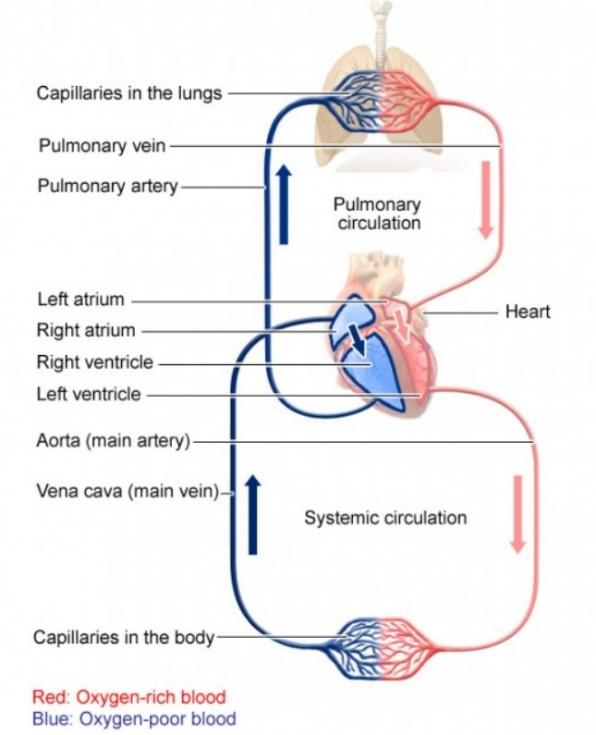
In the circulatory system, the artery carries blood away from the heart. Vein carries blood towards the heart. Capillaries are the smallest blood vessels that deliver oxygen and blood to the cells. Aorta is the biggest artery and it is like a tree. From the aorta, arterioles spread out to the body like the branches of the tree.
There are two circulatory paths in the body. They are systemic circulation and pulmonary circulation.
In systemic circulation, the left ventricle pumps oxygenated blood into the aorta. Then the blood passes into arterioles branching out from the aorta.
In pulmonary circulation, the left ventricle containing deoxygenated blood pumps blood to the pulmonary artery, which is branched into little capillaries surrounded by tiny vesicles known as air sacs. Here, oxygen is picked on by dropping carbon dioxide. During exhalation, fresh oxygen enters the lungs. Oxygenated blood then returns to the heart to the left atrium via pulmonary vein and then pumped into left ventricle and then pumped into whole body.
Note:
The circulation of blood starts during the relaxation of the heart. Blood flows from the left atrium and right atrium into left and right ventricles, which are lower chambers and they both expand. Then the blood is ejected during the contraction of ventricles and the blood is pumped into arteries. Systemic circulation provides nutrients and foods to tissues, organs and cells of the body. Pulmonary circulation acts as a path through which gaseous exchange takes place.
Complete answer:
In the circulatory system, the artery carries blood away from the heart. Vein carries blood towards the heart. Capillaries are the smallest blood vessels that deliver oxygen and blood to the cells. Aorta is the biggest artery and it is like a tree. From the aorta, arterioles spread out to the body like the branches of the tree.
There are two circulatory paths in the body. They are systemic circulation and pulmonary circulation.
In systemic circulation, the left ventricle pumps oxygenated blood into the aorta. Then the blood passes into arterioles branching out from the aorta.
In pulmonary circulation, the left ventricle containing deoxygenated blood pumps blood to the pulmonary artery, which is branched into little capillaries surrounded by tiny vesicles known as air sacs. Here, oxygen is picked on by dropping carbon dioxide. During exhalation, fresh oxygen enters the lungs. Oxygenated blood then returns to the heart to the left atrium via pulmonary vein and then pumped into left ventricle and then pumped into whole body.
Note:
The circulation of blood starts during the relaxation of the heart. Blood flows from the left atrium and right atrium into left and right ventricles, which are lower chambers and they both expand. Then the blood is ejected during the contraction of ventricles and the blood is pumped into arteries. Systemic circulation provides nutrients and foods to tissues, organs and cells of the body. Pulmonary circulation acts as a path through which gaseous exchange takes place.
Recently Updated Pages
Master Class 12 Economics: Engaging Questions & Answers for Success

Master Class 12 English: Engaging Questions & Answers for Success
Master Class 12 Social Science: Engaging Questions & Answers for Success
Master Class 12 Maths: Engaging Questions & Answers for Success
Master Class 12 Physics: Engaging Questions & Answers for Success
Master Class 9 General Knowledge: Engaging Questions & Answers for Success
Trending doubts
One Metric ton is equal to kg A 10000 B 1000 C 100 class 11 physics CBSE
Difference Between Prokaryotic Cells and Eukaryotic Cells
Find the value of the expression given below sin 30circ class 11 maths CBSE
Two of the body parts which do not appear in MRI are class 11 biology CBSE
1 ton equals to A 100 kg B 1000 kg C 10 kg D 10000 class 11 physics CBSE
Draw a diagram of nephron and explain its structur class 11 biology CBSE