




Pashmina is obtained from a variety of
(a) Sheep
(b) Goat
(c) Rabbit
(d) Yak
Answer
 Verified
615k+ views
Hint: Pashmina the finest quality wool is made from animal hair fibers. This animal is a native to Ladakh in India. Their horns are rounded and always move upward.
Complete step by step answer:
Pashmina is the finest quality of wool obtained from a special variety of goat Pashmina living in high altitude regions of India. This goat is mainly native to Tibet, Nepal, and Ladakh in Jammu Kashmir, India. They are also called Changthangi goats.
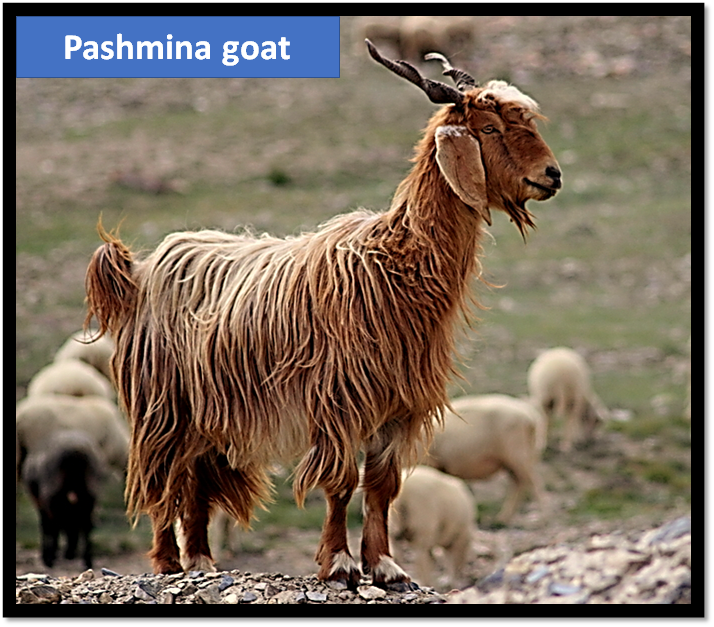
So, the correct answer is,’Goat’.
Additional Information:
- They survive in the grass and at low temperatures.
- The Pashmina goat provides wool for the famous Kashmiri shawl i.e., Pashmina shawls.
- Pashmina fibers range from 12 to 16 microns.
- The fabric made from Pashmina fiber is very soft and warm too.
- For ultra- fine cashmere wool Changthangi goats are raised.
- Pure Pashmina is slightly gauzy as it is women lose because the fiber cannot tolerate high tension.
- In the Himalaya, the traditional producer of Pashmina wool is the Changpa tribes in the Ladakh region.
- They rear Pashmina goats for wool and sheep for meat in the harsh climate of Ladakh.
- Sheep wool is called fleece. It is used in knitwear such as socks and jumpers and also in making chair covers.
- Rabbit wool is called angora as it is obtained from an angora rabbit. It can produce about 3 pounds of hair per year.
- Yak wools are warmer than wool and softer than cashmere.
Note:
- In India, $80\%$ of the Pashmina wool is produced by the changpa tribes.
- Pashmina shawls are the best variety of shawls with a fiber range of 13 micrometers or less.
- Pashmina is also used in making blankets which are also very famous.
- Pashmina fabrics that are used for making dresses include $70\%$ Pashmina blend with $30\%$ silk.
Complete step by step answer:
Pashmina is the finest quality of wool obtained from a special variety of goat Pashmina living in high altitude regions of India. This goat is mainly native to Tibet, Nepal, and Ladakh in Jammu Kashmir, India. They are also called Changthangi goats.
So, the correct answer is,’Goat’.
Additional Information:
- They survive in the grass and at low temperatures.
- The Pashmina goat provides wool for the famous Kashmiri shawl i.e., Pashmina shawls.
- Pashmina fibers range from 12 to 16 microns.
- The fabric made from Pashmina fiber is very soft and warm too.
- For ultra- fine cashmere wool Changthangi goats are raised.
- Pure Pashmina is slightly gauzy as it is women lose because the fiber cannot tolerate high tension.
- In the Himalaya, the traditional producer of Pashmina wool is the Changpa tribes in the Ladakh region.
- They rear Pashmina goats for wool and sheep for meat in the harsh climate of Ladakh.
- Sheep wool is called fleece. It is used in knitwear such as socks and jumpers and also in making chair covers.
- Rabbit wool is called angora as it is obtained from an angora rabbit. It can produce about 3 pounds of hair per year.
- Yak wools are warmer than wool and softer than cashmere.
Note:
- In India, $80\%$ of the Pashmina wool is produced by the changpa tribes.
- Pashmina shawls are the best variety of shawls with a fiber range of 13 micrometers or less.
- Pashmina is also used in making blankets which are also very famous.
- Pashmina fabrics that are used for making dresses include $70\%$ Pashmina blend with $30\%$ silk.
Recently Updated Pages
Master Class 11 English: Engaging Questions & Answers for Success

Master Class 11 Social Science: Engaging Questions & Answers for Success
Master Class 11 Maths: Engaging Questions & Answers for Success
Master Class 11 Chemistry: Engaging Questions & Answers for Success
Master Class 11 Biology: Engaging Questions & Answers for Success
Master Class 11 Physics: Engaging Questions & Answers for Success
Trending doubts
One Metric ton is equal to kg A 10000 B 1000 C 100 class 11 physics CBSE
Difference Between Prokaryotic Cells and Eukaryotic Cells
Find the value of the expression given below sin 30circ class 11 maths CBSE
1 ton equals to A 100 kg B 1000 kg C 10 kg D 10000 class 11 physics CBSE
Two of the body parts which do not appear in MRI are class 11 biology CBSE
What are hard magnetic materials class 11 physics CBSE