




What is the pascal triangle upto \[30\] rows?
Answer
 Verified
552.3k+ views
Hint: One of the most interesting Number Patterns in Pascal's Triangle (named after Blaise Pascal, a famous French Mathematician and Philosopher). To build the triangle, start with " \[1\]" at the top, then continue placing numbers below it in a triangular pattern. Each number is the numbers directly above it added together.
Complete step by step solution:
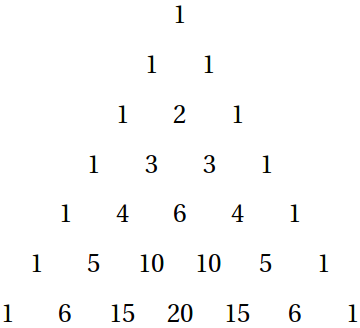
The rows of Pascal's triangle are numbered starting with row \[n = 0\] at the top. The entries in each row are numbered from the left beginning with \[k = 0\] and are usually staggered relative to the numbers in the adjacent rows. Example is shown below:
The formula to find the entry of an element in the nth row and $k^{th}$ column of a pascal’s triangle is given by:
\[\left( {_k^n} \right)\]
The elements of the following rows and columns can be found using the formula given below.
\[\left( {_k^n} \right) = \left( {_{k - 1}^{n - 1}} \right) + \left( {_{\,\,\,\,k}^{n - 1}} \right)\]
Here, \[n\] is any non-negative integer and \[0 \leqslant k \leqslant n\].
The above notation can be written as:
\[\left( {_k^n} \right){ = _n}{C_k} = \dfrac{{n!}}{{k!(n - k!)}}\]
Pascal’s Triangle Binomial Expansion: Pascal’s triangle defines the coefficients which appear in binomial expansions. That means the nth row of Pascal’s triangle comprises the coefficients of the expanded expression of the polynomial \[{(x + y)^n}\].
The expansion of \[{(x + y)^n}\] is:
\[{(x + 1)^3} = {a_0}{x^n} + {a_1}{x^{n - 1}}y + {a_2}{x^{n - 2}}{y^2} + ... + {a_{n - 1}}x{y^{n - 1}} + {a_n}{y^n}\]
Hence the \[{30^{th}}\] row of pascal triangle will be:
\[{(x + 1)^{30}}\]
It can be expanded as follows:
\[{(x + 1)^{30}} = 30{C_0}{x^{30}} + 30{C_1}{x^{30 - 1}}(1) + 30{C_2}{x^{30 - 2}}{(1)^2} + ... + 30{C_{30}}{(1)^{30}}\].
Note:
1) Pascal's Triangle can show the probability of any combination. For example, if you toss a coin three times, there is only one combination that will give you three heads (HHH), but there are three that will give two heads and one tail (HHT, HTH, THH), also three that give one head and two tails (HTT, THT, TTH) and one for all Tails (TTT). This is the pattern. \[1,3,3,1\]..in Pascal's Triangle.
2By adding the numbers in the diagonals of the Pascal triangle the Fibonacci sequence can be obtained.
Complete step by step solution:
The rows of Pascal's triangle are numbered starting with row \[n = 0\] at the top. The entries in each row are numbered from the left beginning with \[k = 0\] and are usually staggered relative to the numbers in the adjacent rows. Example is shown below:
The formula to find the entry of an element in the nth row and $k^{th}$ column of a pascal’s triangle is given by:
\[\left( {_k^n} \right)\]
The elements of the following rows and columns can be found using the formula given below.
\[\left( {_k^n} \right) = \left( {_{k - 1}^{n - 1}} \right) + \left( {_{\,\,\,\,k}^{n - 1}} \right)\]
Here, \[n\] is any non-negative integer and \[0 \leqslant k \leqslant n\].
The above notation can be written as:
\[\left( {_k^n} \right){ = _n}{C_k} = \dfrac{{n!}}{{k!(n - k!)}}\]
Pascal’s Triangle Binomial Expansion: Pascal’s triangle defines the coefficients which appear in binomial expansions. That means the nth row of Pascal’s triangle comprises the coefficients of the expanded expression of the polynomial \[{(x + y)^n}\].
The expansion of \[{(x + y)^n}\] is:
\[{(x + 1)^3} = {a_0}{x^n} + {a_1}{x^{n - 1}}y + {a_2}{x^{n - 2}}{y^2} + ... + {a_{n - 1}}x{y^{n - 1}} + {a_n}{y^n}\]
Hence the \[{30^{th}}\] row of pascal triangle will be:
\[{(x + 1)^{30}}\]
It can be expanded as follows:
\[{(x + 1)^{30}} = 30{C_0}{x^{30}} + 30{C_1}{x^{30 - 1}}(1) + 30{C_2}{x^{30 - 2}}{(1)^2} + ... + 30{C_{30}}{(1)^{30}}\].
Note:
1) Pascal's Triangle can show the probability of any combination. For example, if you toss a coin three times, there is only one combination that will give you three heads (HHH), but there are three that will give two heads and one tail (HHT, HTH, THH), also three that give one head and two tails (HTT, THT, TTH) and one for all Tails (TTT). This is the pattern. \[1,3,3,1\]..in Pascal's Triangle.
2By adding the numbers in the diagonals of the Pascal triangle the Fibonacci sequence can be obtained.
Recently Updated Pages
Master Class 10 English: Engaging Questions & Answers for Success

Master Class 10 Social Science: Engaging Questions & Answers for Success
Master Class 10 Computer Science: Engaging Questions & Answers for Success
Class 10 Question and Answer - Your Ultimate Solutions Guide
Master Class 10 General Knowledge: Engaging Questions & Answers for Success
Master Class 10 Maths: Engaging Questions & Answers for Success
Trending doubts
What is the full form of NDA a National Democratic class 10 social science CBSE
Explain the Treaty of Vienna of 1815 class 10 social science CBSE
Who Won 36 Oscar Awards? Record Holder Revealed
Bharatiya Janata Party was founded in the year A 1979 class 10 social science CBSE
What is the median of the first 10 natural numbers class 10 maths CBSE
Why is it 530 pm in india when it is 1200 afternoon class 10 social science CBSE