




Parts A, B, C and D of the human eye are shown in the diagram. Select the option which gives correct identification along with its functions/characteristics.
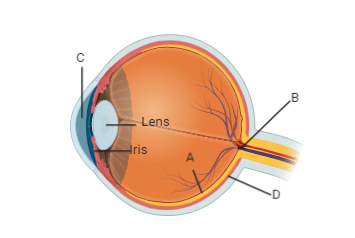
A. Retina - contains photoreceptors- rods and cones.
B. Blindspot - has only a few rods and cones.
C. Aqueous chamber reflects the light which does not pass through the lens.
D. Choroid - its anterior part forms a ciliary body.
Answer
 Verified
628.8k+ views
Hint: The eye is the most significant instrument that detects light and sends signals on the optic nerve (second cranial nerve) to the brain. The retina is sensory in nature whereas the blindspot helps for interpretation. The rod and cones help in vision in light and dark. The aqueous chamber helps in maintaining intraocular pressure and the choroid prevents internal reflection in the eye. The human eye has many parts including the iris, Cornea, Pupil, Sclera, and Conjunctiva.
Complete step by step answer: The human eye is known to be the most complex organ in the human body. It is responsible for functions like providing the vision, helping in color differentiation, etc of the human body.
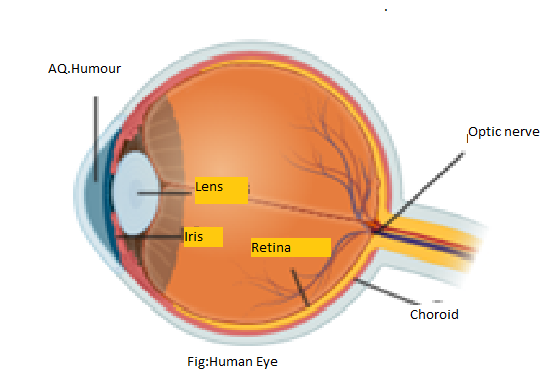
-The Retina (tissue layer) is the sensory layer of the eye that consists of rod and cone cells for vision. The rod cells in the retina facilitate the vision in dim light-weight whereas the cone cells facilitate the vision in sturdy light.
-Blindspot is that particular point of the eye that is void of rod and cone cells. The optic nerve emerges from that point that carries the optic impulse to the lobe of the brain for interpretation.
The aqueous chamber is filled with a clear fluid called humor. It is responsible for maintaining the pressure(intraocular)and index of refraction of the eye.
-The choroid is the vascular layer that absorbs the light and prevents the inner reflection of light within the eye. The anterior part of the choroid coat layer forms the ciliary body which is a membrane.
Hence, the proper choice A- Retina - contains photoreceptors- rods and cones.
Note: Human eye has a special receptor responsible for receiving visual pictures that are then carried to the brain. Light enters the eye through the tissue layer, the clear front surface of the eye, that acts sort of a lens. The iris works very like the controller of a camera onto how much light reaches the back of the eye.
Complete step by step answer: The human eye is known to be the most complex organ in the human body. It is responsible for functions like providing the vision, helping in color differentiation, etc of the human body.
-The Retina (tissue layer) is the sensory layer of the eye that consists of rod and cone cells for vision. The rod cells in the retina facilitate the vision in dim light-weight whereas the cone cells facilitate the vision in sturdy light.
-Blindspot is that particular point of the eye that is void of rod and cone cells. The optic nerve emerges from that point that carries the optic impulse to the lobe of the brain for interpretation.
The aqueous chamber is filled with a clear fluid called humor. It is responsible for maintaining the pressure(intraocular)and index of refraction of the eye.
-The choroid is the vascular layer that absorbs the light and prevents the inner reflection of light within the eye. The anterior part of the choroid coat layer forms the ciliary body which is a membrane.
Hence, the proper choice A- Retina - contains photoreceptors- rods and cones.
Note: Human eye has a special receptor responsible for receiving visual pictures that are then carried to the brain. Light enters the eye through the tissue layer, the clear front surface of the eye, that acts sort of a lens. The iris works very like the controller of a camera onto how much light reaches the back of the eye.
Recently Updated Pages
Basicity of sulphurous acid and sulphuric acid are

Master Class 11 English: Engaging Questions & Answers for Success
Master Class 11 Physics: Engaging Questions & Answers for Success
Master Class 11 Computer Science: Engaging Questions & Answers for Success
Master Class 11 Chemistry: Engaging Questions & Answers for Success
Master Class 11 Social Science: Engaging Questions & Answers for Success
Trending doubts
Difference Between Prokaryotic Cells and Eukaryotic Cells
Two of the body parts which do not appear in MRI are class 11 biology CBSE
One Metric ton is equal to kg A 10000 B 1000 C 100 class 11 physics CBSE
10 examples of friction in our daily life
Draw a diagram of nephron and explain its structur class 11 biology CBSE
What will happen if the mucus is not secreted by the class 11 biology CBSE