




Para rubber is obtained from the latex
(a) Ficus elastica
(b) Hevea brasiliensis
(c) Carica papaya
(d) Musa paradisiaca
Answer
 Verified
613.8k+ views
Hint: It is a flowering plant belonging to the Euphorbiaceae family of spurges. As the milky latex extracted from the tree is the main source of natural rubber, it is the most economically important part.
Complete answer:
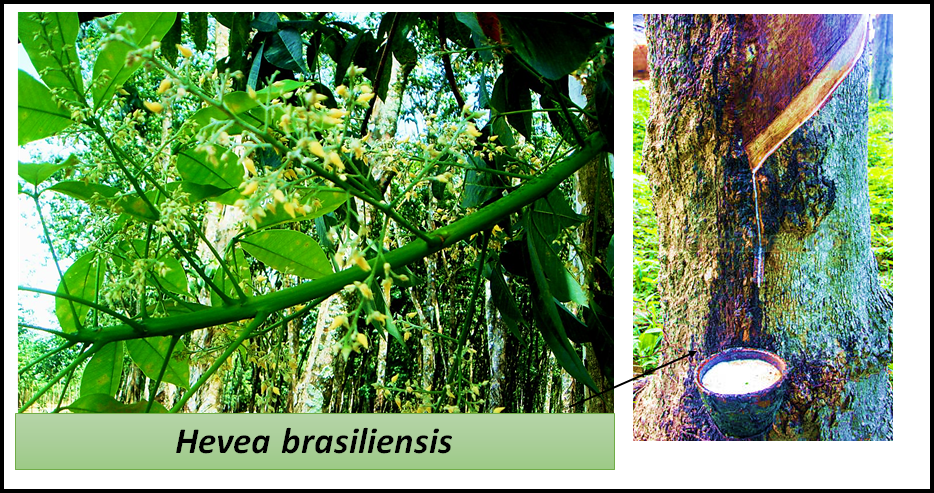
Para rubber is derived from Hevea brasiliensis latex.
H. Brasiliensis is a tall deciduous tree growing in the wild to a height of up to 43 m. The trunk is cylindrical and may have a base that is bloated and bottle-shaped. The bark is a certain shade of brown, and when wounded, the inner bark oozes latex. The leaves have three leaflets and are arranged spirally. The inflorescence consists of distinct male and female flowers. The flowers are creamy-yellow and pungent and have no petals. The fruit is a capsule containing three large seeds; when mature, it opens explosively.
Additional Information: Harvesters make incisions around the latex vessels, only deep enough to tap the vessels without compromising the growth of the tree, and in small buckets, the latex is collected. This method is known as tapping with rubber. From tree to tree and through clone forms, latex output is highly variable.
Some individuals have a severe allergy to latex, and anaphylactic shock may be caused by exposure to natural latex rubber products such as latex gloves. Via processing, the antigenic proteins present in Hevea latex can be purposely reduced (although not eliminated).
Some allergic reactions are not due to latex itself, but to traces of chemicals that are used to speed up the process of cross-linking. Although this may be mistaken for a latex allergy, it is distinct from it, usually taking the form of hypersensitivity of Type IV in the presence of traces of particular chemical processing items.
So, the answer is, “Hevea brasiliensis.”
Note: -The cultivated trees are typically much smaller because the development of the tree is limited by the removal of the latex.
- It takes between seven and ten years for the natural rubber tree to have the first crop.
-As latex production declines with age, when they reach the age of 25 to 30 years, rubber trees are normally cut down. The earlier method was to burn trees, but the wood has been processed for furniture production in recent decades.
-Latex from non-Hevea sources, such as Guayule, can be used by people with an allergy to Hevea latex without an allergic reaction.
Complete answer:
Para rubber is derived from Hevea brasiliensis latex.
H. Brasiliensis is a tall deciduous tree growing in the wild to a height of up to 43 m. The trunk is cylindrical and may have a base that is bloated and bottle-shaped. The bark is a certain shade of brown, and when wounded, the inner bark oozes latex. The leaves have three leaflets and are arranged spirally. The inflorescence consists of distinct male and female flowers. The flowers are creamy-yellow and pungent and have no petals. The fruit is a capsule containing three large seeds; when mature, it opens explosively.
Additional Information: Harvesters make incisions around the latex vessels, only deep enough to tap the vessels without compromising the growth of the tree, and in small buckets, the latex is collected. This method is known as tapping with rubber. From tree to tree and through clone forms, latex output is highly variable.
Some individuals have a severe allergy to latex, and anaphylactic shock may be caused by exposure to natural latex rubber products such as latex gloves. Via processing, the antigenic proteins present in Hevea latex can be purposely reduced (although not eliminated).
Some allergic reactions are not due to latex itself, but to traces of chemicals that are used to speed up the process of cross-linking. Although this may be mistaken for a latex allergy, it is distinct from it, usually taking the form of hypersensitivity of Type IV in the presence of traces of particular chemical processing items.
So, the answer is, “Hevea brasiliensis.”
Note: -The cultivated trees are typically much smaller because the development of the tree is limited by the removal of the latex.
- It takes between seven and ten years for the natural rubber tree to have the first crop.
-As latex production declines with age, when they reach the age of 25 to 30 years, rubber trees are normally cut down. The earlier method was to burn trees, but the wood has been processed for furniture production in recent decades.
-Latex from non-Hevea sources, such as Guayule, can be used by people with an allergy to Hevea latex without an allergic reaction.
Recently Updated Pages
Master Class 11 Social Science: Engaging Questions & Answers for Success

Master Class 11 Chemistry: Engaging Questions & Answers for Success
Master Class 12 Business Studies: Engaging Questions & Answers for Success
Master Class 12 Chemistry: Engaging Questions & Answers for Success
Master Class 12 Biology: Engaging Questions & Answers for Success
Class 12 Question and Answer - Your Ultimate Solutions Guide
Trending doubts
One Metric ton is equal to kg A 10000 B 1000 C 100 class 11 physics CBSE
Difference Between Prokaryotic Cells and Eukaryotic Cells
How many of the following diseases can be studied with class 11 biology CBSE
Two of the body parts which do not appear in MRI are class 11 biology CBSE
Which of the following enzymes is used for carboxylation class 11 biology CBSE
Explain zero factorial class 11 maths CBSE