




Oxidation numbers of ${\text{P}}$ in ${\text{PO}}_4^{3 - }$, of ${\text{S}}$ in ${\text{SO}}_4^{2 - }$ and that of ${\text{Cr}}$ in ${\text{C}}{{\text{r}}_2}{\text{O}}_7^{2 - }$are respectively:
A) $ + 3, + 6{\text{ and }} + 5$
B) $ + 5, + 3{\text{ and }} + 6$
C) $ + 3, + 6{\text{ and }} + 6$
D) $ + 5, + 6{\text{ and }} + 6$
Answer
 Verified
594.6k+ views
Hint: Oxidation number is the charge acquired by the species may be positive, negative or zero by gain or loss of electrons. To solve this we must know the oxidation number of oxygen. The charge on oxygen atoms is $ - 2$.
Complete answer:
First let us draw the structures of ${\text{PO}}_4^{3 - }$, ${\text{SO}}_4^{2 - }$ and ${\text{C}}{{\text{r}}_2}{\text{O}}_7^{2 - }$. The structures are as follows:
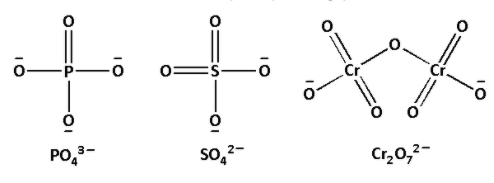
We are given a polyatomic anion ${\text{PO}}_4^{3 - }$. In the given polyatomic anion, we have to find the oxidation number of ${\text{P}}$.
We know that the charge on an oxygen atom is $ - 2$.
We know that the sum of all the oxidation numbers in a polyatomic ion is equal to the charge on the ion. Thus, the total charge on the polyatomic anion is $ - 3$. Thus,
Charge on ${\text{PO}}_4^{3 - }$ $ = {\text{ON of P}} + 4 \times \left( {{\text{ON of O}}} \right)$
Substitute $ - 3$ for the charge on ${\text{PO}}_4^{3 - }$, x for the oxidation number of ${\text{P}}$ and $ - 2$ for the charge on ${\text{O}}$. Thus,
$\Rightarrow - 3 = \left( x \right) + \left( {{\text{4}} \times \left( { - 2} \right)} \right)$
$\Rightarrow x = - 3 + 8$
$\Rightarrow x = + 5$
Thus, the oxidation number of ${\text{P}}$ in ${\text{PO}}_4^{3 - }$ is $ + 5$.
We are given a polyatomic anion ${\text{SO}}_4^{2 - }$. In the given polyatomic anion, we have to find the oxidation number of ${\text{S}}$.
We know that the charge on an oxygen atom is $ - 2$.
We know that the sum of all the oxidation numbers in a polyatomic ion is equal to the charge on the ion. Thus, the total charge on the polyatomic anion is $ - 2$. Thus,
Charge on ${\text{SO}}_4^{2 - }$ $ = {\text{ON of S}} + 4 \times \left( {{\text{ON of O}}} \right)$
Substitute $ - 2$ for the charge on ${\text{SO}}_4^{2 - }$, x for the oxidation number of ${\text{S}}$ and $ - 2$ for the charge on ${\text{O}}$. Thus,
$\Rightarrow - 2 = \left( x \right) + \left( {{\text{4}} \times \left( { - 2} \right)} \right)$
$\Rightarrow x = - 2 + 8$
$\Rightarrow x = + 6$
Thus, the oxidation number of ${\text{S}}$ in ${\text{SO}}_4^{2 - }$ is $ + 6$.
We are given a polyatomic anion ${\text{C}}{{\text{r}}_2}{\text{O}}_7^{2 - }$. In the given polyatomic anion, we have to find the oxidation number of ${\text{Cr}}$.
We know that the charge on an oxygen atom is $ - 2$.
We know that the sum of all the oxidation numbers in a polyatomic ion is equal to the charge on the ion. Thus, the total charge on the polyatomic anion is $ - 2$. Thus,
Charge on ${\text{C}}{{\text{r}}_2}{\text{O}}_7^{2 - }$ $ = 2 \times \left( {{\text{ON of Cr}}} \right) + 7 \times \left( {{\text{ON of O}}} \right)$
Substitute $ - 2$ for the charge on ${\text{C}}{{\text{r}}_2}{\text{O}}_7^{2 - }$, x for the oxidation number of ${\text{Cr}}$ and $ - 2$ for the charge on ${\text{O}}$. Thus,
$\Rightarrow - 2 = \left( {2x} \right) + \left( {{\text{7}} \times \left( { - 2} \right)} \right)$
$\Rightarrow 2x = - 2 + 14$
$\Rightarrow 2x = - 12$
$\Rightarrow x = + 6$
The oxidation number of ${\text{Cr}}$ in ${\text{C}}{{\text{r}}_2}{\text{O}}_7^{2 - }$ is $ + 6$.
Thus, oxidation numbers of ${\text{P}}$ in ${\text{PO}}_4^{3 - }$, of ${\text{S}}$ in ${\text{SO}}_4^{2 - }$ and that of ${\text{Cr}}$ in ${\text{C}}{{\text{r}}_2}{\text{O}}_7^{2 - }$are respectively $ + 5, + 6{\text{ and }} + 6$.
Thus, the correct answer is option (D) $ + 5, + 6{\text{ and }} + 6$.
Note: Rules for assigning the oxidation number to elements are as follows:
i) The oxidation number of an element in its free or uncombined state is always zero.
ii) The oxidation number of monatomic ions is the same as that of the positive or negative charge on the ion.
iii) The sum of all the oxidation numbers in a neutral compound is zero.
iv) The sum of oxidation numbers in a polyatomic ion is equal to the total charge on the polyatomic ion.
v) The oxidation number of alkali metals is always $ + 1$.
vi) The oxidation number of alkaline earth metals is always $ + 2$.
vii) The oxidation number of hydrogen is always $ + 1$.
viii) The oxidation number of oxygen is always $ - 2$.
Complete answer:
First let us draw the structures of ${\text{PO}}_4^{3 - }$, ${\text{SO}}_4^{2 - }$ and ${\text{C}}{{\text{r}}_2}{\text{O}}_7^{2 - }$. The structures are as follows:
We are given a polyatomic anion ${\text{PO}}_4^{3 - }$. In the given polyatomic anion, we have to find the oxidation number of ${\text{P}}$.
We know that the charge on an oxygen atom is $ - 2$.
We know that the sum of all the oxidation numbers in a polyatomic ion is equal to the charge on the ion. Thus, the total charge on the polyatomic anion is $ - 3$. Thus,
Charge on ${\text{PO}}_4^{3 - }$ $ = {\text{ON of P}} + 4 \times \left( {{\text{ON of O}}} \right)$
Substitute $ - 3$ for the charge on ${\text{PO}}_4^{3 - }$, x for the oxidation number of ${\text{P}}$ and $ - 2$ for the charge on ${\text{O}}$. Thus,
$\Rightarrow - 3 = \left( x \right) + \left( {{\text{4}} \times \left( { - 2} \right)} \right)$
$\Rightarrow x = - 3 + 8$
$\Rightarrow x = + 5$
Thus, the oxidation number of ${\text{P}}$ in ${\text{PO}}_4^{3 - }$ is $ + 5$.
We are given a polyatomic anion ${\text{SO}}_4^{2 - }$. In the given polyatomic anion, we have to find the oxidation number of ${\text{S}}$.
We know that the charge on an oxygen atom is $ - 2$.
We know that the sum of all the oxidation numbers in a polyatomic ion is equal to the charge on the ion. Thus, the total charge on the polyatomic anion is $ - 2$. Thus,
Charge on ${\text{SO}}_4^{2 - }$ $ = {\text{ON of S}} + 4 \times \left( {{\text{ON of O}}} \right)$
Substitute $ - 2$ for the charge on ${\text{SO}}_4^{2 - }$, x for the oxidation number of ${\text{S}}$ and $ - 2$ for the charge on ${\text{O}}$. Thus,
$\Rightarrow - 2 = \left( x \right) + \left( {{\text{4}} \times \left( { - 2} \right)} \right)$
$\Rightarrow x = - 2 + 8$
$\Rightarrow x = + 6$
Thus, the oxidation number of ${\text{S}}$ in ${\text{SO}}_4^{2 - }$ is $ + 6$.
We are given a polyatomic anion ${\text{C}}{{\text{r}}_2}{\text{O}}_7^{2 - }$. In the given polyatomic anion, we have to find the oxidation number of ${\text{Cr}}$.
We know that the charge on an oxygen atom is $ - 2$.
We know that the sum of all the oxidation numbers in a polyatomic ion is equal to the charge on the ion. Thus, the total charge on the polyatomic anion is $ - 2$. Thus,
Charge on ${\text{C}}{{\text{r}}_2}{\text{O}}_7^{2 - }$ $ = 2 \times \left( {{\text{ON of Cr}}} \right) + 7 \times \left( {{\text{ON of O}}} \right)$
Substitute $ - 2$ for the charge on ${\text{C}}{{\text{r}}_2}{\text{O}}_7^{2 - }$, x for the oxidation number of ${\text{Cr}}$ and $ - 2$ for the charge on ${\text{O}}$. Thus,
$\Rightarrow - 2 = \left( {2x} \right) + \left( {{\text{7}} \times \left( { - 2} \right)} \right)$
$\Rightarrow 2x = - 2 + 14$
$\Rightarrow 2x = - 12$
$\Rightarrow x = + 6$
The oxidation number of ${\text{Cr}}$ in ${\text{C}}{{\text{r}}_2}{\text{O}}_7^{2 - }$ is $ + 6$.
Thus, oxidation numbers of ${\text{P}}$ in ${\text{PO}}_4^{3 - }$, of ${\text{S}}$ in ${\text{SO}}_4^{2 - }$ and that of ${\text{Cr}}$ in ${\text{C}}{{\text{r}}_2}{\text{O}}_7^{2 - }$are respectively $ + 5, + 6{\text{ and }} + 6$.
Thus, the correct answer is option (D) $ + 5, + 6{\text{ and }} + 6$.
Note: Rules for assigning the oxidation number to elements are as follows:
i) The oxidation number of an element in its free or uncombined state is always zero.
ii) The oxidation number of monatomic ions is the same as that of the positive or negative charge on the ion.
iii) The sum of all the oxidation numbers in a neutral compound is zero.
iv) The sum of oxidation numbers in a polyatomic ion is equal to the total charge on the polyatomic ion.
v) The oxidation number of alkali metals is always $ + 1$.
vi) The oxidation number of alkaline earth metals is always $ + 2$.
vii) The oxidation number of hydrogen is always $ + 1$.
viii) The oxidation number of oxygen is always $ - 2$.
Recently Updated Pages
Master Class 12 Economics: Engaging Questions & Answers for Success

Master Class 12 English: Engaging Questions & Answers for Success
Master Class 12 Social Science: Engaging Questions & Answers for Success
Master Class 12 Maths: Engaging Questions & Answers for Success
Master Class 12 Physics: Engaging Questions & Answers for Success
Master Class 11 Social Science: Engaging Questions & Answers for Success
Trending doubts
One Metric ton is equal to kg A 10000 B 1000 C 100 class 11 physics CBSE
Difference Between Prokaryotic Cells and Eukaryotic Cells
Find the value of the expression given below sin 30circ class 11 maths CBSE
Two of the body parts which do not appear in MRI are class 11 biology CBSE
Draw a diagram of nephron and explain its structur class 11 biology CBSE
10 examples of friction in our daily life