



Out of five petals of a flower are completely internal two completely external and the remaining one is internal at one margin and external at the other emerging. Aestivation is
A) Ascending imbricate
B) Vexillary
C)Quincuncial
D)Valvate
Answer
 Verified
589.5k+ views
Hint: It is an arrangement in which there are five floral parts of a flower. Two petals or sepals are positioned internally and two petals or sepals are positioned externally and the fifth part situated externally at the margin.
Complete answer:
Aestivation is an arrangement of the sepals or petals of a flower in bud condition.
They are the following types of aestivation- Velvet aestivation, Twisted aestivation, imbricate aestivation, Quincuncial aestivation.
-In Quincuncial aestivation floral leaves are spirally arranged. In this leaves 1 and 2 are external,3 is partially external,4 and 5 are internal. This type of modification is mainly seen in Guava.
Additional Information: Valvate aestivation - It is an arrangement of sepals and petals in a flower bud in such a manner that these parts meet at their edges and do not overlap each other. Valvate aestivation is mainly seen in China rose.
Imbricate aestivation- It is an arrangement in which sepals and petals are internal and they are being overlapped on both the margins. In this one sepal or petals are external and overlapping is each other. Imbricate aestivation is mainly seen in Gulmohar.
Vexillary aestivation- it is an arrangement in which smaller petals are covered by one larger petal. The larger petal is called vexillum and the two curved petals are called wings. Vexillary aestivation is mainly seen in polypetalous.
So, the correct answer is, "Quincuncial".
Note: -Position, arrangement, and overlapping of floral perianth parts are called as perianth aestivation.
-If the perianth members are free from one another, then it is called polyphyllous.
-Aestivation is also referred to as prefoliation.
- For the classification of plants, aestivation is considered to be very important.
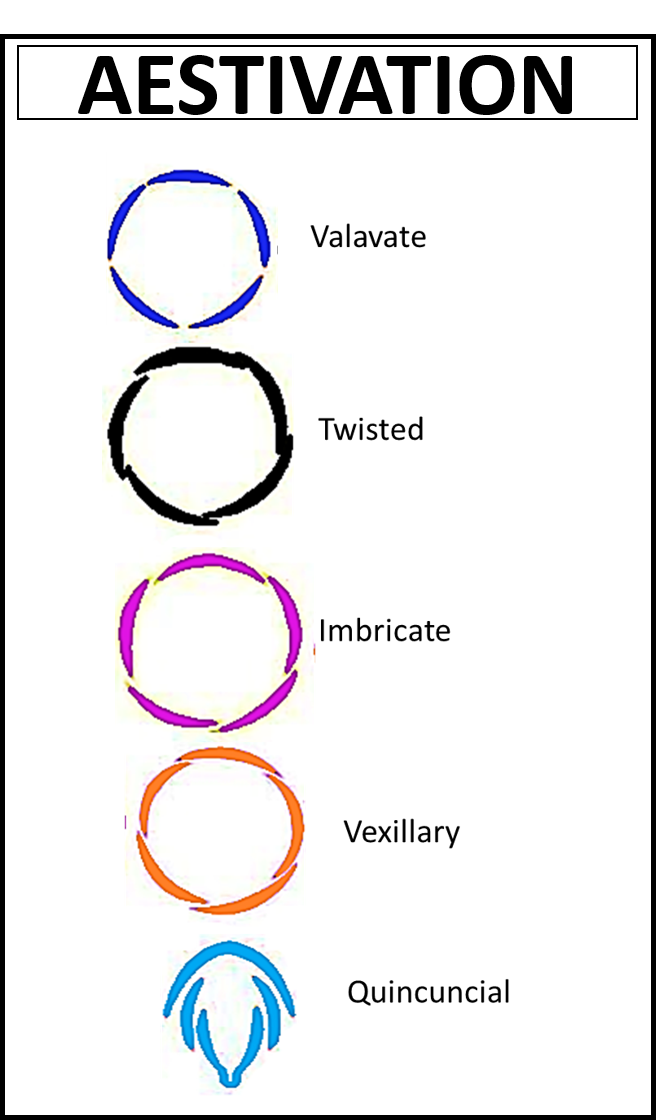
Complete answer:
Aestivation is an arrangement of the sepals or petals of a flower in bud condition.
They are the following types of aestivation- Velvet aestivation, Twisted aestivation, imbricate aestivation, Quincuncial aestivation.
-In Quincuncial aestivation floral leaves are spirally arranged. In this leaves 1 and 2 are external,3 is partially external,4 and 5 are internal. This type of modification is mainly seen in Guava.
Additional Information: Valvate aestivation - It is an arrangement of sepals and petals in a flower bud in such a manner that these parts meet at their edges and do not overlap each other. Valvate aestivation is mainly seen in China rose.
Imbricate aestivation- It is an arrangement in which sepals and petals are internal and they are being overlapped on both the margins. In this one sepal or petals are external and overlapping is each other. Imbricate aestivation is mainly seen in Gulmohar.
Vexillary aestivation- it is an arrangement in which smaller petals are covered by one larger petal. The larger petal is called vexillum and the two curved petals are called wings. Vexillary aestivation is mainly seen in polypetalous.
So, the correct answer is, "Quincuncial".
Note: -Position, arrangement, and overlapping of floral perianth parts are called as perianth aestivation.
-If the perianth members are free from one another, then it is called polyphyllous.
-Aestivation is also referred to as prefoliation.
- For the classification of plants, aestivation is considered to be very important.
Recently Updated Pages
Basicity of sulphurous acid and sulphuric acid are

Master Class 11 Business Studies: Engaging Questions & Answers for Success
Master Class 11 Computer Science: Engaging Questions & Answers for Success
Master Class 11 Economics: Engaging Questions & Answers for Success
Master Class 11 Social Science: Engaging Questions & Answers for Success
Master Class 11 English: Engaging Questions & Answers for Success
Trending doubts
One Metric ton is equal to kg A 10000 B 1000 C 100 class 11 physics CBSE
The largest wind power cluster is located in the state class 11 social science CBSE
Explain zero factorial class 11 maths CBSE
State and prove Bernoullis theorem class 11 physics CBSE
What steps did the French revolutionaries take to create class 11 social science CBSE
Which among the following are examples of coming together class 11 social science CBSE