




Ortho,para-bromoanisole$+NaN{{H}_{2}}~+N{{H}_{3~(liq.)}} $ ? How do you predict the product?
Answer
 Verified
600.9k+ views
Hint :Benzene mechanism is followed in this reaction. It is formed as benzene then further reaction occurs. Ortho, para-bromoanisole is an electron withdrawing group, it undergoes electrophilic substitution. The halogenation will take place only at the ortho and para positions for anisole and not at the meta position
Complete Step By Step Answer:
We know that these are the reaction conditions for generating benzene intermediates. The reaction of ortho-bromoanisole with potassium amide in liquid ammonia (b. p. $ -33\text{ }{}^\circ C $ ) is extremely rapid.
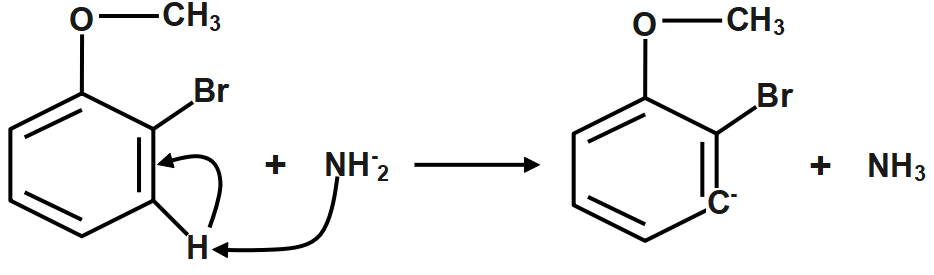
Step1: The amide ion attacks the $ H $ atom that is ortho to $ C3 $ , generating a carbanion.
Step2: Loss of $ B{{r}^{-}}~ $ to form a benzene intermediate.
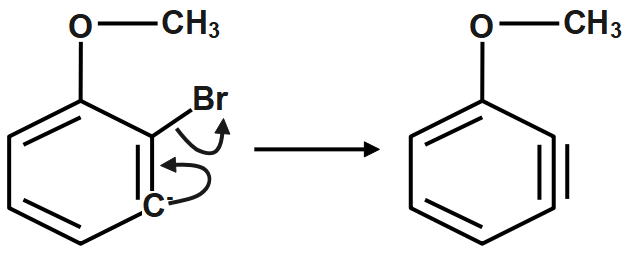
The elimination is by an $ E2cb $ pathway.
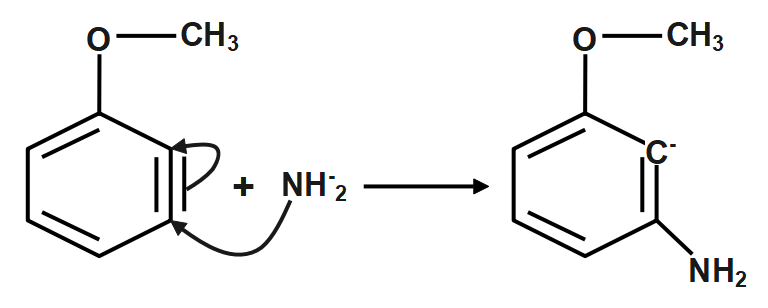
Step3: Addition of $ N{{H}^{-2}}. $ The strain caused by a triple bond in a benzene ring can be relieved by a nucleophilic addition $ \left( AdN \right) $ of $ N{{H}^{-2}}. $ The methoxy group is electron-withdrawing by induction, so the nucleophile will attack $ C3 $ to place the carbanion as close as possible to the methoxy group.
Step4: Protonation of the carbanion.
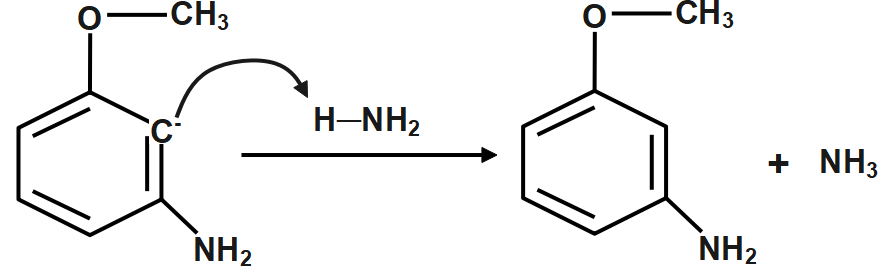
The product is meta-methoxyaniline or para-Bromoanisole
The reaction with para-bromoanisole also follows a benzene mechanism.
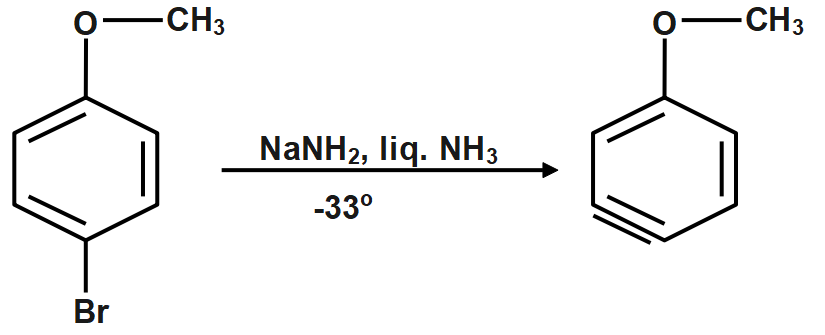
Step5: The nucleophile can attack either end of the triple bond, and the methoxy group is far enough away that its inductive effects are minimal.
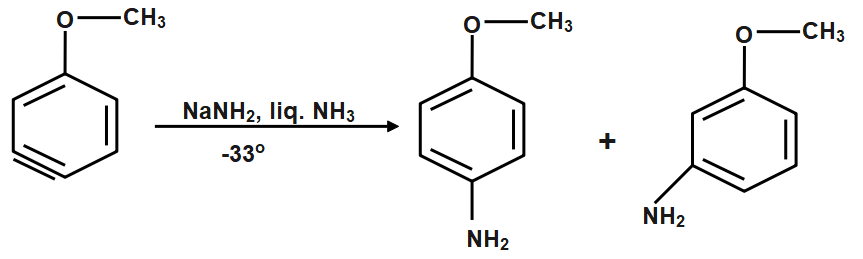
The product is a mixture of para- and meta-methoxyaniline.
Here, we get two products para- and meta-methoxyaniline. Among these two, as we can see para-bromoanisole is the major product and the yield is around 90% for it and the ortho-bromoanisole is the minor product with a very low yield. This is due to the steric hindrance in the ortho position as a bulky methoxy group is attached to the benzene ring.
Note :
As we can see in the above discussion we mentioned that electron withdrawing groups increase the electron density at ortho and para position but the reason behind it can be understood from the resonance hybrid structures of anisole. This is a nucleophilic reaction following the benzene mechanism.
Complete Step By Step Answer:
We know that these are the reaction conditions for generating benzene intermediates. The reaction of ortho-bromoanisole with potassium amide in liquid ammonia (b. p. $ -33\text{ }{}^\circ C $ ) is extremely rapid.
Step1: The amide ion attacks the $ H $ atom that is ortho to $ C3 $ , generating a carbanion.
Step2: Loss of $ B{{r}^{-}}~ $ to form a benzene intermediate.
The elimination is by an $ E2cb $ pathway.
Step3: Addition of $ N{{H}^{-2}}. $ The strain caused by a triple bond in a benzene ring can be relieved by a nucleophilic addition $ \left( AdN \right) $ of $ N{{H}^{-2}}. $ The methoxy group is electron-withdrawing by induction, so the nucleophile will attack $ C3 $ to place the carbanion as close as possible to the methoxy group.
Step4: Protonation of the carbanion.
The product is meta-methoxyaniline or para-Bromoanisole
The reaction with para-bromoanisole also follows a benzene mechanism.
Step5: The nucleophile can attack either end of the triple bond, and the methoxy group is far enough away that its inductive effects are minimal.
The product is a mixture of para- and meta-methoxyaniline.
Here, we get two products para- and meta-methoxyaniline. Among these two, as we can see para-bromoanisole is the major product and the yield is around 90% for it and the ortho-bromoanisole is the minor product with a very low yield. This is due to the steric hindrance in the ortho position as a bulky methoxy group is attached to the benzene ring.
Note :
As we can see in the above discussion we mentioned that electron withdrawing groups increase the electron density at ortho and para position but the reason behind it can be understood from the resonance hybrid structures of anisole. This is a nucleophilic reaction following the benzene mechanism.
Recently Updated Pages
Which of the following graphs shows the variation of class 12 physics CBSE

Draw a labelled diagram of the human male reproductive class 12 biology CBSE
Describe the experiment to compare the emf of two cells class 12 physics CBSE
What is standard hydrogen electrode
What is conventional current and electric current class 12 physics CBSE
2Bromopentane is treated with an alcoholic KOH solution class 12 chemistry CBSE
Trending doubts
Draw a labelled sketch of the human eye class 12 physics CBSE
Which are the Top 10 Largest Countries of the World?
Differentiate between homogeneous and heterogeneous class 12 chemistry CBSE
Draw ray diagrams each showing i myopic eye and ii class 12 physics CBSE
Which is the correct genotypic ratio of mendel dihybrid class 12 biology CBSE
What is the Full Form of PVC, PET, HDPE, LDPE, PP and PS ?