




Optically active dimethylcyclobutane is:
(A) $ cis-1,2-dimethyl\;cyclobutane $
(B) $ trans-1,2-dimethyl\;cyclobutane $
(C) $ cis-1,3-dimethyl\;cyclobutane $
(D) $ trans-1,3-dimethyl\;cyclobutane $
Answer
 Verified
589.2k+ views
Hint: An optically active compound has the ability to rotate the plane of oscillation of polarised light. For a compound to be optically active, the molecules should be asymmetric or at least one carbon should be chiral. An asymmetric compound does not contain any point or axis of symmetry about which the molecule will be symmetric. A compound whose image cannot be superimposed is known as a chiral compound.
Complete answer:
An optically active compound is the compound that rotates the plane of polarized light, hence also known as polarizer.
To check whether the compound is optically active, we need to check if the compound is asymmetric as well as chiral.
For an asymmetric compound, it is not possible to find a point or an axis around which the compound is symmetric, meaning the sections on both sides of the point or axis are similar.
An asymmetric compound for hydrocarbons, can also be defined as the compound where all four valencies of carbon are satisfied by different groups.
A chiral compound is a compound whose mirror image taken from any of the axes is not superimposable on the original compound.
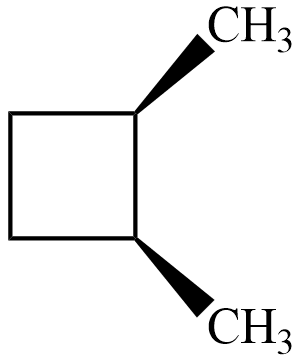
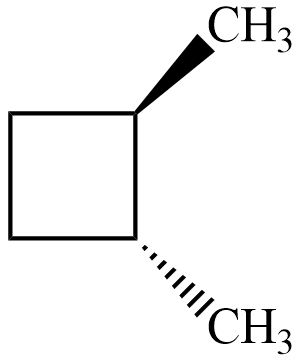
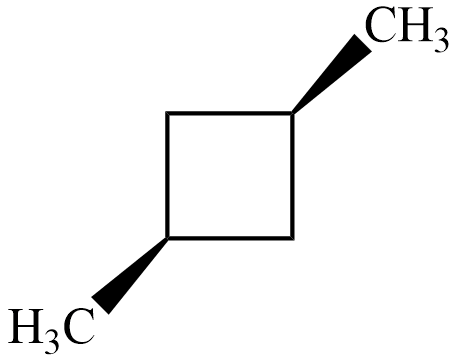
To find the optically active isomer of dimethylcyclobutane, let us draw the structures of all the given isomers.
$ cis-1,2-dimethyl\;cyclobutane $
$ trans-1,2-dimethyl\;cyclobutane $
$ cis-1,3-dimethyl\;cyclobutane $
$ trans-1,3-dimethyl\;cyclobutane $

Now, for both the isomers of , there exists an axis of symmetry as shown below about which the compound is symmetrical
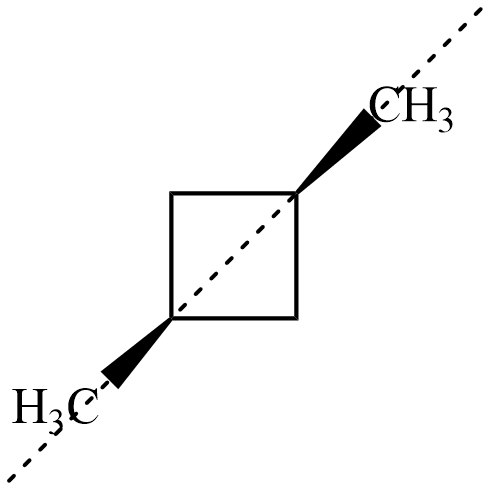
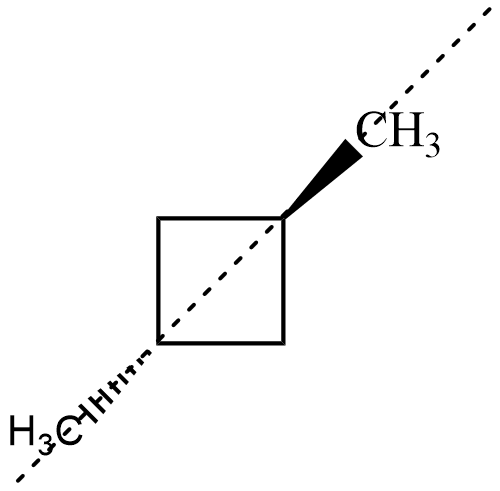
Hence, both isomers of $ 1,3-dimethyl\;cyclobutane $ are not optically active.
Now, for the isomer $ cis-1,2-dimethyl\;cyclobutane $ , there is no plane of symmetry but its mirror image is similar to original and hence superimposable as shown.
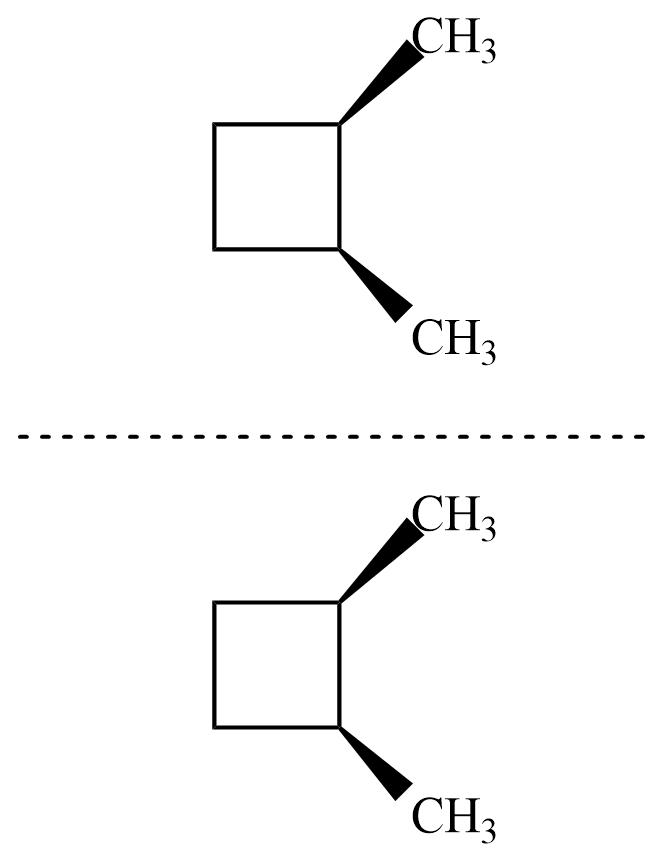
Hence, the isomer is achiral and thus not optically active.
For the isomer $ trans-1,2-dimethylbutane $ , its mirror image is as shown
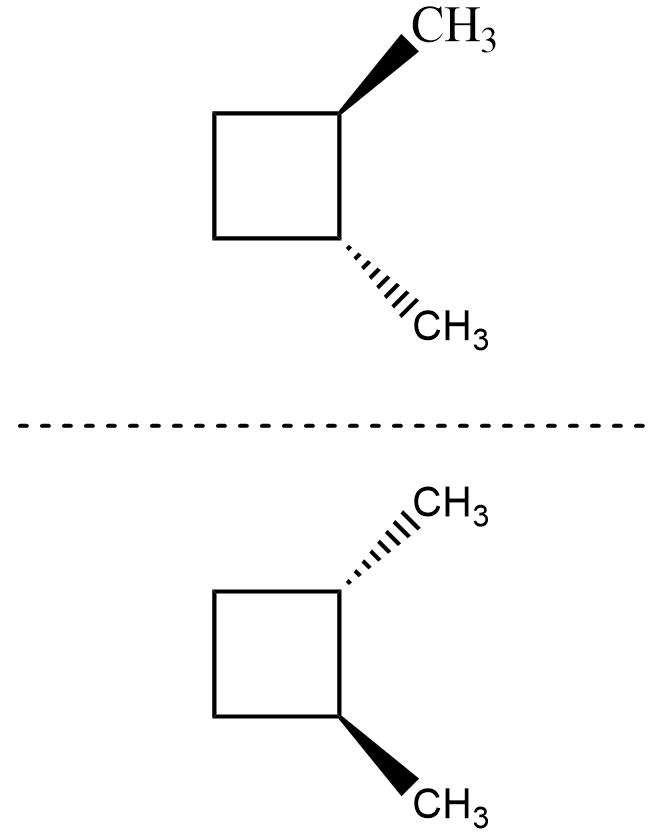
The mirror image is not superimposable on the compound and hence, it is chiral and thus optically active as we cannot find any plane or axis about which it is symmetrical.
Hence, the correct answer is Option $ (B) $ .
Note:
The point to understand here is that even though cyclobutane appears to be a planar compound, due to $ sp^3 $ hybridization, one of the carbons makes an angle of $ 25{}^\circ $ with the plane formed by the other three carbons. Also, we need to remember that for a compound to be optically active, it has to be asymmetric as well as chiral.
Complete answer:
An optically active compound is the compound that rotates the plane of polarized light, hence also known as polarizer.
To check whether the compound is optically active, we need to check if the compound is asymmetric as well as chiral.
For an asymmetric compound, it is not possible to find a point or an axis around which the compound is symmetric, meaning the sections on both sides of the point or axis are similar.
An asymmetric compound for hydrocarbons, can also be defined as the compound where all four valencies of carbon are satisfied by different groups.
A chiral compound is a compound whose mirror image taken from any of the axes is not superimposable on the original compound.
To find the optically active isomer of dimethylcyclobutane, let us draw the structures of all the given isomers.
$ cis-1,2-dimethyl\;cyclobutane $
$ trans-1,2-dimethyl\;cyclobutane $
$ cis-1,3-dimethyl\;cyclobutane $
$ trans-1,3-dimethyl\;cyclobutane $
Now, for both the isomers of , there exists an axis of symmetry as shown below about which the compound is symmetrical
Hence, both isomers of $ 1,3-dimethyl\;cyclobutane $ are not optically active.
Now, for the isomer $ cis-1,2-dimethyl\;cyclobutane $ , there is no plane of symmetry but its mirror image is similar to original and hence superimposable as shown.
Hence, the isomer is achiral and thus not optically active.
For the isomer $ trans-1,2-dimethylbutane $ , its mirror image is as shown
The mirror image is not superimposable on the compound and hence, it is chiral and thus optically active as we cannot find any plane or axis about which it is symmetrical.
Hence, the correct answer is Option $ (B) $ .
Note:
The point to understand here is that even though cyclobutane appears to be a planar compound, due to $ sp^3 $ hybridization, one of the carbons makes an angle of $ 25{}^\circ $ with the plane formed by the other three carbons. Also, we need to remember that for a compound to be optically active, it has to be asymmetric as well as chiral.
Recently Updated Pages
Which will be the least stable resonating structure class 11 chemistry CBSE

How many 5 digit telephone numbers can be construc-class-11-maths-CBSE
How do you find the angle of the resultant vector class 11 physics CBSE
Draw labelled diagram of the following i Gram seed class 11 biology CBSE
1 Quintal is equal to a 110 kg b 10 kg c 100kg d 1000 class 11 physics CBSE
What is the need and importance of classification class 11 biology CBSE
Trending doubts
One Metric ton is equal to kg A 10000 B 1000 C 100 class 11 physics CBSE
Find the value of the expression given below sin 30circ class 11 maths CBSE
Draw a diagram of nephron and explain its structur class 11 biology CBSE
10 examples of friction in our daily life
Proton was discovered by A Thomson B Rutherford C Chadwick class 11 chemistry CBSE
How many kilometers are there in 100 meters class 11 maths CBSE