




Ophisaurus is a___________________
(a)Blind snake
(b)Glass snake
(c)Sea snake
(d)Tree snake
Answer
 Verified
597.3k+ views
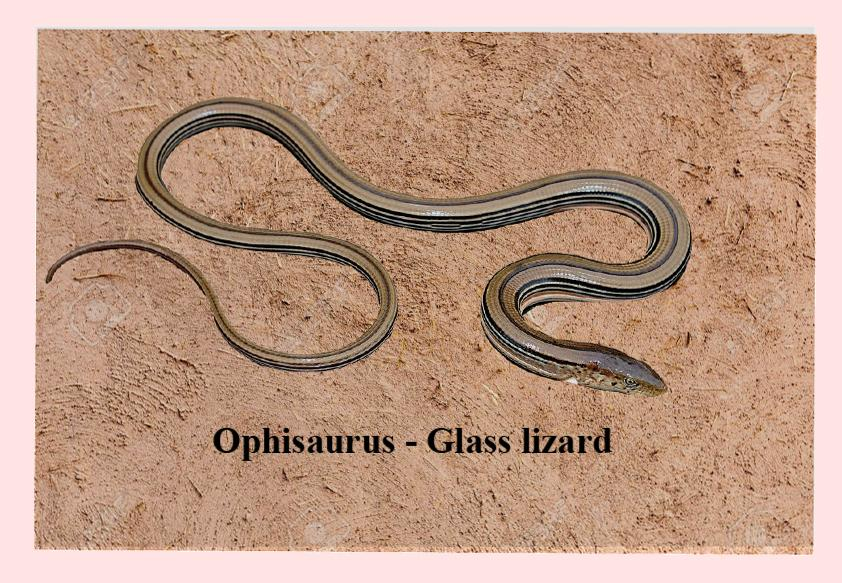
Hint: Ophisaurus is a limbless and almost snake-like fossorial lizard. Its body is elongated, snout is pointed, and the tail is exceptionally long, constituting nearly two-third of the length of the whole body.
Complete answer:
Ophisaurus is the North American and Eastern Himalayan glass lizard. It is also known as glass snakes. They resemble snakes in appearance but are actually lizards. This lizard externally differs from snakes in having movable eyelids and external ear openings. The North American glass lizard differs from Indian form in having a pair of cloacal spikes. They usually feed on the insects, reptiles and spiders. Some of them have very small, stub-like legs near their rear vents. These are vestigial organs, which means they have evolved and are no longer in use. These animals are also known as jointed snakes.
Additional Information: -Their locomotion is by lateral undulations of the body. Ophisaurus is well known for caudal autotomy.
-When seized by enemies, it breaks off its tail into fragments which wriggle about attracting the attention of the enemy. By the time the lizard slowly moves away. They are so-named because their tails can be broken easily like lizards. They also have the ability to check predation by breaking a part of the tail.
-They belong to the class reptilia, Subclass Diapsida and order squamata.
So, the correct answer is 'Glass snake'.
Note: In Diapsida Supratemporal and infratemporal fossa are present. Reptiles are cold-blooded, lung breathing, oviparous tetrapods, with dry skin covered by exoskeleton of epidermal scales, called corneocytes.
-The group is a heterogeneous assemblage, represented today by lizards, snakes, crocodiles, turtles, tortoises and sphenodon.
-Reptiles are believed to be evolved from the carboniferous amphibian stock Ichthyostega, which existed about 360 million years ago. This significantly involved the evolution of shelled and amniotic eggs.
Complete answer:
Ophisaurus is the North American and Eastern Himalayan glass lizard. It is also known as glass snakes. They resemble snakes in appearance but are actually lizards. This lizard externally differs from snakes in having movable eyelids and external ear openings. The North American glass lizard differs from Indian form in having a pair of cloacal spikes. They usually feed on the insects, reptiles and spiders. Some of them have very small, stub-like legs near their rear vents. These are vestigial organs, which means they have evolved and are no longer in use. These animals are also known as jointed snakes.
Additional Information: -Their locomotion is by lateral undulations of the body. Ophisaurus is well known for caudal autotomy.
-When seized by enemies, it breaks off its tail into fragments which wriggle about attracting the attention of the enemy. By the time the lizard slowly moves away. They are so-named because their tails can be broken easily like lizards. They also have the ability to check predation by breaking a part of the tail.
-They belong to the class reptilia, Subclass Diapsida and order squamata.
So, the correct answer is 'Glass snake'.
Note: In Diapsida Supratemporal and infratemporal fossa are present. Reptiles are cold-blooded, lung breathing, oviparous tetrapods, with dry skin covered by exoskeleton of epidermal scales, called corneocytes.
-The group is a heterogeneous assemblage, represented today by lizards, snakes, crocodiles, turtles, tortoises and sphenodon.
-Reptiles are believed to be evolved from the carboniferous amphibian stock Ichthyostega, which existed about 360 million years ago. This significantly involved the evolution of shelled and amniotic eggs.
Recently Updated Pages
Master Class 9 General Knowledge: Engaging Questions & Answers for Success

Master Class 9 Maths: Engaging Questions & Answers for Success
Master Class 9 Science: Engaging Questions & Answers for Success
Master Class 9 English: Engaging Questions & Answers for Success
Master Class 9 Social Science: Engaging Questions & Answers for Success
Class 9 Question and Answer - Your Ultimate Solutions Guide
Trending doubts
One Metric ton is equal to kg A 10000 B 1000 C 100 class 11 physics CBSE
Difference Between Prokaryotic Cells and Eukaryotic Cells
Two of the body parts which do not appear in MRI are class 11 biology CBSE
1 ton equals to A 100 kg B 1000 kg C 10 kg D 10000 class 11 physics CBSE
10 examples of friction in our daily life
Name the Largest and the Smallest Cell in the Human Body ?